
BPH Decongestant Risk Calculator
This calculator helps you understand your risk of urinary retention when taking decongestants with benign prostatic hyperplasia (BPH). Based on clinical studies, enter your information to see your personalized risk level.
Your Risk Assessment
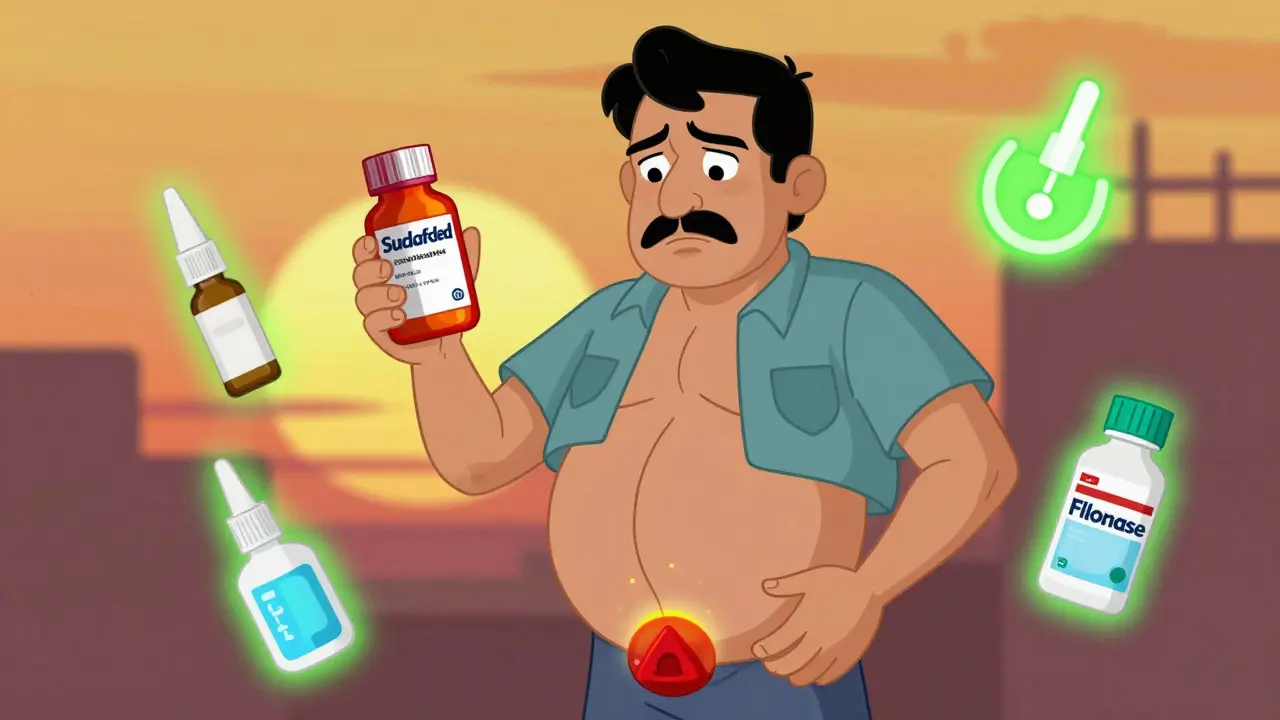
Men over 50 with an enlarged prostate-known as benign prostatic hyperplasia, or BPH-often take decongestants for colds or allergies without realizing they could be putting themselves at serious risk. A single pill of pseudoephedrine, found in popular cold medicines like Sudafed, can trigger sudden, painful urinary retention. For someone with BPH, this isn’t just inconvenient-it’s a medical emergency.
What Is Benign Prostatic Hyperplasia (BPH)?
BPH isn’t cancer, but it’s incredibly common. By age 60, about half of all men have some degree of prostate enlargement. By 85, that number jumps to 90%. The prostate wraps around the urethra, the tube that carries urine out of the bladder. As it grows, it squeezes the urethra, making it harder to start urinating, weakens the stream, and leaves you feeling like your bladder isn’t fully empty. These symptoms are measured using the International Prostate Symptom Score (IPSS), where scores above 12 indicate moderate to severe BPH.
The problem isn’t just the size of the prostate-it’s the muscle. About half of the enlarged prostate is made of smooth muscle that’s packed with alpha-1 receptors. These receptors are designed to respond to adrenaline, tightening up to control blood flow and other functions. But when you take a decongestant, you’re accidentally triggering those same receptors in your prostate and bladder neck, making them contract even more.
Why Decongestants Are Dangerous for BPH Patients
Decongestants like pseudoephedrine and phenylephrine work by narrowing blood vessels in the nose to reduce swelling. But they don’t stop there. These drugs are alpha-1 adrenergic agonists, meaning they activate the same receptors that control the smooth muscle in your prostate and bladder neck. When those muscles tighten, the urethra gets even more pinched.
Studies show pseudoephedrine increases urethral resistance by 35-40% in men with BPH. In one double-blind trial at Massachusetts General Hospital, men over 50 with BPH saw a 27% drop in urinary flow after just one 30mg dose. The effects can last up to 24 hours. That’s longer than most people realize. Many assume if they feel fine after a few hours, they’re safe. They’re not.
The risk isn’t theoretical. A 2021 study in the Journal of Urology found men with BPH who took decongestants were 2.8 times more likely to develop acute urinary retention-where the bladder fills completely but you can’t urinate at all. About 70% of those cases required a catheter for 2-3 days. That’s not a minor inconvenience. It’s a hospital visit, a painful procedure, and days of recovery.
Pseudoephedrine vs. Phenylephrine vs. Nasal Sprays
Not all decongestants are the same. Pseudoephedrine is the worst offender. A 2022 meta-analysis found it increased the odds of urinary retention by 3.45 times compared to no use. Phenylephrine, found in many store-brand cold medicines, is a bit safer but still carries a 2.15-fold increased risk. Both are systemic-meaning they enter your bloodstream and affect your prostate.
Nasal sprays like oxymetazoline (Afrin) are different. They’re applied directly to the nose and absorbed minimally into the blood. Studies show they only raise the risk of retention by 1.25 times-barely higher than not using anything. That makes them a much better option for men with BPH, as long as you don’t use them for more than 3 days in a row (to avoid rebound congestion).
Age makes the risk worse. Men over 70 using pseudoephedrine have a 51.8% chance of developing subclinical voiding dysfunction-a hidden worsening of urinary symptoms that can lead to full retention. In men under 50 with mild BPH, that number is only 17.3%. If you’re over 70 and have any BPH symptoms, pseudoephedrine should be off-limits.

What Alternatives Actually Work?
You don’t need to suffer through congestion just to avoid a decongestant. There are safer, effective alternatives:
- Saline nasal irrigation-using a neti pot or squeeze bottle with sterile saltwater-works for 68% of users, according to a 2022 Cochrane Review. It’s cheap, safe, and has zero urinary side effects. Many BPH patients on forums report it’s the only thing that works without triggering symptoms.
- Intranasal corticosteroids like fluticasone (Flonase) or mometasone (Nasonex) reduce inflammation in the nasal passages. They’re effective in 72% of cases and have no impact on the prostate. These are meant for daily use over weeks, not quick fixes, but they’re ideal for chronic congestion.
- Non-sedating antihistamines like loratadine (Claritin) or cetirizine (Zyrtec) help with allergies without affecting the prostate. First-gen antihistamines like diphenhydramine (Benadryl) are risky-they have anticholinergic effects that can worsen urinary retention. Loratadine’s risk is only 1.35 times higher than no use; Benadryl’s is 2.85.
- Steam inhalation and humidifiers can loosen mucus without drugs. Simple, free, and safe.
One Reddit user, u/BPH_Warrior, shared how a single 30mg pseudoephedrine pill led to complete urinary retention. He described feeling his bladder fill but being unable to push anything out. He spent 12 hours in pain before getting catheterized. He now uses saline rinses every night.
What Should You Do If You’re Already Taking Decongestants?
If you have BPH and are currently taking pseudoephedrine or phenylephrine, stop immediately. Don’t wait for symptoms to get worse. Talk to your doctor or pharmacist about switching to a safer alternative.
Pharmacists are now trained to screen men over 50 for BPH when they buy decongestants. In 2022, the FDA required all pseudoephedrine packaging to include a warning about urinary retention risk. But that’s not enough. Only 63% of men now know about the risk-down from 73% of sales happening without pharmacist consultation, according to SAMHSA’s 2023 report.
If you absolutely must use a decongestant (and your doctor agrees), follow this protocol:
- Use the lowest possible dose-30mg pseudoephedrine max.
- Take it for no more than two days in a row.
- Start an alpha-blocker like tamsulosin (Flomax) 72 hours before taking the decongestant. A 2022 Cleveland Clinic study showed this cuts retention risk by 85%.
- Monitor your urine flow. If your stream feels weaker, or you’re straining more than usual, stop the decongestant.
Many urology clinics now include decongestant avoidance in their routine BPH management. The American Urological Association and European Association of Urology both recommend complete avoidance of systemic alpha-agonists in men with BPH. The European guidelines say this approach prevents 92% of medication-induced urinary retention cases.

When to Seek Emergency Help
Acute urinary retention is a medical emergency. Signs include:
- Complete inability to urinate, even with strong urge
- Severe lower abdominal pain or pressure
- Feeling like your bladder is full but nothing comes out
If you experience this, go to the ER. You’ll need a catheter to drain your bladder. Left untreated, it can lead to bladder damage, kidney problems, or infection. Don’t wait. Don’t try to “wait it out.”
The Bigger Picture: Why This Problem Persists
Despite all the evidence, pseudoephedrine is still sold over the counter in most pharmacies. It’s cheap, effective for congestion, and many men don’t know the risk. Even some doctors overlook it. The American Geriatrics Society’s 2023 Beers Criteria lists pseudoephedrine as a “potentially inappropriate medication” for men over 65 with BPH. Yet, it’s still on shelves next to cough drops.
Companies are trying to fix this. Purdue Pharma’s experimental drug PF-06943303, a bladder-selective alpha-blocker, showed 92% effectiveness in preventing pseudoephedrine-induced retention in Phase II trials. The NIH is funding a $2.3 million trial to test combination therapies. But until those are approved, the safest choice is simple: avoid the risk.
The message is clear: if you have BPH, don’t take pseudoephedrine. Don’t assume you’re fine because you’ve used it before. Your prostate changes over time. What was safe at 55 might be dangerous at 65. Talk to your doctor. Ask your pharmacist. And if you’re looking for relief from congestion, reach for saline rinse or Flonase instead. Your bladder will thank you.
Can I take Sudafed if I have an enlarged prostate?
No. Sudafed contains pseudoephedrine, which significantly increases the risk of acute urinary retention in men with benign prostatic hyperplasia (BPH). Studies show it can raise the risk by nearly 3.5 times. Even a single dose can cause complete inability to urinate, requiring emergency catheterization. Avoid all pseudoephedrine-containing products if you have BPH.
Is phenylephrine safer than pseudoephedrine for BPH?
Phenylephrine is less risky than pseudoephedrine, but still dangerous. It increases urinary retention risk by about 2.15 times compared to no use. While it’s slightly less potent, it still acts on the same alpha receptors in your prostate and bladder neck. It’s not a safe alternative-just less dangerous. Better options exist.
What’s the safest decongestant for someone with BPH?
The safest options are non-systemic: saline nasal irrigation (like NeilMed Sinus Rinse) and intranasal corticosteroids (like Flonase). These work directly in the nose without entering your bloodstream, so they don’t affect your prostate. For allergies, loratadine (Claritin) is a safer antihistamine than diphenhydramine (Benadryl). Avoid anything that enters your blood system.
Can I take decongestants if I’m on tamsulosin for BPH?
Even if you’re on tamsulosin, avoid pseudoephedrine unless under direct medical supervision. While combining tamsulosin with a low-dose decongestant can reduce risk by 85% in studies, that’s not a guarantee. It still increases strain on your bladder and prostate. The goal isn’t to manage the risk-it’s to avoid it entirely. Use saline rinses or Flonase instead.
How do I know if I’m developing urinary retention?
Watch for sudden changes: weaker urine stream, increased straining to start or finish urination, feeling like your bladder isn’t emptying, or needing to urinate more often with little output. If you can’t urinate at all despite a strong urge, that’s acute retention. Go to the ER immediately. Don’t wait.
Comments (9)
shiv singh
Bro. I took Sudafed last winter and woke up with my bladder screaming like a banshee. Thought I was dying. Catheterized at 3 AM. Now I use a neti pot like a monk. If you're over 50 and still popping pseudoephedrine, you're not brave-you're just dumb.
Robert Way
wait so phenylephrine is bad too?? i thought that was the safe one?? i just took one yesterday omg im gonna die
Sarah Triphahn
Let me break this down for you like you're five. Decongestants = prostate muscle squeeze = you can't pee. It's not rocket science. It's basic pharmacology. But no, you'd rather Google 'best cold medicine for men' and pick the one with the prettiest packaging. You're not a victim-you're a walking case study in poor decision-making.
Henry Sy
Y’all are acting like this is some new revelation. I’ve been telling my uncle for years-he’s 72, takes Sudafed like candy, says ‘I’ve been doing it since ’89.’ Last month? Catheter. Three days in the hospital. Now he’s all ‘I didn’t know!’ Bro, you didn’t know because you didn’t want to know. You wanted your nose to be clear, not your bladder to be functional. The real tragedy? He still won’t use Flonase. Says it’s ‘too fancy.’
Meanwhile, I’m over here with a neti pot on my nightstand and a bottle of saline in my gym bag. I’ve got more peace of mind than most people have in their entire marriage.
And don’t even get me started on the pharmacy clerks. I’ve watched them hand out pseudoephedrine like it’s candy to guys who look like they’ve been holding it in since the Reagan administration. No questions. No warnings. Just ‘Here you go, sir, enjoy your urinary retention.’
It’s not a conspiracy-it’s negligence dressed up as convenience.
And the worst part? The guy who wrote this post? He’s the hero we didn’t know we needed.
Vicky Zhang
Oh my gosh, I’m so glad someone finally said this. I’ve been terrified to tell my dad because he thinks he’s invincible-he’s 68, takes Sudafed every time he gets a cold, and says ‘I’ve never had a problem!’ But I’ve seen him sitting there, face twisted in pain, just… staring at the bathroom door. He doesn’t say anything. He just sighs and walks away. I cried last week when I realized he’s been suffering silently for years because he didn’t know it was the medicine. Now I’ve got a whole folder of safe alternatives printed out and taped to his fridge. He still rolls his eyes, but he’s started using the neti pot. Baby steps, right? You’re not alone. We’ve all got a dad like this. Let’s save them before it’s too late.
Allison Deming
It is deeply concerning that this information remains so poorly disseminated despite overwhelming clinical evidence. The continued over-the-counter availability of pseudoephedrine without mandatory pharmacist counseling represents a systemic failure in public health policy. The American Urological Association’s guidelines are clear, yet regulatory agencies continue to prioritize commercial interests over patient safety. The fact that only 63% of men are aware of this risk-down from 73%-indicates a dangerous erosion of health literacy. This is not an individual failure; it is a societal one. We must demand stricter labeling, mandatory screening protocols at point-of-sale, and public education campaigns funded by pharmaceutical manufacturers who profit from these dangerous products. The cost of inaction is not merely discomfort-it is catheterization, hospitalization, and potential renal damage.
Susie Deer
USA makes this shit legal so you can't blame the guy who took it. Blame the government. They let it sit next to cough drops. That's on them. Not me. Not you. Them. End of story.
TooAfraid ToSay
Wait so if you're African and have BPH you're just supposed to suffer through colds? No one here sells Flonase or neti pots. We got Sudafed and that's it. You tell me what to do when your only option is poison or sniffles? This post sounds like a rich American's fantasy. I'm not even mad. Just tired.
Dylan Livingston
How ironic that the same people who scream about Big Pharma being evil are the first to grab a bottle of pseudoephedrine like it’s a magic wand. You want natural? Go outside. Breathe. Drink water. Suffer a little. Maybe then you’ll stop treating your body like a broken vending machine that needs a good kick. Meanwhile, I’m over here using a humidifier and a spoonful of honey, and my prostate is thanking me. You call that ‘alternative medicine.’ I call it common sense. But hey, if you’d rather risk your bladder for a sniffle, be my guest. I’ll be the one with the clean catheter-free life.