
Citrus Medication Interaction Checker
Check Your Medication
Enter your prescription name to see if it interacts with pomelo or Seville orange.
Result
Most people know grapefruit can mess with their meds. But what about the big, pinkish fruit you see in Asian markets labeled as "Chinese grapefruit"? Or the bitter orange marmalade your grandmother swears by? Those are pomelo and Seville orange-and they’re just as dangerous as grapefruit when you’re on certain drugs. In fact, in some cases, they’re worse.
Why These Fruits Are More Dangerous Than You Think
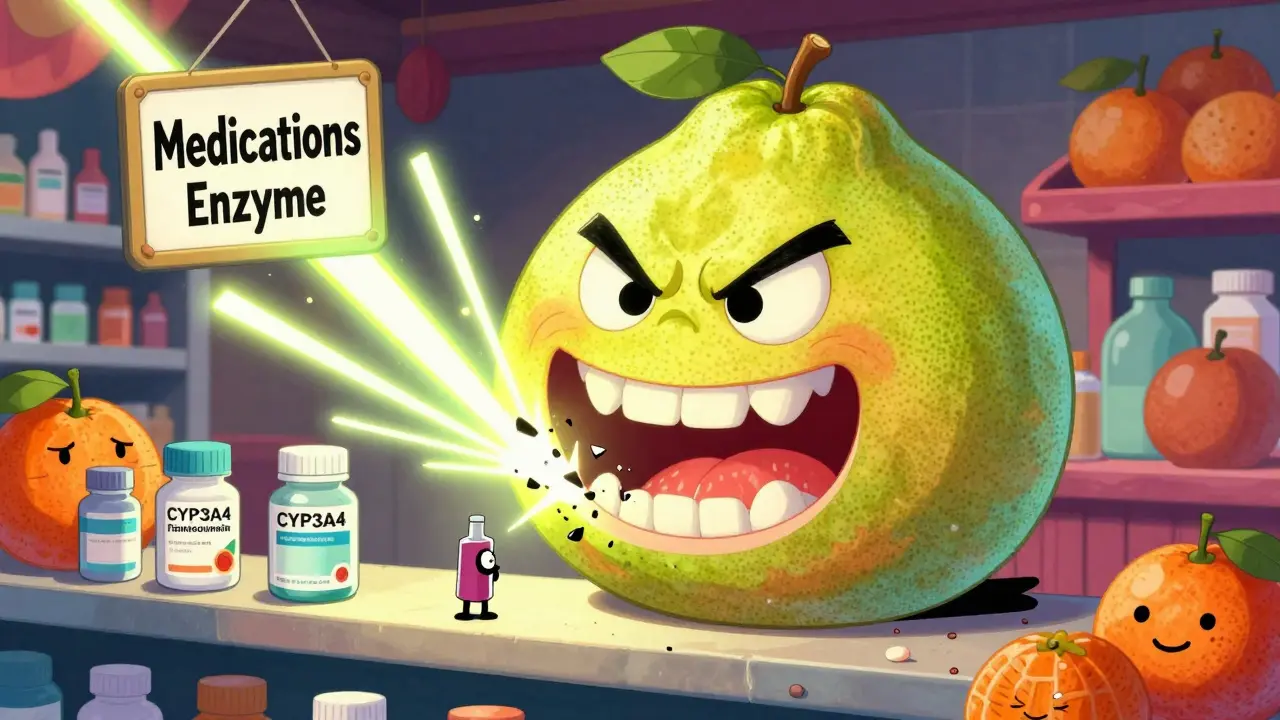
Pomelo and Seville orange don’t just look like grapefruit-they act like it, and then some. Both contain high levels of chemicals called furanocoumarins, especially bergamottin and 6',7'-dihydroxybergamottin. These compounds shut down an enzyme in your gut called CYP3A4, which normally breaks down drugs before they enter your bloodstream. When that enzyme is blocked, your body absorbs way more of the medication than it should. The numbers don’t lie. A 2014 study in the Journal of Agricultural and Food Chemistry found pomelo has 1.5 to 2.5 micromoles of bergamottin per liter-higher than grapefruit’s 1.0 to 2.0. Seville orange? Some varieties hit 3.0 to 4.0. That’s up to 30% more than grapefruit. And it’s not just juice. Eating the flesh, peeling the rind, or even having marmalade made from Seville orange can trigger the same reaction. This isn’t theoretical. In 2011, a transplant patient in Spain had a life-threatening spike in tacrolimus levels after eating Seville orange marmalade daily. His blood levels jumped 400%. He ended up in the hospital. That case was published in Transplantation Proceedings. Similar stories show up in Reddit threads from pharmacists and patients who didn’t realize pomelo was a risk.Which Medications Are at Risk?
Not all drugs are affected. The danger is limited to medications processed by CYP3A4 and blocked by OATP transporters. These include:- Statins like simvastatin and atorvastatin-can cause muscle breakdown (rhabdomyolysis)
- Calcium channel blockers like amlodipine and felodipine-can drop blood pressure dangerously low
- Immunosuppressants like tacrolimus and cyclosporine-can lead to kidney damage or rejection
- Benzodiazepines like midazolam-can cause extreme drowsiness or breathing problems
- Some anti-arrhythmics like amiodarone-can trigger irregular heart rhythms
The 72-Hour Rule You Can’t Ignore
Here’s the part most people miss: this isn’t a "don’t eat it while taking your pill" issue. It’s a "don’t eat it for days before or after" issue. Furanocoumarins don’t just block the enzyme temporarily-they destroy it. Your body has to make new enzymes to replace them. That takes time. The FDA says the effect can last up to 72 hours. So if you had a slice of pomelo on Monday, it’s still affecting your meds on Thursday. That’s why the FDA recommends avoiding these fruits for at least three days before starting a new medication and throughout the entire course. Many patients think they’re safe if they take their pill hours after eating the fruit. They’re wrong.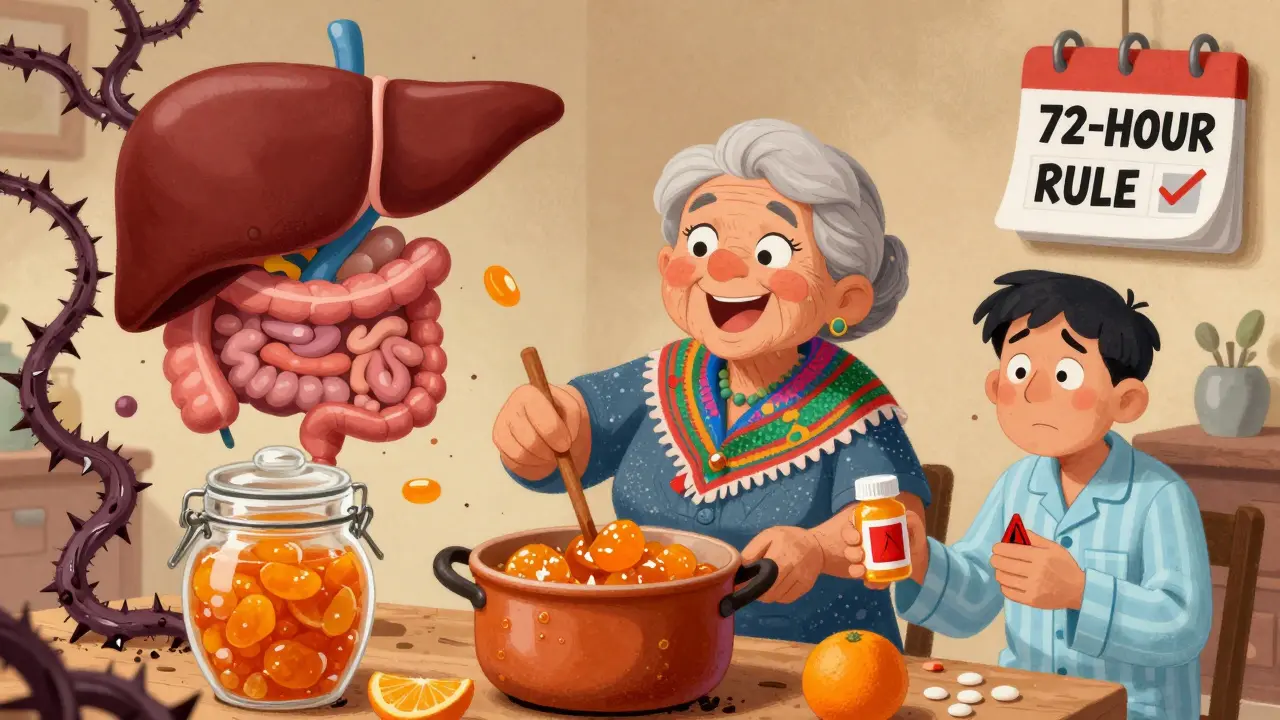
Why Nobody Warns You
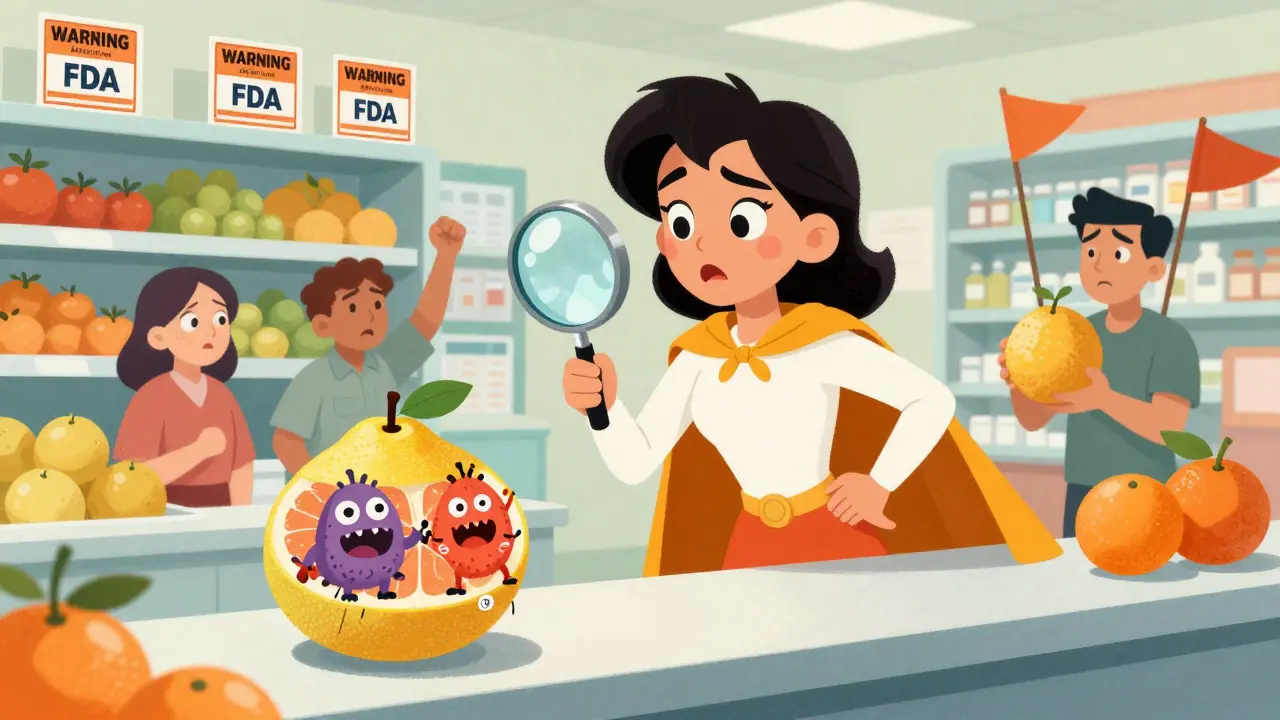
Grapefruit has warning labels. Pomelo? Rarely. Seville orange marmalade? Almost never. A 2022 FDA review found only 37% of pomelo and Seville orange products carry any interaction warning. Compare that to 78% for grapefruit. Why? Because no one talks about them. Most consumers don’t know what pomelo is. They see a big, weird citrus and think it’s just exotic. Pharmacists don’t ask about it. Doctors don’t mention it. A 2023 American Pharmacists Association survey showed only 42% of community pharmacists routinely screen for pomelo or Seville orange interactions. That’s compared to 87% for grapefruit. Patients aren’t warned. And when something goes wrong-like muscle damage from statins or kidney failure from immunosuppressants-it’s often blamed on the drug itself, not the fruit. One Reddit user, u/PharmTech2021, shared a case where a patient developed rhabdomyolysis after eating pomelo daily for two weeks. Nobody told them it was dangerous. The patient had no idea pomelo was in the same risk category as grapefruit.What You Should Do
If you’re on any medication that interacts with grapefruit, assume pomelo and Seville orange are off-limits too. Here’s what to do:- Check your meds. Look up your prescription on the University of Florida Center for Pharmacogenomics list. They track 107 drugs with known interactions.
- Ask your pharmacist. Don’t just say, "Does grapefruit interact?" Say, "What about pomelo or Seville orange?"
- Read labels. If you buy marmalade, check the ingredients. "Bitter orange" means Seville orange. If you buy a large, thick-skinned citrus labeled "Chinese grapefruit," it’s pomelo.
- Switch to safe citrus. Sweet oranges, tangerines, and clementines are safe. They don’t contain furanocoumarins.
- Wait three days. If you accidentally eat one, avoid your meds for 72 hours. Don’t just skip one dose-wait the full time.
What’s Changing
The tide is turning. The FDA proposed new labeling rules in 2023 that would require warnings on all furanocoumarin-containing citrus fruits, including pomelo and Seville orange. Implementation is expected by mid-2025. The European Food Safety Authority already requires warnings in 17 EU countries. The University of Washington just got $2.1 million from the NIH to study pomelo interactions specifically. And the American Society for Clinical Pharmacology and Therapeutics predicts provider awareness will rise 65% by 2027 as electronic health records start flagging these fruits automatically. But until then, you can’t rely on labels or systems. You have to be your own advocate.Real-Life Consequences
A 2021 study in Clinical Pharmacology & Therapeutics found only 30% of adverse events linked to pomelo or Seville orange are correctly identified as food-drug interactions. The rest get misclassified as side effects, overdoses, or organ failure. That means the real danger is hidden. Patients who’ve been warned and avoided these fruits report 82% satisfaction in managing their meds safely, according to a 2022 Mayo Clinic survey. Those who didn’t know? They’re the ones ending up in ERs with unexplained muscle pain, low blood pressure, or kidney issues. It’s not about fear. It’s about control. You can still enjoy citrus. Just know which ones are safe and which ones can quietly sabotage your treatment.Is pomelo the same as grapefruit?
No, pomelo is a different fruit-it’s larger, less acidic, and has thicker skin. But chemically, it’s very similar. Both contain high levels of furanocoumarins that inhibit the same drug-metabolizing enzymes. Pomelo often has even higher concentrations, making it just as risky, if not more so.
Can I eat Seville orange if I take my medication at night?
No. The interaction isn’t about timing-it’s about enzyme destruction. Furanocoumarins permanently disable CYP3A4 in your gut. It takes up to 72 hours for your body to make new enzymes. Eating Seville orange in the morning and taking your pill at night still puts you at risk.
Are all citrus fruits dangerous with medications?
No. Only citrus fruits with high furanocoumarins-grapefruit, pomelo, and Seville orange. Sweet oranges, tangerines, clementines, and mandarins are safe. They don’t contain enough of these compounds to cause interactions.
Does peeling the fruit make it safe?
No. Furanocoumarins are concentrated in the peel and the white pith, but they’re also present in the flesh. Even the juicy part of pomelo or Seville orange can trigger an interaction. Peeling doesn’t remove the risk.
What should I do if I accidentally ate pomelo and I’m on a statin?
Stop eating pomelo immediately. Watch for muscle pain, weakness, or dark urine-signs of rhabdomyolysis. Contact your doctor. Don’t skip your next dose unless instructed. The risk is highest in the first 72 hours after consumption. Your doctor may check your CK levels to be safe.
Why aren’t there warning labels on pomelo in grocery stores?
Because the FDA hasn’t required them yet-though that’s changing. As of 2023, only 37% of pomelo products carry warnings, compared to 78% for grapefruit. Many retailers don’t recognize the risk, and consumers rarely ask. The FDA’s new labeling proposal, expected by 2025, will change this.
Can I drink orange juice instead of grapefruit juice if I’m on medication?
Yes, but only if it’s sweet orange juice. Regular orange juice (from sweet oranges) is safe. Avoid anything labeled "bitter orange," "Seville orange," or "pomelo juice." Always check the ingredient list.
Comments (12)
Kathy Scaman
Just ate a whole pomelo for breakfast and now I’m side-eyeing my blood pressure meds. Thanks for the heads-up-this is the kind of info you wish you’d known sooner.
Mindee Coulter
My grandma’s Seville orange marmalade is legendary but now I’m scared to touch it. I’ve been putting it on my toast every morning with my statin. Time to switch to jam.
Bryan Fracchia
It’s wild how something so natural can be so quietly dangerous. We treat fruit like harmless candy but some of these citrus fruits are basically chemical weapons for your liver. I’m glad someone’s talking about this. We need more awareness, not just labels.
fiona vaz
As a pharmacist, I’ve seen this go wrong too many times. Patients assume if it’s not grapefruit, it’s safe. Pomelo and Seville orange are the silent killers in the produce aisle. Always ask. Always check. Always assume the worst until proven otherwise.
Rose Palmer
Thank you for this comprehensive breakdown. I’ve been educating my patients about this for years, but most pharmacies still don’t have protocols in place. The 72-hour rule is critical-many patients think they’re fine if they space their dose. They’re not. This deserves a public health campaign.
Sue Latham
Oh honey, you’re telling me my beloved marmalade is basically poison? And I thought I was just being fancy with my breakfast. Now I feel like a villain in my own kitchen. 😅
Lance Long
I used to think citrus was citrus. Then I got on a beta-blocker and found out my favorite smoothie was a ticking time bomb. I switched to sweet oranges and my blood pressure stabilized. This isn’t hype-it’s survival. Please, if you’re on meds, do the research. Your body will thank you.
Howard Esakov
Of course the FDA doesn’t warn about pomelo-it’s not *cool* enough. Grapefruit gets all the attention because it’s trendy. Pomelo? That’s just some weird Asian fruit only hippies and immigrants eat. But hey, if you’re dumb enough to eat it with your meds, you deserve what you get. 🤷♂️
Chris Urdilas
Wait-so my mom’s homemade bitter orange cake is a potential ER visit? That’s the one she bakes for every holiday. I’m gonna need a family intervention. And maybe a new recipe. 😅
Anna Lou Chen
It’s not about the fruit-it’s about the epistemic violence of pharmaceutical hegemony. The CYP3A4 enzyme is a colonial construct, and the FDA’s delayed regulation reflects a broader ontological erasure of non-Western citrus epistemologies. We must decolonize our pharmacopeia.
John Rose
Is there a reliable database that lists all furanocoumarin-containing citrus varieties? I’d like to cross-reference my supplements and herbal teas too. Just curious if this extends beyond the big three.
Mark Alan
MY DAD DIED BECAUSE OF A POMELO. NO ONE TOLD HIM. NOW I’M FIGHTING TO MAKE THIS A FEDERAL LAW. 🇺🇸💔 #PomeloJustice