
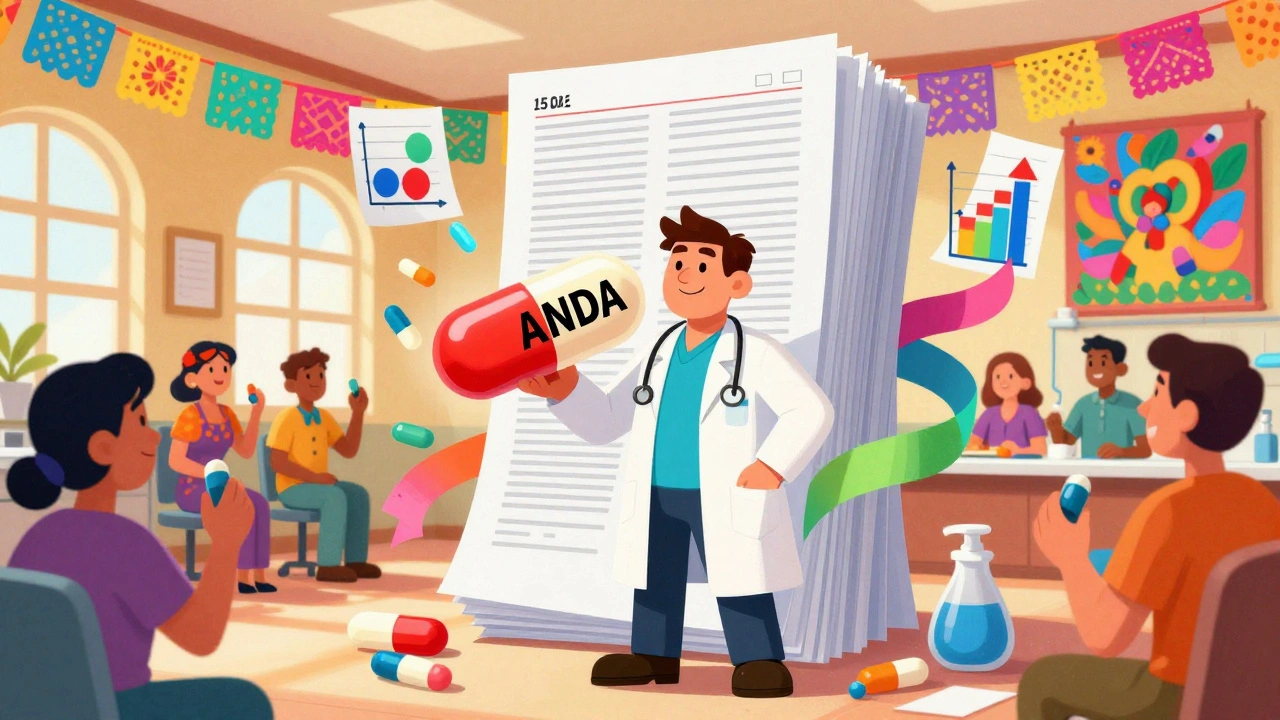
The U.S. Food and Drug Administration doesn’t just approve new drugs - it ensures that generic drugs are just as safe and effective as their brand-name counterparts, but at a fraction of the cost. This isn’t guesswork. It’s a strict, science-based system built over decades, designed to keep millions of Americans affordable access to life-saving medications. If you’ve ever picked up a generic prescription and wondered how the FDA knows it works the same way, here’s how it actually works.
How Generic Drugs Get Approved Without Repeating Clinical Trials
Brand-name drug companies spend years and billions of dollars proving their drugs are safe and effective through clinical trials. Generic manufacturers don’t have to do that. Instead, they use a shortcut called the Abbreviated New Drug Application, or ANDA. This isn’t a loophole - it’s a legal pathway created by the Hatch-Waxman Act of 1984. The law recognized that once a patent expires, other companies should be able to make the same medicine without duplicating expensive research.
To get approval, a generic company must prove two things: pharmaceutical equivalence and bioequivalence. Pharmaceutical equivalence means the generic has the same active ingredient, strength, dosage form (pill, injection, cream), and route of administration (oral, topical, etc.) as the brand-name drug. Bioequivalence is the real test: it proves the generic delivers the same amount of drug into the bloodstream at the same rate as the original. This is done through small, controlled studies in 24 to 36 healthy volunteers. The FDA requires the 90% confidence interval for the drug’s absorption (measured as AUC and Cmax) to fall between 80% and 125% of the brand-name drug’s values. If it doesn’t, the application gets rejected.
The ANDA Review Process: From Submission to Approval
Submitting an ANDA isn’t just filling out a form. It’s a massive undertaking. A typical application runs 15,000 to 20,000 pages - dense with chemistry data, manufacturing details, and bioequivalence study results. The FDA’s Office of Generic Drugs (OGD) receives over 1,200 applications a year. Not all make it past the first step.
When an ANDA arrives, it goes through a Filing Review. If it’s missing key information - like incomplete manufacturing controls or unclear bioequivalence data - the FDA issues a Refuse-to-Receive (RTR) letter. In 2022, 15.3% of submissions got this response. That means the application never even entered the review queue. Companies often fix the issues and resubmit, but delays can add months.
Once accepted, the substantive review begins. Standard ANDAs have a 10-month target review time. Priority applications - like first generics or drugs in shortage - get an 8-month clock. In 2023, the FDA approved 1,256 ANDAs, up from 1,115 the year before. But the backlog is real. As of late 2022, over 1,800 applications were pending, with some waiting more than three years. The FDA attributes this to staffing limits and the growing complexity of the drugs being submitted.
Manufacturing Standards: No Compromises
Even if a generic drug works the same in the body, it has to be made right. The FDA requires all generic manufacturers to follow Current Good Manufacturing Practices (CGMP), the same rules applied to brand-name drugs. Facilities are inspected regularly - about 82.7% of generic drug plants were inspected in 2023. These inspections aren’t surprise visits. Companies must register their sites and submit detailed documentation on their processes, equipment, and quality controls.
One of the biggest reasons for RTR letters is CGMP-related issues. In 2022, 41.7% of incomplete submissions were flagged for manufacturing problems. This includes things like inconsistent batch testing, unvalidated cleaning procedures, or poor documentation. The FDA doesn’t tolerate corners being cut. A single contaminated batch can trigger a nationwide recall. That’s why companies spend millions on compliance - and why the FDA’s inspections are non-negotiable.
Complex Generics: The New Frontier
Not all generic drugs are created equal. Simple pills are easy to copy. But complex products - like inhalers, injectables, topical creams, and extended-release tablets - are much harder. The active ingredient might be the same, but how it’s delivered, how it dissolves, or how it sticks to skin can vary dramatically between manufacturers.
The FDA has made this a priority. In 2018, only 22.1% of approved generics were complex. By 2023, that number jumped to 37.5%. The agency launched the Complex Generic Drugs Initiative to help companies navigate these challenges. Guidance documents now cover everything from nasal sprays to transdermal patches. The FDA even uses real-world data and AI tools to speed up reviews for these tricky products. In late 2024, AI-assisted review was piloted on 12% of ANDAs.
But progress isn’t easy. Complex generics require more sophisticated testing, larger studies, and specialized expertise. That’s why they take longer to develop and cost more - between $5 million and $6.3 million - compared to $2.4 million for simple pills. Still, the payoff is huge. These drugs treat chronic conditions like asthma, diabetes, and epilepsy, where even small differences in delivery can affect outcomes.
Cost Savings and Real-World Impact
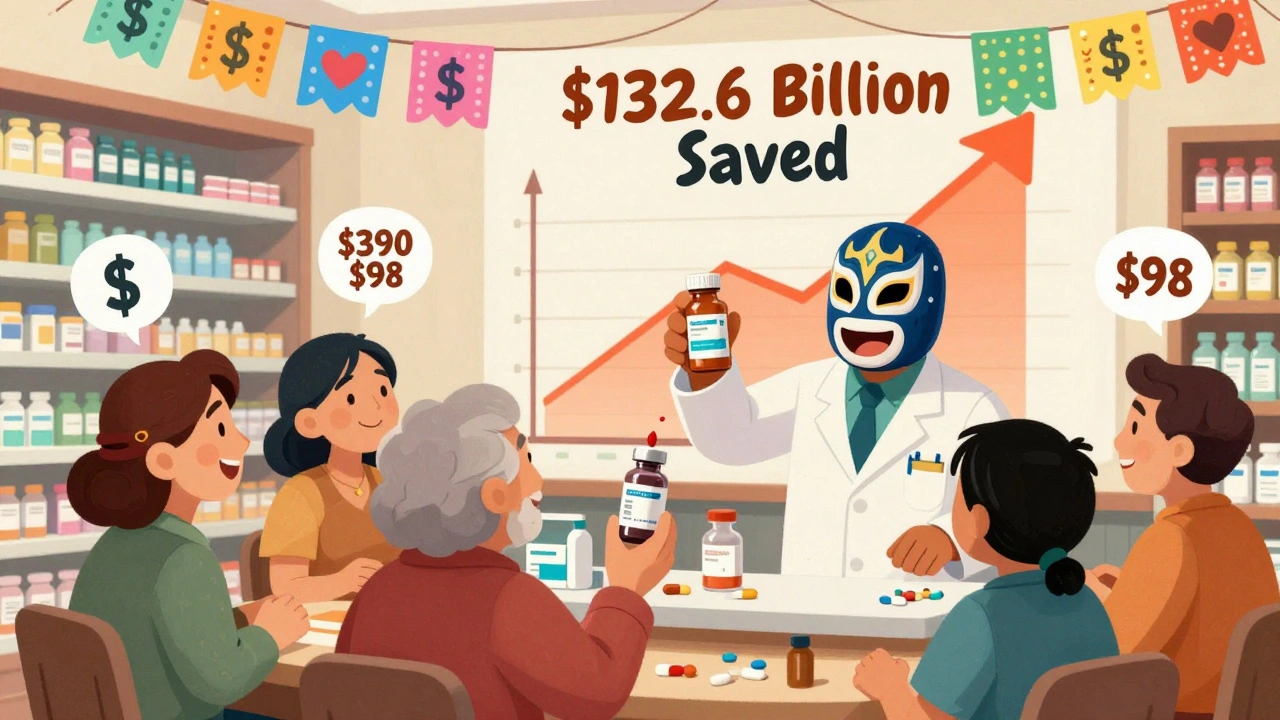
Generic drugs make healthcare affordable. They account for 90% of all prescriptions filled in the U.S., but only 23% of total drug spending. In 2023, they saved patients and insurers $132.6 billion. Pharmacists report patients’ out-of-pocket costs drop 80-85% when switching from brand to generic. One Reddit user shared how their insulin bill fell from $390 a month to $98 after switching to a generic biosimilar approved by the FDA.
But public trust matters. A 2023 CVS Health survey found 78.4% of patients felt confident in generics, and 63.2% said they noticed no difference in effectiveness. Still, 22.7% of adverse event reports involving generics cited perceived lack of efficacy. The FDA investigated these cases and found 92.3% were due to disease progression, not the drug itself. Misunderstandings happen - especially when patients switch brands and feel different. But the science doesn’t lie: if the bioequivalence data checks out, the drug works the same.
What’s Changing in 2025 and Beyond
The FDA isn’t standing still. In October 2025, it launched a new pilot program that speeds up reviews for generic manufacturers who produce their drugs in the U.S. Applications from these companies get a 30% faster review clock. This is part of a broader push to reduce reliance on foreign suppliers - 78% of active pharmaceutical ingredients (APIs) for generics come from outside the U.S., mostly from India and China.
The Generic Drug User Fee Amendments (GDUFA) IV, which took effect in 2025, brings $2.1 billion in funding through 2027. $412 million of that is specifically for complex generics. The FDA also plans to use real-world evidence in 25% of complex generic approvals by 2026. That means data from electronic health records and patient outcomes could supplement traditional clinical trials.
Industry analysts predict the FDA will approve 1,500-1,700 ANDAs annually by 2027. With over 2,100 first-generic applications pending as of early 2024, the pressure is on to keep up. The Congressional Budget Office estimates generics will save $1.9 trillion over the next decade. That’s not just a number - it’s millions of people who can afford their medications because of this system.
Why This Matters for You
If you take a generic drug, you’re benefiting from one of the most successful public health programs in modern history. The FDA doesn’t just rubber-stamp generics. It holds them to the same scientific standards as brand-name drugs - and often more, because it now has to prove equivalence for more complex delivery systems. The process isn’t perfect. There are delays. There are backlogs. But the core mission hasn’t changed: ensure that every pill, patch, or injection labeled as generic delivers the same therapeutic benefit as the original, at a price you can afford.
The next time you fill a prescription and see a generic, know this: it didn’t just appear on the shelf. It passed through a rigorous, science-driven review process designed to protect your health - and your wallet.
Are generic drugs really as effective as brand-name drugs?
Yes. The FDA requires generic drugs to have the same active ingredient, strength, dosage form, and route of administration as the brand-name version. They must also prove bioequivalence - meaning they deliver the same amount of drug into your bloodstream at the same rate. Studies show 92% of perceived differences in effectiveness are due to other factors, like disease progression or psychological expectations, not the drug itself.
Why do some people say generics don’t work as well?
Some patients notice differences when switching from brand to generic, especially with complex drugs like extended-release pills or inhalers. These differences are usually due to inactive ingredients (like fillers or coatings), which can affect how fast the drug dissolves. But the FDA requires all generics to meet strict bioequivalence standards. If a patient feels a change, they should talk to their doctor - it’s rarely because the generic is ineffective, but sometimes because the formulation isn’t ideal for their body.
How long does it take for the FDA to approve a generic drug?
Standard ANDA applications have a 10-month review target. Priority applications, like first generics or drugs in shortage, are reviewed in 8 months. But the actual time can be longer due to backlogs or incomplete submissions. In 2022, over 300 applications waited more than 36 months for review. The FDA is working to reduce delays through faster review programs and increased staffing.
Are generic drugs made in the same facilities as brand-name drugs?
Sometimes. Many generic manufacturers use the same facilities as brand-name companies, especially after patents expire. But most generics are made in separate plants, often overseas. The FDA inspects all of them equally - whether they’re in the U.S., India, or China. All must meet the same Current Good Manufacturing Practice (CGMP) standards. The agency doesn’t care where the drug is made - only that it’s made right.
What’s the difference between an ANDA and an NDA?
An NDA (New Drug Application) is for brand-name drugs and requires full clinical trials to prove safety and effectiveness. It can cost over $2 billion and take 10-15 years. An ANDA (Abbreviated New Drug Application) is for generics and skips those trials. Instead, it proves bioequivalence to an already-approved drug. ANDAs cost $2.4-6.3 million and take 3-4 years to develop. The ANDA process exists to promote competition and lower prices without compromising safety.
Do generic drugs have the same side effects as brand-name drugs?
Yes - because they contain the same active ingredient, they have the same potential side effects. Inactive ingredients (like dyes or preservatives) can vary, and in rare cases, these may cause allergic reactions in sensitive individuals. But the core safety profile - including common side effects like nausea, dizziness, or fatigue - is identical. The FDA monitors adverse events through its FAERS database and investigates any patterns of concern.
What to Do If Your Generic Isn’t Working
If you switch to a generic and feel different - whether it’s less effective, more side effects, or just a strange sensation - don’t assume it’s broken. Talk to your pharmacist or doctor. Sometimes, switching between different generic manufacturers (even if they’re both FDA-approved) can cause minor variations in how the drug feels. Your doctor can help determine if it’s the formulation or something else. Never stop taking your medication without consulting a professional.
Final Thought
The FDA’s role in approving generics isn’t about cutting corners. It’s about smart regulation. By eliminating unnecessary duplication, the agency makes life-saving drugs affordable without sacrificing safety. The system works - for 9 out of 10 prescriptions. That’s not luck. It’s science, oversight, and a commitment to public health.
Comments (12)
Andrew Frazier
lol so the FDA just lets any junk from India pass as 'bioequivalent'? My cousin took a generic for blood pressure and ended up in the ER. They don't test for real-world variability, just lab rats in a 10-month checklist. This whole system is a scam to make Big Pharma look good while we get cheap poison.
Nava Jothy
I am so disappointed in the FDA!!! 🥺 How can you allow such a thing?! In India, we have real quality control - not this '80-125%' nonsense! My uncle died because of a generic from 'America' - the tablet dissolved too fast! 😭 The FDA is not protecting people, it is protecting corporations! 🚨💔
brenda olvera
i just want to say thank you to the FDA for making my insulin affordable 🙏 i used to pay $400 a month now its $89 and i can actually breathe at night. dont let the naysayers scare you - if your doctor says its good, it is. science is real and so is the savings
Myles White
The complexity of the ANDA review process is often underestimated by the general public. The sheer volume of documentation - upwards of 20,000 pages per application - requires multidisciplinary teams to evaluate everything from dissolution profiles to impurity thresholds, and the FDA's Office of Generic Drugs is operating at near-maximum capacity with a backlog that's grown exponentially since 2020. The introduction of AI-assisted review in late 2024 was a necessary step, but it's only been applied to 12% of cases so far, and the training data for these models still lacks sufficient representation of complex delivery systems like transdermal patches and inhaled corticosteroids, which means even with automation, the bottleneck persists. Add to that the fact that 78% of APIs originate overseas, and you're looking at a system that's stretched thin not because of incompetence, but because of geopolitical supply chain fragility and chronic underfunding despite the GDUFA IV funding increase.
Mansi Bansal
The FDA's bioequivalence standards are fundamentally flawed. The 80-125% confidence interval is not a scientific benchmark - it is a regulatory compromise. When one considers that a 20% variance in Cmax can lead to clinically significant fluctuations in plasma concentration - particularly with narrow-therapeutic-index drugs such as warfarin or levothyroxine - the notion that 'it's close enough' becomes not just irresponsible, but ethically indefensible. The agency's reliance on 24-36 healthy volunteers is archaic. Where are the pharmacogenomic studies? Where is the diversity in testing populations? This is not medicine - it is statistical theater.
Kay Jolie
Okay but let’s be real - the FDA is basically the only thing keeping generics from being total garbage. I mean, the bioequivalence criteria? That’s not just a box-ticking exercise - it’s the difference between a pill that works and one that makes you feel like you’ve been hit by a truck. And the fact that they’re now using AI to review complex generics? That’s next-level. Like, imagine your inhaler actually delivering the right dose every time instead of just spraying air. The system isn’t perfect, but it’s the best we’ve got. And honestly? It’s saving millions of people from financial ruin. 🙌
pallavi khushwani
i think about how medicine is supposed to be about healing, not profit. the fact that we need a 15,000 page form to make a pill that's chemically identical to another one... it's kind of tragic. why does it have to be so complicated? maybe we're measuring the wrong things. what if the real question is not whether the drug enters the bloodstream at the same rate, but whether it helps people live better? the numbers are important, but so is the human story behind them
Clare Fox
i used to think generics were just cheaper versions but now i realize theyre the only reason i can afford my meds. my dad was on a brand name statin for years until he lost his job. switched to generic and he’s been fine. the science checks out. the fear people have? its usually just fear of change. not the drug
Akash Takyar
I must commend the FDA for maintaining rigorous standards, despite the immense pressure to expedite approvals. The fact that over 82% of manufacturing facilities are inspected annually - regardless of geographic location - demonstrates an unwavering commitment to public health. The rise in complex generics, from 22% to 37.5% in five years, is a testament to the agency's adaptability. However, I urge policymakers to ensure that the GDUFA IV funding is not merely allocated, but effectively deployed - particularly in training inspectors fluent in the nuances of transdermal and extended-release technologies. The global supply chain must not compromise the sanctity of patient safety.
Jackie Petersen
they're all made in china and india. the FDA doesn't even visit most of these plants. this is a lie. the pills are full of fillers and contaminants. my friend's kid had seizures after switching. they buried it. you think they care about you? they care about the 132 billion they saved. i'd rather pay $400 for the brand.
Annie Gardiner
I mean, if generics are so identical, why do I feel different every time I switch brands? It’s not placebo - it’s the fillers. The FDA says it’s fine, but nobody asks what’s in those fillers. Are they testing for endocrine disruptors? Are they checking for glyphosate contamination? No. Because then the whole system collapses. We’re not being protected - we’re being experimented on.
Rashmi Gupta
The FDA approves generics based on data from healthy young volunteers. But what about elderly patients with kidney disease? Or people with gut malabsorption? The system assumes uniform biology. It doesn’t account for real human variation. So yes, technically it’s 'bioequivalent' - but in practice? It’s a gamble. And someone’s always paying the price.