
Geriatric Polypharmacy Risk Estimator
Enter the number of medications to see the estimated risk profile.
Guidance for Next Steps
Enter a medication count to see recommended clinical interventions.
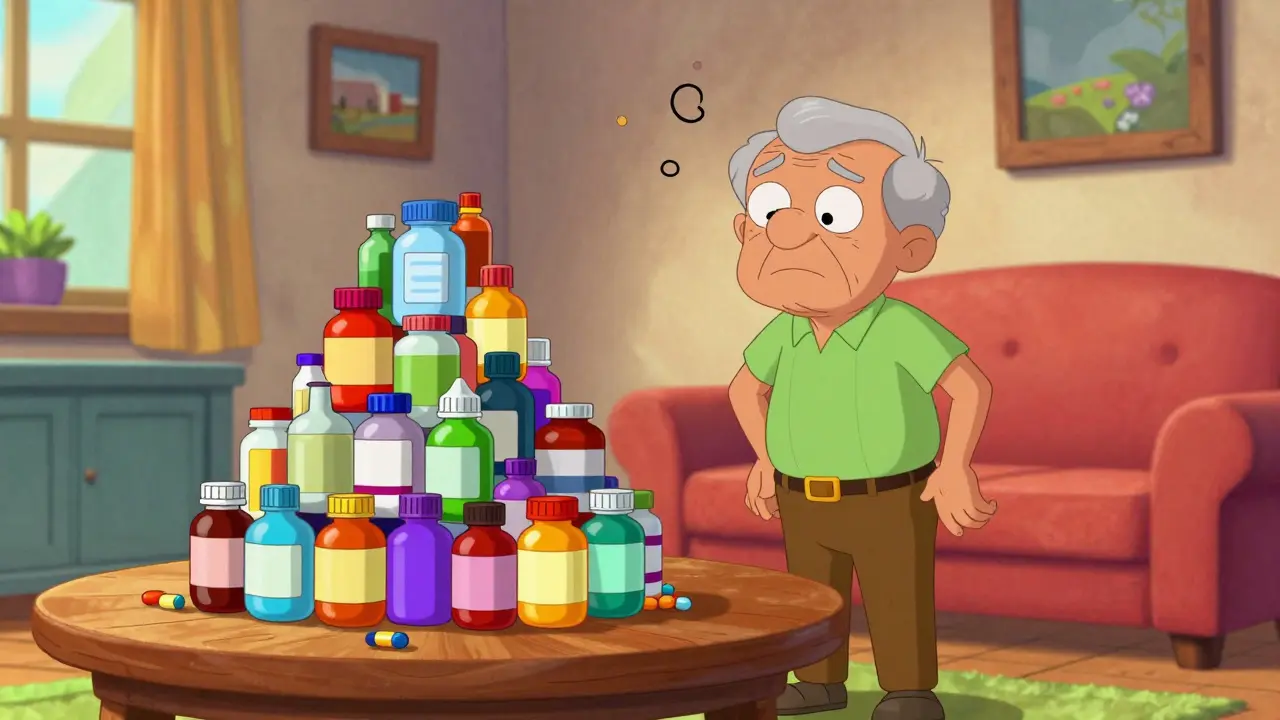
Taking five or more medications at once might seem like a necessary part of aging, but it often creates a dangerous tipping point. When an older adult hits that threshold, the risk of injurious falls jumps by 30% to 50%. It's a phenomenon known as geriatric polypharmacy is the routine use of five or more medications in older adults, often leading to adverse drug events due to complex interactions and changing physiology. While treating chronic conditions is vital, adding more pills isn't always the answer. In fact, medication-related issues cause nearly 28% of all hospital admissions for seniors. The goal isn't just to cut pills, but to align treatment with a patient's current life goals and health status.
Why the Number of Pills Matters
It isn't just about the volume of medicine; it's about how the aging body processes them. As we get older, our kidneys and liver don't clear drugs as efficiently. This means a dose that worked at 50 might be toxic at 75. Every single additional medication added to a regimen increases the risk of a fall by about 8%, regardless of what the drug is. Imagine a patient taking a blood pressure med, a statin, a diuretic, a sleep aid, and a blood thinner. The interaction between these can lead to dizziness, confusion, or internal bleeding-events that can strip a senior of their independence in a matter of hours.
The Three Levels of Medication Reviews
Not all medication reviews are created equal. If you are looking at Comprehensive Medication Reviews (CMRs), you'll find they fall into three distinct categories of intensity. Understanding which one is needed can be the difference between a superficial check and a life-saving intervention.
- Type I: A basic review of the prescription list. This is essentially a "paper check" to see what is being taken.
- Type II: This adds an assessment of adherence. The clinician checks if the patient is actually taking the meds as prescribed or if they're skipping doses.
- Type III: The gold standard. This involves a face-to-face or video consultation where the clinician evaluates the medications in the context of the patient's actual clinical condition and physical state.
Data from 2023 shows that only Type III reviews significantly move the needle, reducing unplanned hospital readmissions by over 18%. A simple list check (Type I) rarely changes the outcome because it misses the "human element"-like a patient who can't open their pill bottle or who is experiencing subtle side effects they haven't mentioned.
| Tool | Primary Focus | Clinical Evidence | Best Use Case |
|---|---|---|---|
| Beers Criteria | Potentially inappropriate meds | Strong guidelines | Identifying drugs to avoid |
| STOPP/START | Screening and stopping/starting | Positive clinical endpoints | Active deprescribing workflows |
| FORTA | Medication suitability for aged | Proven effectiveness | Evaluating if a drug is "fit" for a senior |
The Art of Deprescribing
Deprescribing isn't just "stopping meds." It's a planned process of reducing or eliminating medications that no longer provide benefit or where the risk outweighs the reward. This is particularly tricky with psychotropic medications; if you stop these too quickly, about 24% of patients experience severe adverse events. The key is a slow, monitored taper.
A major hurdle here is the "prescribing cascade." This happens when a doctor treats a side effect of one drug by prescribing a second drug, which then causes a new side effect, leading to a third drug. For example, a patient takes a medication that causes swelling, so they are given a diuretic for the swelling, which then causes potassium loss, leading to a potassium supplement. A skilled clinician looks for these patterns to break the cycle.
Interestingly, the most successful results happen when pharmacists lead the charge. When pharmacists work under Collaborative Practice Agreements (CPAs), they've shown 37.6% higher rates of successful deprescribing compared to when doctors work alone. This is likely because pharmacists have the dedicated time-often 45 to 60 minutes per review-to dig into the details.
Tailoring the Approach to the Patient
Not every senior reacts the same way to these interventions. For instance, patients between 65 and 79 years old see a much higher mortality reduction (about 14.7%) from these reviews than those over 80. Additionally, patients without dementia tend to benefit more because they can provide more accurate feedback about their symptoms and adherence.
There is also a danger in being too aggressive. If a clinician stops a medication without proper monitoring, they risk "therapeutic abandonment." Around 7% of patients have seen their diseases worsen because an essential medication was cut too hastily. The balance is delicate: you want to remove the clutter, but you can't remove the lifelines.
Modern Tools and the Future of Care
We are moving away from rigid checklists toward AI-driven precision. Systems like the Polypharmacy Risk Score integrated into EHRs can now predict adverse drug events with over 87% accuracy. This allows doctors to flag high-risk patients before a fall or a hospital visit even happens.
The future is moving toward value-based care. By 2030, comprehensive polypharmacy management is expected to be the standard of care. Why? Because it saves money. Comprehensive management can reduce healthcare costs by nearly $1,900 per patient annually. When you prevent one emergency room visit for a fall, the intervention pays for itself many times over.
Practical Steps for Implementation
If you're a provider or a caregiver, the process should follow a specific sequence to be effective:
- Meticulous Reconciliation: Spend at least 20 minutes verifying every single pill, including over-the-counter supplements and vitamins.
- Tool Application: Use a validated tool like STOPP/START to identify which meds are no longer appropriate.
- Goal Alignment: Discuss with the patient. Do they value a lower blood pressure number more than they value avoiding the dizziness that the medication causes?
- Tapering Plan: Never stop a long-term medication abruptly. Create a step-down schedule.
- Monitoring: Schedule a follow-up within two weeks to ensure the disease hasn't flared up.
What exactly is considered polypharmacy?
In most clinical settings, polypharmacy is defined as the routine use of five or more medications. While some define it differently, the five-pill threshold is the widely accepted standard used by the American Geriatrics Society and other major health organizations to identify patients at higher risk for adverse drug events.
Can't I just stop the medications that seem unnecessary?
Absolutely not. Stopping medications without a clinical taper can lead to withdrawal symptoms or a rebound effect where the original condition returns more aggressively. This is especially dangerous with blood pressure meds and psychotropic drugs. Always work with a healthcare provider to create a gradual reduction plan.
Which tool is best for checking medication appropriateness?
While the Beers Criteria is very famous for listing "drugs to avoid," the STOPP/START and FORTA criteria have shown more positive results in randomized controlled trials for actually improving patient clinical endpoints. STOPP/START is particularly useful for identifying which medications to stop and which essential ones are actually missing.
Why is a pharmacist's involvement so important?
Pharmacists have specialized training in drug-drug interactions and pharmacokinetics. Because they often have more time for comprehensive reviews (45-60 minutes) than a primary care physician, they can spot the "prescribing cascade" and identify subtle interaction risks that might be missed in a brief 15-minute appointment.
How does polypharmacy affect the risk of falls?
Taking more than four medications increases the risk of injurious falls by 30-50%. Each additional drug beyond that threshold adds roughly an 8% increase in fall risk. This happens due to side effects like orthostatic hypotension (a drop in blood pressure when standing), sedation, or cognitive impairment.