

What Are Hormone Therapy Combinations?
Hormone therapy combinations, often called combined hormone replacement therapy (HRT), are used to treat menopause symptoms in women who still have their uterus. These combinations include estrogen and progestogen - two hormones that work together to relieve hot flashes, night sweats, and vaginal dryness while protecting the uterine lining. Without progestogen, estrogen alone can cause the lining of the uterus to grow too much, raising the risk of endometrial cancer. That’s why women with a uterus almost always need both hormones.
For women who’ve had a hysterectomy, estrogen-only therapy is safe and commonly used. But if you still have your uterus, skipping progestogen isn’t an option. This isn’t just medical advice - it’s a safety rule backed by decades of research.
Two Main Types of Combination Therapy
There are two main ways to combine estrogen and progestogen: sequential and continuous. The right choice depends on whether you’re still having periods or not.
- Sequential HRT: This is for women who are still having periods - either irregularly or monthly. You take estrogen every day, then add progestogen for the last 10 to 14 days of the month. This mimics your natural cycle and usually causes a withdrawal bleed, similar to a period. It’s designed for perimenopause or early menopause.
- Continuous HRT: This is for women who haven’t had a period for a full year. You take both hormones every single day, with no break. There’s no monthly bleed, which many women prefer. But in the first few months, some may experience spotting or irregular bleeding as the body adjusts.
Choosing between them isn’t about preference alone. It’s about your body’s current stage. Starting continuous therapy too early can lead to unpredictable bleeding. Waiting too long to switch from sequential can mean unnecessary periods when you’re already past menopause.
Generic Hormone Options: What’s Available and How Much Do They Cost?
Most hormone therapy prescriptions today are generic. That means they’re cheaper, just as effective, and widely covered by insurance. Common generic formulations include:
- Estrogen: Conjugated estrogens (0.3mg, 0.45mg, 0.625mg tablets), estradiol (0.5mg, 1mg tablets)
- Progestogen: Medroxyprogesterone acetate (2.5mg, 5mg, 10mg tablets), micronized progesterone (100mg, 200mg capsules)
In the U.S., these generics typically cost between $4 and $40 per month, depending on the dose, brand, and insurance. In Australia, prices are often lower due to the Pharmaceutical Benefits Scheme (PBS), with many scripts costing under $10 after subsidy. The biggest cost difference isn’t between brands - it’s between delivery methods.
Oral tablets are the cheapest, but they’re not always the safest. Transdermal options - patches, gels, sprays - cost more upfront but carry fewer risks. A patch might cost $60-$80 a month without insurance, but it could save you from hospital bills down the road.
Delivery Methods Matter More Than You Think
How you take your hormones changes how your body handles them - and that affects your risk profile.
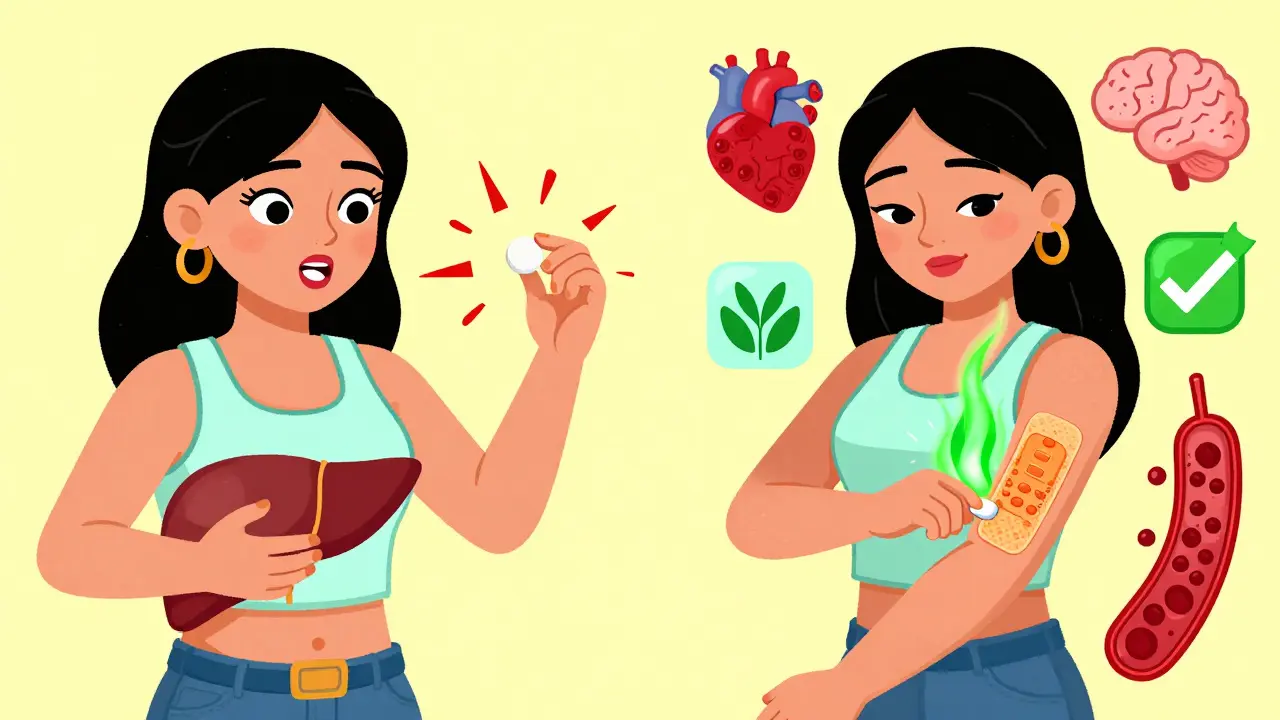
Oral pills go through your liver first. This can increase clotting factors, raising your risk of blood clots, stroke, and heart attack - especially if you’re over 60 or have high blood pressure. Studies show oral HRT increases venous thromboembolism (VTE) risk by 2 to 3 times compared to non-users.
Transdermal patches, gels, and sprays deliver hormones straight through the skin. They bypass the liver, so clotting risks stay low. The NIH and European guidelines now recommend transdermal estrogen as the first choice for women with a history of clotting issues, obesity, or high blood pressure.
There’s also the Mirena IUS - a small device placed in the uterus that releases progestogen locally. It’s great for women who want to avoid daily pills and reduce uterine bleeding. It can be used with oral or transdermal estrogen for full hormone coverage.
Practical tip: If you’re using a gel, wait at least 60 minutes before showering or hugging someone. Skin-to-skin contact can transfer the hormone - and you don’t want your partner getting a dose they didn’t ask for.
Who Should Avoid Hormone Therapy?
HRT isn’t for everyone. There are clear red flags:
- History of breast cancer
- History of blood clots, stroke, or heart attack
- Unexplained vaginal bleeding
- Severe liver disease
- Pregnancy
Even if you’re otherwise healthy, starting HRT after age 60 or more than 10 years after menopause begins increases risks. That’s not a hard rule - but it’s a strong warning. The Women’s Health Initiative found that women over 60 on oral HRT had a 39% higher stroke risk. For women with heart disease, transdermal estrogen is the only safe option.
Dr. Gutierrez from Houston Methodist puts it simply: “Throwing hormones at someone who hasn’t had them for decades - especially if they’re older or have heart issues - can be dangerous.”
How Long Should You Stay on Hormone Therapy?
There’s no one-size-fits-all answer. Most women take HRT for 3 to 5 years to get through the worst symptoms. But some need it longer - especially if they had early menopause (before age 45).
Research shows that for healthy women under 60 or within 10 years of menopause, the benefits outweigh the risks. Short-term use reduces hot flashes by 80% and improves sleep and mood. Long-term use (5+ years) slightly increases breast cancer risk - about 1 in 1,000 women per year of use. But here’s the key: not all progestogens are equal.
Micronized progesterone (natural progesterone) has a better safety profile than synthetic progestins like medroxyprogesterone. Studies show synthetic progestins raise breast cancer risk by 2.7% per year. Micronized progesterone? Only 1.9%. That’s a big difference. Many doctors now prefer it, especially for women with a family history of breast cancer.
Every year, you should revisit your treatment with your doctor. Are your symptoms under control? Are you still at risk for clots or cancer? Has your blood pressure changed? HRT isn’t a “set it and forget it” solution.

What About Breakthrough Bleeding?
If you’re on continuous HRT and start spotting - don’t panic. It’s common in the first 3 to 6 months. About 15-20% of women experience this as their body adjusts. But if bleeding lasts longer than 6 months, or if it’s heavy or irregular, you need to see your doctor.
Possible causes: wrong dose, wrong type of progestogen, or something else - like polyps or endometrial thickening. A simple ultrasound or biopsy can rule out serious issues. Don’t ignore persistent bleeding. It’s not normal, even if you’ve been on HRT for a while.
What’s New in Hormone Therapy?
Research is moving fast. In 2023, the FDA approved a new transdermal patch that combines estrogen and progesterone in one patch. Early results suggest it may lower breast cancer risk compared to older oral combinations.
The Kronos Early Estrogen Prevention Study (KEEPS) found that starting transdermal estradiol within 3 years of menopause may protect the heart without increasing artery plaque. That’s a game-changer - it suggests timing matters as much as dosage.
Future treatments like tissue-selective estrogen complexes (TSECs) and selective progesterone receptor modulators (SPRMs) are in late-stage trials. These aim to give the benefits of hormones without the cancer risks. They’re not available yet, but they’re coming.
Final Thoughts: Personalization Is Everything
Hormone therapy isn’t about taking the most popular drug. It’s about matching your body’s needs with the safest, most effective option. Your age, hysterectomy status, family history, and personal health goals all matter.
Start low. Go slow. Use transdermal if you can. Choose micronized progesterone over synthetic. Reassess every year. And remember - HRT isn’t for preventing heart disease or dementia. It’s for relieving menopause symptoms. If you’re using it for anything else, you’re using it wrong.
Millions of women use HRT safely every year. But safety only comes from knowing your options - and making smart choices based on real data, not myths from the internet or outdated advice.
Can I take generic hormone therapy instead of brand-name?
Yes. Generic hormone therapies are just as effective as brand-name versions. They contain the same active ingredients - estrogen and progestogen - in the same doses. The only differences are inactive ingredients like fillers or coatings, which don’t affect how the drug works. In the U.S., generics cost 70-90% less. Most insurance plans cover them. Ask your pharmacist or doctor for the generic version unless you have a specific reason not to.
Is transdermal HRT safer than pills?
Yes, for most women. Transdermal estrogen (patches, gels, sprays) doesn’t pass through the liver first, so it doesn’t increase clotting factors like oral pills do. Studies show a 2- to 3-fold lower risk of blood clots and stroke with transdermal methods. If you’re over 45, have high blood pressure, are overweight, or have a history of clots, transdermal is the preferred option. It’s not risk-free, but it’s significantly safer.
How do I know if I need progestogen with my estrogen?
If you still have your uterus, you need progestogen. Estrogen alone causes the uterine lining to thicken, which can lead to endometrial cancer - the risk increases 2 to 12 times without progestogen. If you’ve had a hysterectomy, you don’t need it. If you’re unsure, check your medical records or ask your doctor. Never take estrogen alone if you have a uterus - it’s not just risky, it’s dangerous.
Does hormone therapy cause weight gain?
Hormone therapy itself doesn’t cause weight gain. But menopause does. As estrogen drops, your metabolism slows, and fat tends to shift to your abdomen. Some women notice bloating or fluid retention when starting HRT, but that usually fades. If you’re gaining weight, it’s more likely due to aging, less activity, or diet changes - not the hormones. Focus on movement, protein intake, and sleep. HRT can actually help by improving energy and sleep quality, making it easier to stay active.
How long does it take for HRT to work?
Most women notice improvement in hot flashes and night sweats within 2 to 4 weeks. But full symptom relief - including mood, sleep, and vaginal dryness - often takes 3 to 6 months. It’s not instant. Finding the right dose and delivery method can take time. Don’t give up after a month. Keep track of your symptoms and talk to your doctor at your 3-month checkup. Adjustments are normal.
Can I stop hormone therapy suddenly?
You can, but it’s not recommended. Stopping abruptly can trigger a return of menopause symptoms - sometimes worse than before. Hot flashes, sleep problems, and mood swings can come back hard. If you want to stop, work with your doctor to taper slowly. Reduce the dose by 25% every few weeks. This helps your body adjust. Some women stay on low-dose HRT long-term if symptoms persist. There’s no shame in continuing if it improves your quality of life.
Comments (15)
Jane Lucas
I started transdermal last year and honestly my hot flashes vanished like magic. No more midnight panic sweats. My doctor said it’s safer too. Best decision ever.
Kylie Robson
Let me clarify something since people keep mixing this up - micronized progesterone isn’t just ‘natural’ because it sounds fancy. It’s structurally identical to endogenous progesterone, unlike medroxyprogesterone which is a synthetic progestin with androgenic properties that up your breast cancer risk. The WHI data is clear: 2.7% vs 1.9% per year. This isn’t marketing. It’s pharmacology.
Caitlin Foster
OMG YES. I was on oral HRT for 6 months and felt like I was slowly turning into a walking blood clot. Switched to the patch and suddenly I could walk up stairs without feeling like I’d run a marathon. Also, my husband stopped asking if I was having a stroke every time I got hot. THANK YOU FOR THIS ARTICLE.
Janice Holmes
I don’t know why everyone’s acting like this is some groundbreaking revelation. The liver first-pass effect of oral estrogen has been documented since the 1980s. The NIH has been pushing transdermal for over a decade. Why are we still talking about this like it’s new? Because Big Pharma still profits off pills. Patch? Gel? Too expensive. Pills? Covered by insurance. Profit over safety. Again.
Miriam Piro
They don’t want you to know this but the FDA approved that combo patch in 2023 because the pharmaceutical industry is terrified of lawsuits. The real reason? They’ve been caught hiding data from the 1990s showing synthetic progestins cause endometrial hyperplasia even with estrogen. They’ve been lying for 30 years. The Mirena IUS? It’s not just a contraceptive - it’s a Trojan horse. They’re trying to get you hooked on hormone delivery systems so they can control your body long-term. You think you’re getting relief? You’re getting implanted corporate surveillance.
dean du plessis
I’m a guy from South Africa and I read this because my wife is on HRT. Honestly this is the clearest explanation I’ve seen. No fluff. Just facts. I didn’t know about the liver thing with pills. We’re switching to gel next month. Thanks for writing this.
Jay Ara
i been on micronized progesterone since 2021 and no spotting no mood swings just chill. if u got uterus u need it no debate. dont let dr scare u with numbers. listen to your body
Andrew Gurung
I’m sorry, but if you’re still taking oral estrogen after 50, you’re not managing menopause - you’re gambling with your life. And if you’re using medroxyprogesterone? That’s not hormone therapy. That’s chemical negligence. I’ve seen too many women end up in the ER with clots because their doctor didn’t update their knowledge since 2005. This isn’t medicine. It’s malpractice with a prescription pad.
Todd Scott
In Nigeria, we don’t have easy access to transdermal options, so we rely on generics. But even here, doctors are starting to shift. A recent study in Lagos showed that women on micronized progesterone had 40% lower incidence of breakthrough bleeding than those on synthetic progestins. It’s not just Western medicine - this is global evidence. The key is access. We need policy changes so that safer options aren’t a luxury.
Paula Alencar
I must emphasize: the notion that hormone therapy causes weight gain is a persistent myth that has caused immense psychological harm to women. Weight gain during menopause is multifactorial - decreased muscle mass, reduced physical activity, insulin resistance, and sleep disruption all contribute. HRT, particularly transdermal estrogen, may actually mitigate fat redistribution by stabilizing cortisol and improving sleep architecture. To attribute weight gain to HRT is not only inaccurate - it is dangerous, as it discourages women from seeking relief from debilitating symptoms.
Nikki Thames
You all sound so naive. Do you really think the pharmaceutical companies want you to know that micronized progesterone is cheaper and safer? They don’t. They’ve spent billions marketing medroxyprogesterone because it’s patent-protected and they own the brand. Generic micronized progesterone? It’s been available since 2010. Why is it still not first-line? Because profit > prevention. And you’re just another consumer who’ll take the pill because it’s covered. Wake up.
Will Neitzer
It is imperative to underscore that the decision to initiate or discontinue hormone therapy must be individualized, evidence-based, and subject to periodic reassessment. The Women’s Health Initiative findings, while pivotal, must be contextualized within the timing hypothesis: initiation within the critical window of early menopause yields cardiovascular benefit, whereas initiation after age 60 or more than a decade post-menopause increases risk. Furthermore, the route of administration significantly alters pharmacokinetics and thrombotic potential. To generalize HRT as uniformly risky or beneficial is a gross oversimplification of a complex endocrine paradigm.
Chris Garcia
In my village in Ghana, women used to drink bitter leaf tea and sit in steam baths for hot flashes. Now, some are on HRT. But here’s what no one says - the real revolution isn’t the patch or the gel. It’s that women are finally being listened to. We used to be told to ‘just endure.’ Now we have data, choices, and dignity. That’s the real hormone therapy - respect.
Elizabeth Alvarez
I’ve been researching this for two years and I’m convinced - the estrogen-progestogen combo is part of a global population control program. The WHO, CDC, and FDA are all connected to the same shadow consortium that also runs the flu vaccines. Why? Because they want women to bleed less, feel less, and stay docile. The spotting on continuous HRT? That’s not your body adjusting - that’s your uterus fighting back. They don’t want you to feel anything. They want you numb. The Mirena? It’s a microchip disguised as an IUD. They’re tracking your hormonal cycles. I’ve seen the blueprints.
James Bowers
The clinical evidence supporting transdermal estrogen as the preferred modality in women with cardiovascular risk factors is robust and unequivocal. Furthermore, the differential oncogenic potential of synthetic progestins versus micronized progesterone has been consistently demonstrated in prospective cohort studies. It is therefore both medically and ethically incumbent upon clinicians to prioritize these formulations in accordance with current guidelines. Failure to do so constitutes a deviation from the standard of care.