
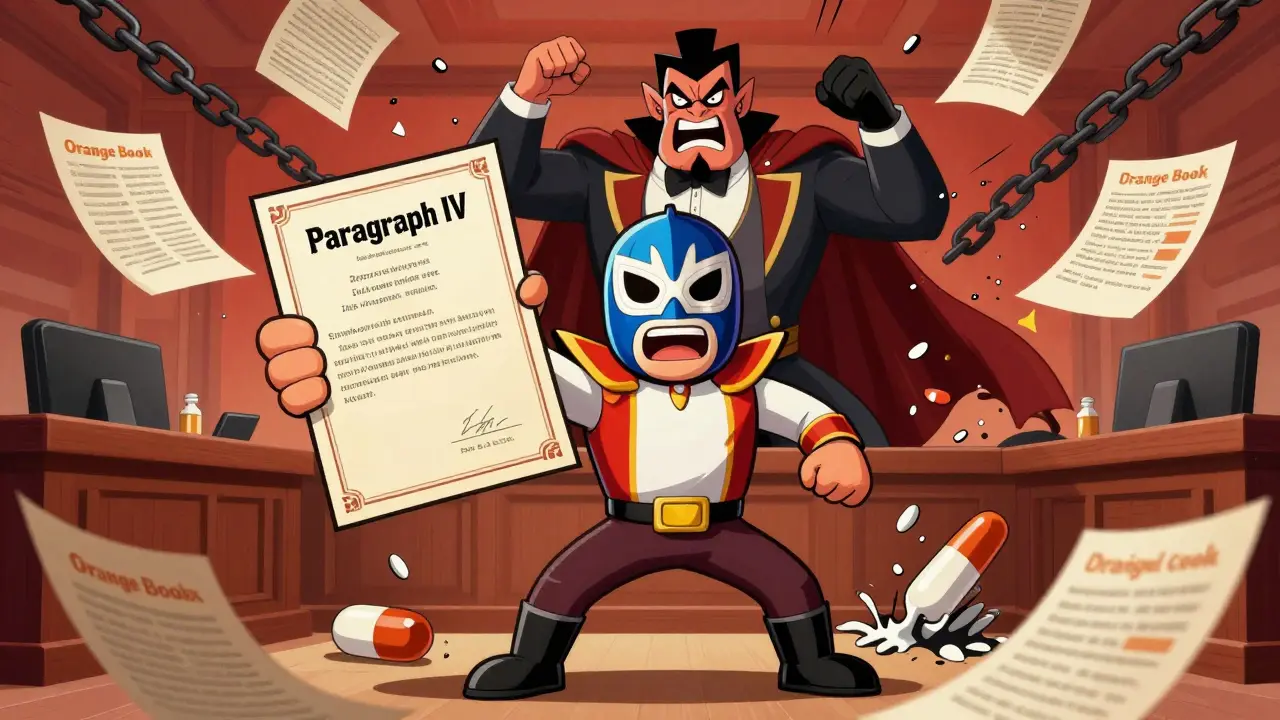
When a brand-name drug’s patent is about to expire, the race to bring out a cheaper generic version begins - but it’s not just a matter of copying the formula. There’s a legal mechanism built into U.S. drug law called Paragraph IV certification that turns patent disputes into high-stakes courtroom battles. It’s how generic drug makers legally challenge patents they believe are weak, invalid, or not actually infringed by their version of the drug. And when it works, it drops prices by up to 80% in months.
What Is Paragraph IV and Why Does It Exist?
Paragraph IV isn’t a law itself. It’s a section of the Hatch-Waxman Act, passed in 1984. Before this law, generic drug makers had to run full clinical trials to prove their version worked - expensive, slow, and nearly impossible for small companies. Brand-name drugmakers, meanwhile, could extend their monopoly by filing dozens of minor patents on things like pill coatings or dosing schedules, even if those didn’t change how the drug worked. The Hatch-Waxman Act struck a deal: let generics enter faster, but give brand companies extra patent time to make up for the years lost during FDA review. In return, generics could skip full trials if they proved their product was bioequivalent - meaning it worked the same way in the body. But here’s the twist: to file for approval, a generic company had to say something bold in its application - either that the brand’s patents had expired (Paragraph III), or that they were invalid, unenforceable, or wouldn’t be infringed (Paragraph IV). That Paragraph IV statement? It’s not just a claim. Under U.S. patent law, it’s treated as an artificial act of infringement. That means the moment the generic company files it, the brand company can sue. And that lawsuit triggers a 30-month clock during which the FDA can’t approve the generic - even if it’s safe and effective.How the Paragraph IV Process Actually Works
It starts with the Orange Book. Officially called the “Approved Drug Products with Therapeutic Equivalence Evaluations,” this FDA-published list shows every approved drug and its patents. Generic makers scan this like detectives, looking for weak spots - patents that are vague, overly broad, or based on old science. Once they pick a target, they file an Abbreviated New Drug Application (ANDA) with the FDA. Alongside it, they send a formal notice to the brand company. This isn’t a letter. It’s a legal document that must include detailed arguments: why the patent is invalid (maybe prior art exists), or why their product doesn’t infringe (maybe the patent claims a specific salt form, and theirs is different). The brand company then has 45 days to sue. If they do, the FDA hits pause. No approval until either:- The court rules the patent is invalid or not infringed
- The patent expires
- The 30-month clock runs out (even if the case isn’t finished)
The 180-Day Exclusivity Prize
The real driver behind Paragraph IV isn’t just access to the market - it’s the prize. The first generic company to file a successful Paragraph IV challenge gets 180 days of exclusive rights to sell its version. No other generic can enter during that time. That’s huge. During those six months, the first filer can capture 70-80% of the generic market. In 1996, Barr Labs challenged Eli Lilly’s patent on Prozac. After a five-year legal battle, they won. Their 180-day exclusivity period earned them hundreds of millions in revenue. That’s why so many generic companies race to be first - even if it means filing before they’re fully ready. But here’s the catch: if multiple companies file on the same day, they share the exclusivity. And if the first filer doesn’t launch within 75 days of winning, they lose it. That’s led to messy legal fights - and sometimes, brand companies pay generics to delay entry. These “pay-for-delay” deals were common until the Supreme Court banned them in 2013 (FTC v. Actavis), saying they were anti-competitive.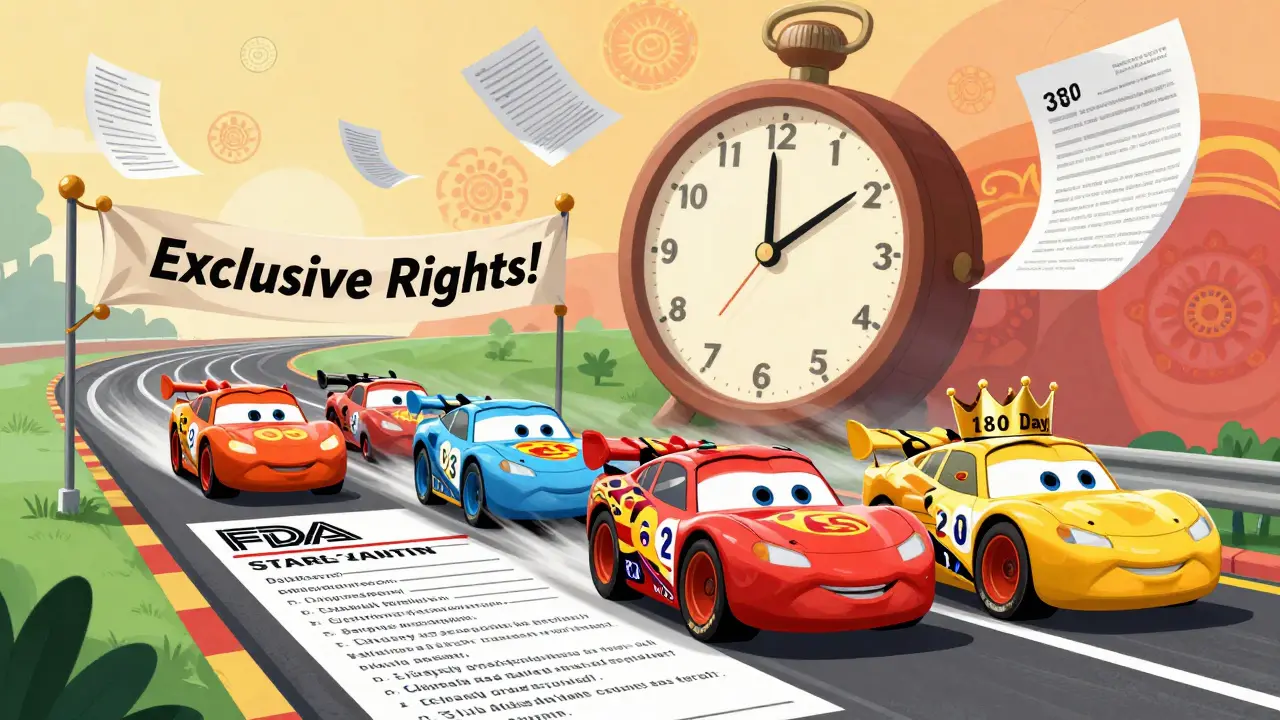
Why Paragraph IV Works - and When It Doesn’t
Paragraph IV succeeds about 65% of the time, according to a study of over 1,700 cases. But it’s not a magic bullet. It works best when:- The patent is narrow or based on obvious modifications
- The brand company listed too many patents (called a “patent thicket”)
- The generic company has strong scientific evidence and legal strategy
The Cost and Risk for Generic Companies
This isn’t cheap. A single Paragraph IV lawsuit costs an average of $7.8 million - more than three times the cost of a patent challenge at the USPTO. Generic companies spend $2.3 million just on pre-filing analysis: reviewing patents, running lab tests, hiring expert witnesses. And if they lose? They can be hit with massive damages. In 2017, Mylan lost its case against Novartis over Gleevec®. The court found Mylan had willfully infringed. The judgment? $1.1 billion. Even before a case ends, companies must invest $15-25 million to get manufacturing ready. They can’t wait for approval - they have to be ready to ship the moment the court says yes.
What’s Changing Now?
The system is under pressure. In 2020, the average drug had 4.8 Orange Book patents - up from 1.2 in 1984. That’s not innovation. That’s legal padding. The FDA now requires Paragraph IV filers to challenge all listed patents, not just the main one. That makes filings more complex and expensive. New laws are trying to fix the imbalance. The 2023 CREATES Act forces brand companies to sell samples of their drugs to generics - something they used to withhold to delay testing. The FDA’s 2022 rule on citizen petitions cracked down on brand companies filing last-minute objections to block approvals. And the Inflation Reduction Act of 2022 lets Medicare negotiate drug prices. That changes the math for brand companies. If they know the government will soon cap prices, they might be less willing to pay for delays.Why This Matters to You
Paragraph IV isn’t just a legal quirk. It’s why you can buy a $10 generic version of a drug that cost $300 just a year ago. Between 2009 and 2019, generic drugs that entered through Paragraph IV challenges saved U.S. consumers $1.68 trillion. In Europe, there’s no equivalent. Generic entry takes years longer. In the U.S., it’s often under two years after patent expiry - thanks to this system. But the system is fragile. If patent thickets grow too large, or if courts keep siding with brand companies, the pipeline of cheap drugs will slow. That’s why regulators are watching closely. The FTC now lists reforming Paragraph IV as a top priority. It’s a system built on balance. Too much protection for brands, and generics never come. Too little, and innovation dies. Paragraph IV walks that line - and right now, it’s working, but barely.What is a Paragraph IV certification?
A Paragraph IV certification is a legal statement filed by a generic drug company with its FDA application, claiming that a brand-name drug’s patent is invalid, unenforceable, or won’t be infringed by the generic version. This triggers a patent lawsuit and a 30-month delay in FDA approval - but if the generic wins, it can enter the market early.
Why does the brand company get a 30-month stay?
The 30-month stay gives brand companies time to litigate patent disputes without losing market control. It’s not a guarantee they’ll win - it’s a pause button. The FDA can’t approve the generic until the court rules, the patent expires, or the 30 months run out - whichever comes first.
How does the 180-day exclusivity period work?
The first generic company to successfully file a Paragraph IV challenge gets 180 days of exclusive rights to sell its version. No other generic can enter during that time. This creates a huge financial incentive - the first filer can capture most of the market before competitors arrive.
Can a brand company stop a Paragraph IV challenge?
Yes - by suing within 45 days of being notified. If they win the lawsuit, the generic can’t enter until the patent expires. But if they lose, the generic enters immediately. Many brand companies settle instead of risking a loss, especially if their patent is weak.
Why do some Paragraph IV challenges fail?
They often fail when brand companies use “evergreening” - filing patents on minor changes like packaging, delivery methods, or new uses, not the active ingredient. Courts usually uphold these. Also, if the generic’s legal arguments are weak or poorly written, the FDA may reject the filing outright.
Comments (10)
Samuel Bradway
I used to pay $400 for my dad's heart med until the generic hit. Now it's $12. Paragraph IV didn't just save money-it saved his life. No hype, just real people getting access to what they need.
Caleb Sutton
Big Pharma bribes judges. The 30-month stay? A legal loophole designed to keep you poor. They don't care about patents-they care about your insulin bill.
Jamillah Rodriguez
So basically, the system is a drama fest where companies sue each other so we can get cheaper pills? I'm just here for the popcorn.
Susheel Sharma
The structural asymmetry inherent in the Hatch-Waxman framework reveals a profound misalignment between innovation incentives and public health imperatives. The 180-day exclusivity window, while ostensibly pro-competitive, functions as a monopolistic rent-extraction mechanism masquerading as market liberalization.
Prajwal Manjunath Shanthappa
It's fascinating-yet profoundly tragic-that we've reduced life-saving pharmaceuticals to a high-stakes game of legal chess, where the only winners are the litigators and the shareholders... and even they're not truly winning, are they?
Alex LaVey
For anyone who’s ever struggled to afford meds, this system-flawed as it is-still gives hope. It’s not perfect, but it’s one of the few things keeping prices from spiraling into the stratosphere. Keep pushing for reform, but don’t lose sight of how much good it’s already done.
Meenal Khurana
Paragraph IV is the reason my asthma inhaler costs $5 now.
Joy Johnston
It's worth noting that the FDA's recent requirement to challenge all listed patents significantly increases the burden on generic manufacturers-especially smaller firms with limited legal resources. While intended to close loopholes, this may inadvertently reduce competition rather than enhance it.
Shelby Price
Wait, so if a company files a Paragraph IV and then doesn’t launch within 75 days, they lose the exclusivity? That’s wild. So someone could just sit on it and wait for the right moment? 😳
Lorena Druetta
Every time I see a $10 pill where there used to be a $300 one, I think of the scientists, lawyers, and small companies who fought for it. This isn’t just law-it’s justice in a bottle.