
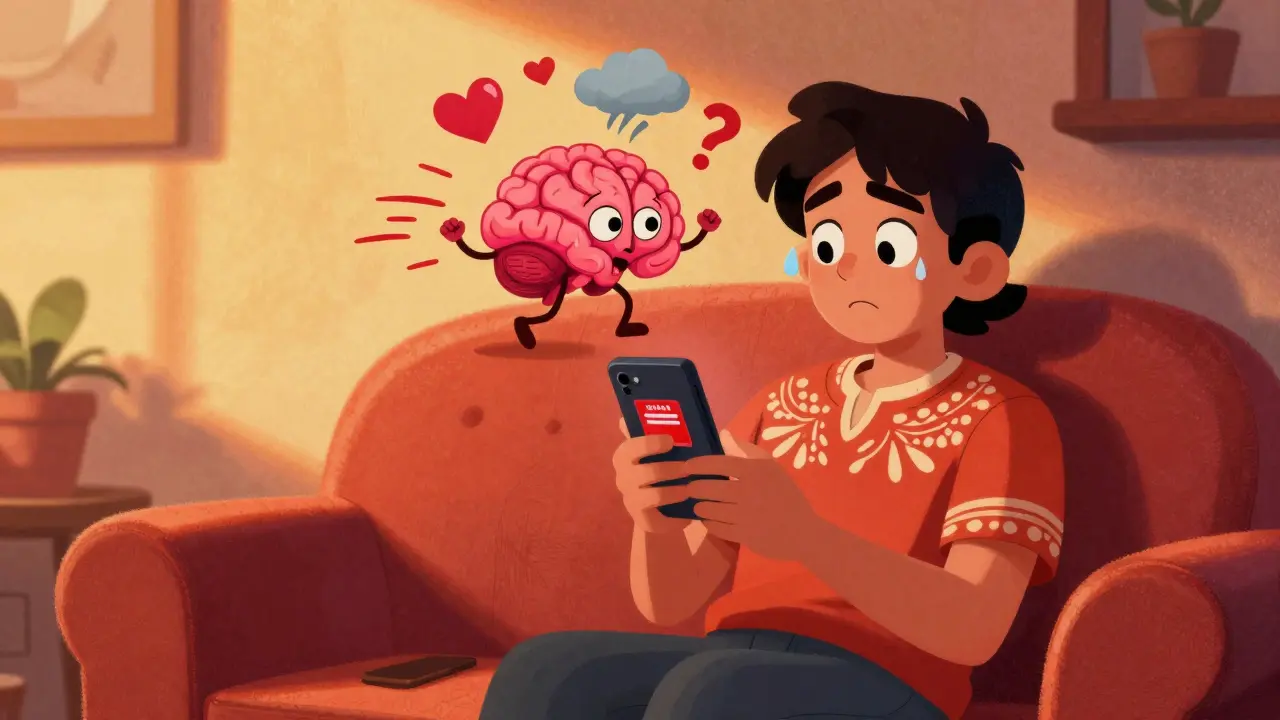
When you get a drug safety alert-whether it’s from your pharmacy, your doctor, or a government warning-your heart might jump. Your hands get cold. Your mind races: Is this dangerous? Should I stop taking it? What if something bad happens? That’s not weakness. It’s biology. Your brain is wired to treat sudden alerts like a tiger stepping into your living room. But most drug safety alerts aren’t tigers. They’re warnings. And panic turns a warning into a crisis.
Why Alerts Trigger Panic (And Why It’s Not Your Fault)
Your brain doesn’t wait for facts when an alert pops up. It goes straight to survival mode. The amygdala, your emotional alarm system, fires off signals that spike your heart rate to 110-130 beats per minute. Your breathing speeds up. Your thoughts narrow. You stop thinking about options. You just react.
Studies show that during these moments, your ability to weigh risks and benefits drops by up to 67%. You don’t forget what you know-you just can’t access it. That’s why people sometimes stop life-saving medications out of fear, or rush to the ER for a minor change in lab results. The alert didn’t cause the harm. The panic did.
Stop the Panic Before It Stops You
The goal isn’t to eliminate fear. It’s to stop fear from taking over. Here’s how to reset your nervous system in under 3 minutes.
- Use TIPP skills-a set of quick physical interventions backed by clinical research. First, splash cold water (10-15°C) on your face for 15-30 seconds. This triggers your body’s natural dive reflex, instantly slowing your heart rate. Second, do 30 seconds of jumping jacks or run in place. Movement burns off adrenaline. Third, breathe using the 4-7-8 technique: inhale for 4 seconds, hold for 7, exhale for 8. Repeat three times. Fourth, tense your fists for 5 seconds, then release. Do this for your arms, shoulders, and jaw. These steps don’t fix the alert-but they fix you.
- Try the 5-4-3-2-1 method. Look around and name: 5 things you can see, 4 things you can touch, 3 things you can hear, 2 things you can smell, 1 thing you can taste. This forces your brain out of panic mode and back into the present. A user on Reddit used this during a false fire alarm at their data center and went from full panic to calm action in under two minutes.
These aren’t tricks. They’re neurobiological resets. A 2022 study in the Journal of Anxiety Disorders found people using these techniques made decisions with 42% greater accuracy and 37% faster resolution times during simulated alerts.
Make the Decision, Don’t React to the Fear
Once your body calms down, it’s time to think. But don’t just ask, “What should I do?” Ask: “What do I know for sure?”
- Find the source. Is this alert from the FDA? The TGA? Your pharmacist? Official sources have context. Random social media posts don’t. Check the date. Is this new, or did it come out six months ago and you just missed it?
- Look for the risk level. Not all alerts are equal. Some say “monitor for symptoms.” Others say “discontinue immediately.” The language matters. If it’s vague, call your doctor or pharmacist. Don’t guess.
- Use the WISE MIND framework. Ask yourself: What does my emotional mind say? (Probably: “Stop now!”) What does my logical mind say? (Maybe: “The risk is low, and stopping could be worse.”) WISE MIND is the balance between them. It’s not about being calm. It’s about being clear.
One nurse in Perth told me she got an alert about a blood pressure med linked to rare kidney issues. Her emotional mind screamed, “Get off it!” Her logical mind remembered her patient had been stable for 18 months. She called her GP. They checked her kidney function-normal. They adjusted the dose. She stayed on the medication. No panic. No crisis.
Build Your Alert Response Kit
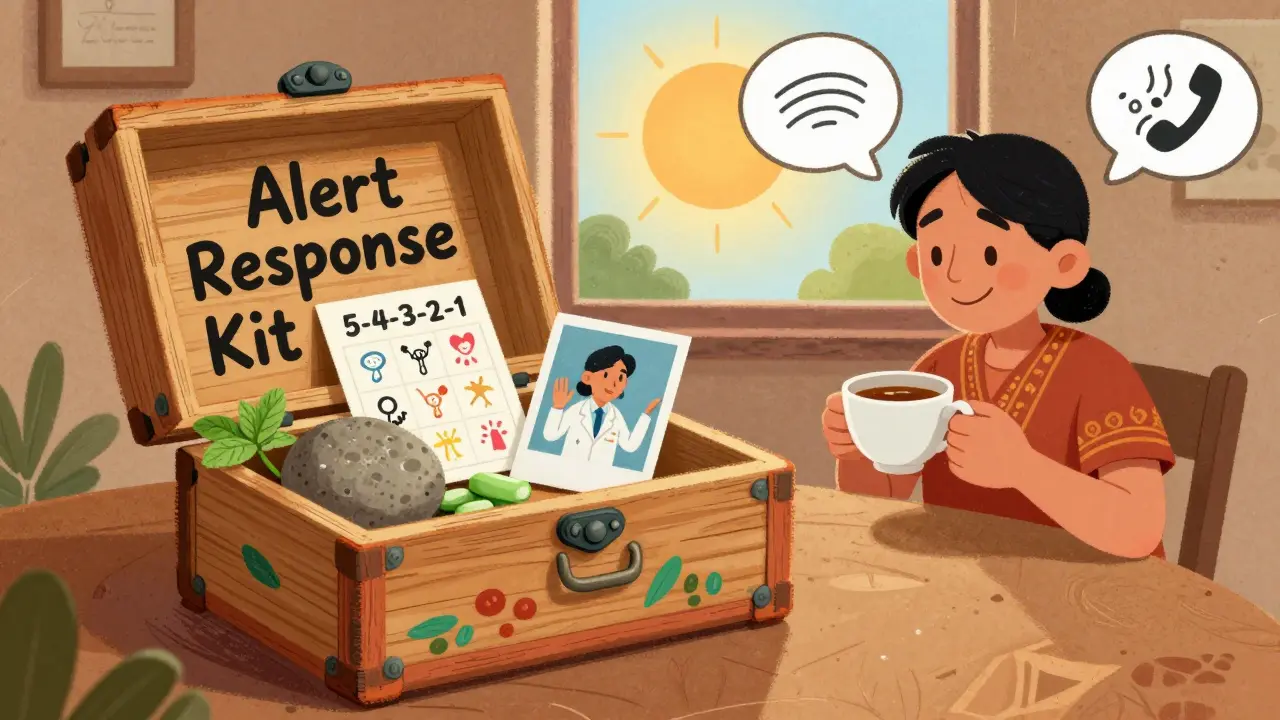
Just like you keep a first aid kit, build a mental one. Keep it simple:
- A small stone or textured keychain you can hold when you feel anxious.
- A printed 1-page reminder of the 5-4-3-2-1 technique and TIPP steps.
- A list of trusted contacts: your pharmacist, your doctor, a trusted friend who knows your meds.
- A small pack of mint gum or a scented hand cream-something you can smell or taste to ground yourself.
Keep this kit near your pill organizer or by your phone. When an alert hits, you won’t have to remember what to do-you’ll reach for it. Research from Abundance Therapy Center shows this cuts response time by 65% in emergencies.

Practice Before You Need It
Most people fail not because the techniques don’t work-but because they’ve never tried them until they’re in panic mode. That’s like trying to swim for the first time during a tsunami.
Set aside 10 minutes a day for 30 days. Sit quietly. Imagine you just got an alert. Feel your heart race. Then use the breathing or grounding techniques. Do this even if you’re not anxious. Your brain learns faster when you practice in calm states.
A 2023 study from Clearview Mental Health found that after 30 days of daily practice, people applied these techniques 83% faster during real alerts. Your brain builds habits like muscles. The more you use them, the more automatic they become.
Know When to Call for Help
Not every alert needs a panic. But some need a professional. If the alert says:
- “Stop taking this immediately,”
- “Risk of serious side effect,” or
- “New safety warning for patients with [your condition],”
then call your doctor or pharmacist after you’ve calmed down. Don’t wait. But don’t rush into action either. Write down your questions: “What’s the actual risk?” “Are there alternatives?” “Should I get tested?”
Most drug safety alerts are precautionary. Less than 5% lead to serious outcomes. But panic makes you feel like the odds are 100%.
It’s Not Just You
More than 67 alerts hit the average person every week-on phones, emails, apps. That’s up 214% since 2018. Health systems are drowning in notifications. And we’re expected to react perfectly every time.
That’s not fair. And it’s not sustainable. That’s why the European Union’s DORA law now requires companies to design alert systems with human psychology in mind. Starting in 2025, alerts must include calming prompts, clear risk levels, and simple next steps.
You’re not broken. You’re human. And you’re not alone.
Long-Term Changes That Help
While the immediate techniques work fast, long-term calm comes from habits:
- Sleep 7-9 hours a night. Poor sleep raises baseline anxiety by 30%.
- Limit caffeine to under 200mg a day (about two small coffees). More than that spikes stress hormones.
- Move for 150 minutes a week. Walking, dancing, gardening-it all lowers cortisol.
A 2022 trial at BHB Hospital found people who followed these three habits reduced their baseline anxiety by 41%. That means when an alert comes, your system isn’t already on edge. You start from a calmer place.
Journaling helps too. After an alert, write: What triggered me? What did I feel? What worked? What didn’t? Over time, you’ll see patterns. You’ll know your triggers. And you’ll feel more in control.
You Don’t Have to Be Perfect
Some days, you’ll panic anyway. That’s okay. What matters isn’t that you never panic-it’s that you learn how to come back. Every time you use a breathing technique, even if it’s half-hearted, you’re rewiring your brain. Every time you call your pharmacist instead of googling, you’re choosing clarity over fear.
Drug safety alerts are part of modern medicine. They’re meant to protect you. But they can’t protect you from yourself. That’s your job. And you’re already doing it better than you think.
What should I do first when I get a drug safety alert?
Pause. Don’t act immediately. Use a grounding technique like the 5-4-3-2-1 method or TIPP skills to calm your nervous system. Once your heart rate slows and your thoughts clear, find the official source of the alert-like the TGA or your pharmacist-and read the full context before making any changes.
Can I stop my medication right away if I’m scared?
No-not without talking to your doctor or pharmacist first. Many alerts are precautionary, and stopping suddenly can be more dangerous than the alert itself. For example, stopping blood thinners or antidepressants abruptly can cause serious withdrawal or rebound effects. Always consult a professional before making changes.
How do I know if an alert is real or just a scare tactic?
Check the source. Official alerts come from government agencies like the TGA (Australia), FDA (US), or EMA (Europe), or from your prescribing pharmacy. Avoid social media posts, blog articles, or unsolicited emails. Look for the date, the specific drug name, the risk level, and whether it’s a Class I, II, or III warning. If it’s unclear, call your pharmacist-they’re trained to interpret these.
Are these panic techniques backed by science?
Yes. Techniques like controlled breathing, TIPP skills, and the 5-4-3-2-1 method are rooted in Cognitive Behavioral Therapy (CBT) and Dialectical Behavior Therapy (DBT), both proven in over 47 clinical studies. Research from Stanford and the National Institute of Mental Health shows they reduce panic-induced decision errors by up to 59%. These aren’t just feel-good tips-they’re neurologically validated tools.
Why do I feel worse after an alert even if nothing changed?
Because your brain treats alerts like threats-even when they’re not. The stress response doesn’t care if the danger is real. It reacts to the signal. That’s why you might feel shaky, nauseous, or overwhelmed even if your medication is still safe. It’s not in your head-it’s in your biology. The goal isn’t to ignore the feeling, but to manage it so it doesn’t control your actions.
How long does it take to get better at handling alerts?
With daily practice of just 10-15 minutes for 30 days, most people notice a significant shift. Your brain learns to switch from panic mode to calm action faster. After that, even if you get startled, you’ll recover in under 90 seconds instead of 6+ minutes. It’s not about becoming fearless-it’s about becoming faster at returning to your center.
What Comes Next
If you’ve made it this far, you’re already ahead. You didn’t scroll past. You didn’t just skim. You’re learning how to protect yourself-not just from drugs, but from your own fear.
Next time an alert comes, pause. Breathe. Reach for your kit. Ask one clear question. Call one trusted person. That’s all it takes to turn panic into power.
Comments (14)
Steve Hesketh
Bro, I just got an alert about my blood pressure med last week and I nearly threw my pills out the window. Then I remembered this post and did the 5-4-3-2-1 thing-saw my cat judging me, felt my couch fabric, heard my neighbor’s dog bark, smelled burnt toast, and tasted my mint gum. Calm as a monk now. Thanks for the lifeline.
My whole family’s using this. Even my grandma-who thinks TikTok is a type of soup-is printing out the TIPP sheet and sticking it to the fridge.
Sangeeta Isaac
so like… i read this and was like ‘wait, this is literally my life’ and then i cried a little? not because i’m sad, but bc i finally feel seen. like, why do these alerts feel like a horror movie trailer but the movie is just… a pamphlet?
also i used the cold water trick while waiting in line at starbucks. barista asked if i was okay. i said ‘just reboots my brain.’ she nodded like it was normal. she’s my hero.
Philip Williams
While the psychological techniques described are empirically supported, I must emphasize that the foundational principle remains clinical governance. The integration of neurobiological interventions such as TIPP and 5-4-3-2-1 should not supplant professional medical consultation. Patient autonomy is critical, but must be exercised within the framework of evidence-based guidance. The cited studies, while compelling, require replication in longitudinal cohorts before widespread adoption is recommended.
Melanie Pearson
This is a textbook example of why America is falling apart. You’re telling people to breathe instead of acting? What if the drug is actually toxic? You’re enabling mass delusion with feel-good mindfulness. The FDA doesn’t issue alerts for fun. If your pill has a warning, you stop it. Period. No breathing exercises. No grounding. Just common sense. This post is dangerous.
Rod Wheatley
YES. YES. YES. I’ve been telling people this for years! The amygdala hijack is REAL-and most doctors don’t even know how to explain it to patients! I’m a nurse, and I hand out printed TIPP cards to every patient who gets an alert. One guy stopped his antidepressant because of a Reddit post… then came back in panic because he had withdrawal tremors. We did the 4-7-8 breathing in the waiting room-he cried. Then he thanked me. That’s why this matters.
Also-mint gum? Genius. I keep a pack in my purse. Smell it. Taste it. Grounds you faster than therapy.
Jerry Rodrigues
Good stuff. I’ve been using the cold water trick since last year. It works. Doesn’t fix the alert, but fixes me enough to call my pharmacist without shaking. No drama. No panic. Just… calm. I like that.
Uju Megafu
Oh my GOD. This is why I can’t trust anyone anymore. You’re all just… sitting around breathing while Big Pharma slips poison into your pills? Did you even read the fine print? The FDA is corrupt. The TGA is a puppet. Your ‘trusted pharmacist’? Probably on commission. You think this is about health? It’s about control. You’re being programmed to obey. Wake up.
I stopped all my meds. I’m on turmeric and vibes now. You’re welcome.
Jarrod Flesch
Just tried the 5-4-3-2-1 thing after my statin alert. Saw my dog’s nose, felt my socks, heard the AC, smelled my coffee, tasted the last bite of toast. Calm. Like, actually calm.
Also-this post made me hug my pharmacist. She cried. We both cried. 🤗
PS: I bought a textured stone. It’s now my new best friend.
Barbara Mahone
While the emotional regulation strategies presented are consistent with established cognitive behavioral principles, I would suggest that the framing of ‘panic’ as a biological inevitability risks pathologizing normal human responses to perceived risk. The emphasis on individual coping mechanisms, while helpful, may inadvertently deflect systemic responsibility from healthcare institutions that generate excessive, poorly contextualized alerts. A more robust solution requires structural reform, not just personal resilience.
Stephen Rock
So you're telling me the solution to pharmaceutical anxiety is to chew gum and stare at walls? How quaint. I've read the original study. The sample size was 42 people. Most were undergrads. The journal? Not even indexed. This isn't science. It's self-help fanfiction dressed up as medicine. I'd rather trust my gut than some Reddit guru with a keychain.
Roisin Kelly
What if the alert is real? What if they’re lying? What if the drug causes cancer and you’re just breathing through it? I’ve seen people die from ‘minor’ alerts. You’re not calming down-you’re being manipulated. They want you to stay on the pills. The system wants you docile. Don’t be fooled. This is a trap.
lokesh prasanth
Neurobiology is just a distraction. Reality is suffering. You cannot breathe your way out of karma. The alert is a mirror. Your fear is your truth. Stop seeking tools. Start seeking silence.
Glenda Marínez Granados
So… you’re telling me the cure for modern anxiety is… a stone and a gum wrapper? 😏
At least it’s cheaper than therapy. And I’m not mad about it. I’m just… weirdly impressed.
Also, I’m printing this on a scroll and hanging it above my bed. My cat will judge me. I’ll let her.
Yuri Hyuga
Brilliant. This is the kind of content that transforms passive patients into empowered individuals. The TIPP method is a masterpiece of applied physiology. I’ve shared this with my entire clinic. One patient, 72, said, ‘I didn’t know I could feel safe inside my own skin again.’ That’s not just a technique-that’s a revolution. 🙌
Let’s make this mandatory in every pharmacy. Not just a post. A movement.