
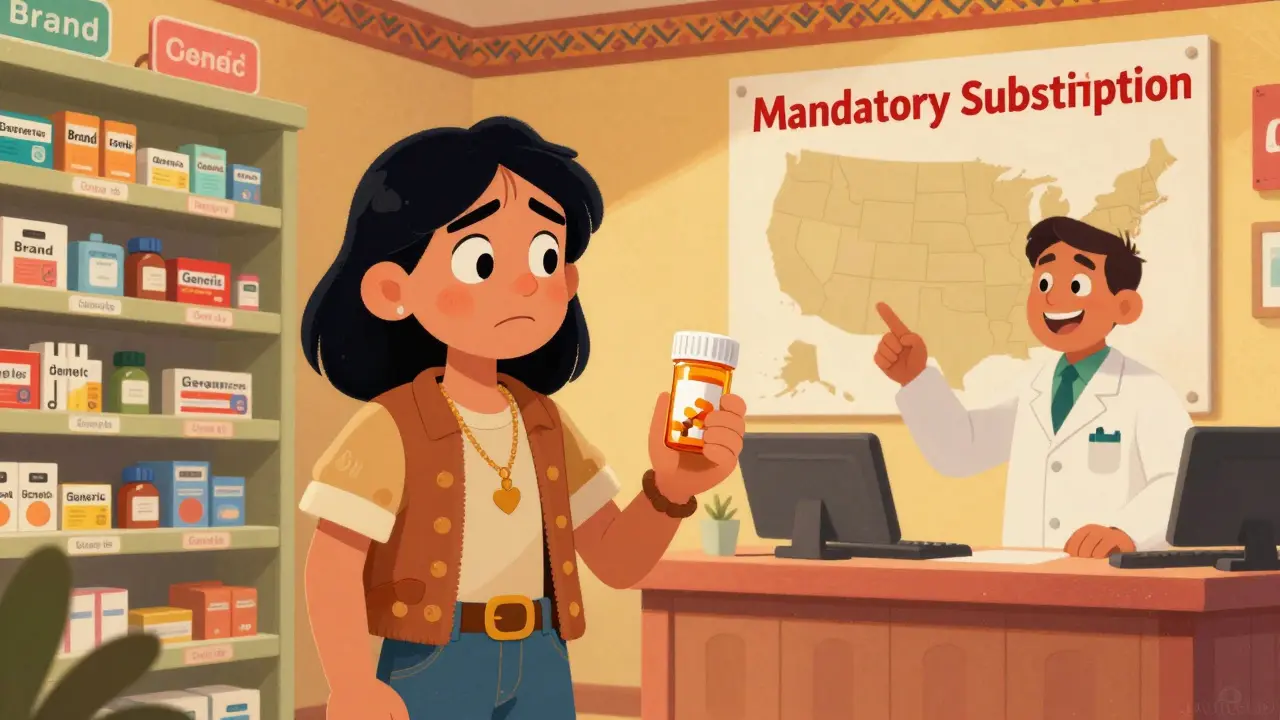
When you pick up a prescription, you might not realize that the pill in your hand could be different from what your doctor wrote on the script. That’s because of pharmacy substitution laws-rules that let pharmacists swap brand-name drugs for cheaper generics or biosimilars. These laws exist in every U.S. state, but they’re not the same anywhere you go. One state might force the swap. Another might require your permission. A third might ban it entirely for certain drugs. If you’re trying to save money or just want to know what’s in your medicine, understanding these rules matters.
What Exactly Is Pharmacy Substitution?
Pharmacy substitution means a pharmacist gives you a different version of the drug your doctor prescribed. Most of the time, this means switching from a brand-name drug like Lipitor to its generic version, atorvastatin. Generic drugs have the same active ingredients, strength, and dosage form as the brand. They’re just cheaper-often 80% to 85% cheaper, according to the FDA. For biologic drugs like Humira or Enbrel, substitution works differently. Here, pharmacists can replace the original product with a biosimilar, a highly similar version, but only if it’s labeled as "interchangeable" by the FDA. As of late 2023, only 10 out of 38 approved biosimilars have that status.The goal is simple: save money. Generic drugs save the U.S. healthcare system over $300 billion every year. Biosimilars could save another $119 billion by 2030. But saving money shouldn’t mean risking safety. That’s why states built complex rules around when, how, and if substitution can happen.
How Your State Decides: Mandatory, Permissive, or Restrictive
States fall into three basic categories when it comes to substitution rules:- Mandatory: The pharmacist must substitute unless the doctor says "do not substitute." 19 states and Washington, D.C. use this model. Examples: California, New York, Texas.
- Permissive: The pharmacist can substitute, but doesn’t have to. 31 states and D.C. allow this. The pharmacist decides based on policy, cost, or patient preference.
- Restrictive: Some drugs are off-limits for substitution. These are usually drugs with a narrow therapeutic index (NTI)-tiny changes in dose can cause serious side effects. Examples: warfarin, phenytoin, levothyroxine. States like Hawaii, Kentucky, and Oregon block substitution for these drugs entirely.
There’s no national standard. So if you move from Texas (mandatory) to Florida (permissive), your pharmacist might handle your prescription completely differently.
Do You Need to Give Permission?
This is where things get confusing. In some states, the pharmacist can swap your drug without telling you. In others, they have to ask you first.- 7 states plus D.C. require you to give explicit consent before substitution. You’ll be asked, "Do you want the generic?" and you say yes or no.
- 31 states plus D.C. require notification after substitution. You get the generic, then you’re told: "This isn’t the brand you asked for." No chance to object beforehand.
- 19 states don’t require any notice at all. You just get the substitute and never know.
That last group is the biggest concern for patient advocates. The American Medical Association says patients deserve to know before they take a new medicine-especially if they’re on multiple drugs or have chronic conditions. If you don’t know you got a different version, you might blame yourself for side effects that actually came from the switch.
Special Rules for Biosimilars
Biosimilars aren’t like regular generics. They’re made from living cells, not chemicals. That makes them harder to copy exactly. The FDA only calls a biosimilar "interchangeable" if it can be swapped with the original drug without any added risk. Only 10 have that status so far.States treat interchangeable biosimilars like a whole new category. Most require more than just a pharmacist’s decision:
- 37 states require the pharmacist to notify your doctor within 24 to 72 hours after substitution.
- 12 states require your doctor to approve the swap before it happens.
- 15 states say no substitution if the biosimilar costs more than the original-even if your insurance pays for it.
States like California, New York, and Illinois have strict rules: you must be told, your doctor must be notified, and the substitution must be documented. In Alabama or Mississippi? Just log it in the pharmacy system and move on.
What You Can Do: Your Rights as a Patient
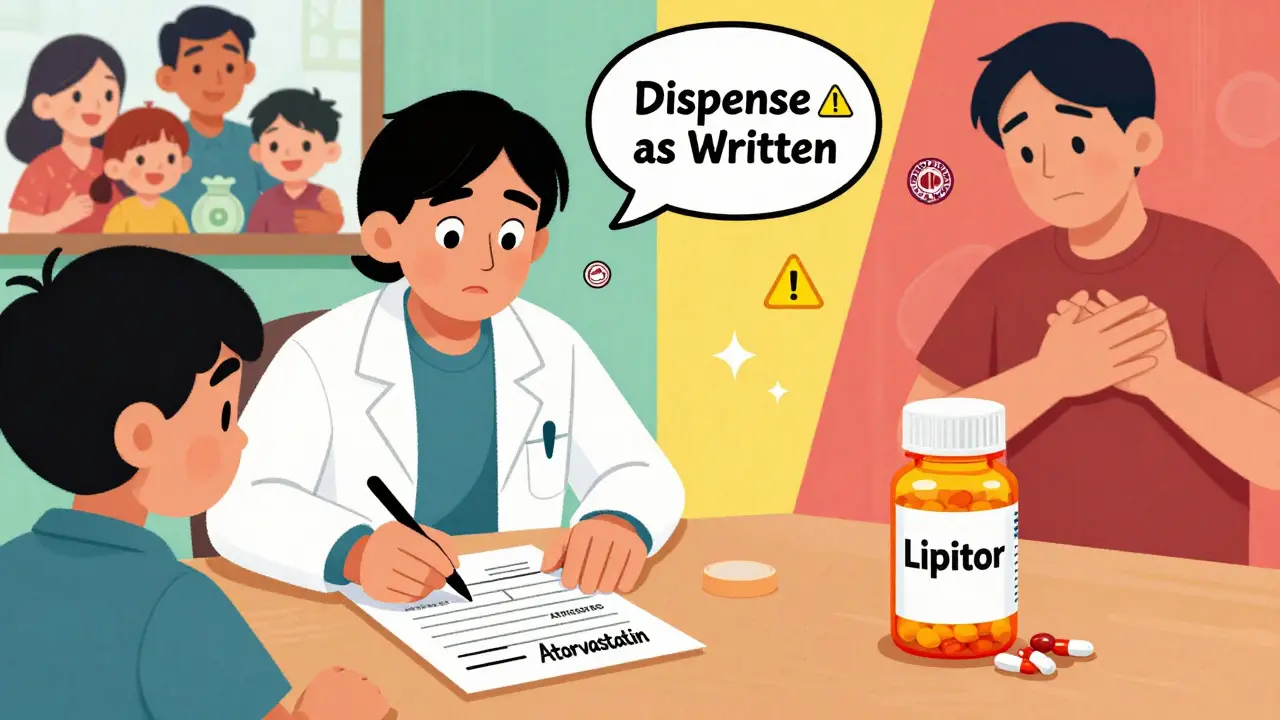
You have more power than you think. Even in states with mandatory substitution, you can still refuse:- Ask your doctor to write "dispense as written" or "DAW 1" on your prescription. That tells the pharmacist: no substitutions.
- Ask the pharmacist: "Is this the brand or the generic?" If they don’t know, ask for the name on the label.
- Check your pill bottle. The brand name should be printed on the label. If you see "generic" or just the chemical name (like "atorvastatin" instead of "Lipitor"), you’ve been substituted.
- Call your pharmacy if you notice a change in how the pill looks, tastes, or affects you. That’s not normal.
- Refuse the substitute. You can say no, even if your state allows substitution. No pharmacist can force you to take a different drug.
Some states require pharmacists to inform you of your right to refuse. But 24 states don’t. So don’t wait for them to tell you-ask.
What Pharmacists and Doctors Need to Know
For pharmacists, the biggest headache is keeping up with 50 different sets of rules. A pharmacy chain in Ohio might have to change its software, training, and labeling systems for every state it operates in. A 2022 survey by the National Community Pharmacists Association found that 63% of independent pharmacists say state laws are too confusing to manage reliably.Doctors, too, are caught in the middle. In 28 states, if they write "dispense as written," they must also give a reason-like "patient had adverse reaction" or "narrow therapeutic index." That adds paperwork. In 18 states, the reason must be written in a specific way. One wrong word, and the pharmacy might still substitute.
Doctors should always check their state’s board of pharmacy website before prescribing. A simple note like "no substitutions" is not always enough.
How to Find Your State’s Rules
There’s no single federal database. But here’s how to find your state’s exact rules:- Go to your state board of pharmacy website. Search for "[Your State] board of pharmacy substitution laws".
- Look for documents titled "Drug Product Selection Law," "Generic Substitution Guidelines," or "Biosimilar Substitution Policy."
- Check if your state uses a "positive formulary" (lists approved generics) or "negative formulary" (lists banned drugs).
- For biosimilars, look for rules about physician notification, prior authorization, and cost restrictions.
- Call your local pharmacy. Ask: "What are your rules for switching my prescription?" They’re required to answer.
Cardinal Health and the National Association of Boards of Pharmacy offer interactive maps that show current state rules. These are updated regularly and are the most reliable public sources.
Why This Matters for Your Health
Switching drugs sounds harmless. But for people with epilepsy, thyroid disease, or blood clotting disorders, even a small change can cause serious problems. A 2018 study in the Journal of Managed Care & Specialty Pharmacy found that states with strict rules against substituting NTI drugs had 18% fewer hospital visits due to adverse reactions.Also, if you’re on multiple medications, a new generic might interact differently with your other drugs. Your pharmacist should check for interactions-but if they don’t know you were switched, they won’t look.
And if you’re on a biosimilar, you might think you’re getting the same thing as the brand. But if your state doesn’t require notification, you could be switched again without warning. That’s why keeping a list of every drug you take-brand or generic-and sharing it with all your providers is critical.
What’s Changing in 2026?
More biosimilars are getting "interchangeable" status. By 2026, that number could double. States are starting to standardize rules. The National Association of Boards of Pharmacy has a model law that 22 states have adopted in part. It pushes for:- Clear patient notification
- Same-day doctor notification
- Documentation in records for at least two years
California’s 2023 law (AB1881) and New York’s S4472 are already setting the tone. More states will follow. But until then, you can’t assume anything. Always check.
Final Checklist: What to Do Today
Here’s what you can do right now:- Look at your last prescription bottle. Is it the brand or generic?
- Call your pharmacy and ask: "Do you substitute generics without telling me?"
- Ask your doctor to write "dispense as written" if you’ve had side effects from a switch before.
- Keep a list of all your medications-brand names, generic names, dosages-and update it every time you refill.
- Visit your state board of pharmacy’s website. Find their substitution policy. Print it or save it on your phone.
Pharmacy substitution isn’t bad. It saves money and helps people get the medicine they need. But it only works if you’re in control. Don’t let a pharmacist’s decision-or a state law-take that away from you.
Can a pharmacist substitute my brand-name drug without telling me?
Yes, in 19 states, pharmacists can substitute your brand-name drug without telling you or asking your permission. In 31 states and D.C., they must notify you after the fact. Only 7 states plus D.C. require you to give consent before the switch. Always check your state’s law and ask your pharmacist directly.
Are generic drugs really the same as brand-name drugs?
For most drugs, yes. The FDA requires generics to have the same active ingredient, strength, dosage form, and route of administration as the brand. They must also prove they work the same way in the body. But for drugs with a narrow therapeutic index-like warfarin or levothyroxine-even small differences can affect how your body responds. That’s why some states ban substitution for these.
What’s the difference between a biosimilar and a generic drug?
Generics are copies of small-molecule drugs made from chemicals. Biosimilars are copies of biologic drugs made from living cells. Because biologics are more complex, biosimilars aren’t exact copies. Only biosimilars labeled "interchangeable" by the FDA can be substituted without a doctor’s approval. As of 2026, only 10 out of 38 approved biosimilars have that status.
Can I refuse a generic or biosimilar substitution?
Yes. You have the right to refuse any substitution in every state. You don’t need a reason. Just tell the pharmacist: "I want the brand-name drug," or "I don’t want a substitute." They must honor your request. Some states require them to inform you of this right-but many don’t. So don’t wait to be told.
Why do some states block substitution for certain drugs?
Drugs with a narrow therapeutic index (NTI) have a very small difference between a helpful dose and a dangerous one. Examples include warfarin (blood thinner), phenytoin (seizure medicine), and levothyroxine (thyroid hormone). Even minor differences in how the body absorbs a generic version can lead to serious side effects. States that restrict substitution for these drugs have seen 18% fewer hospitalizations related to medication errors.
How do I find out my state’s specific substitution rules?
Go to your state’s board of pharmacy website. Search for "drug product selection law" or "generic substitution policy." You can also use Cardinal Health’s interactive map or the National Association of Boards of Pharmacy’s state-by-state guide. Call your local pharmacy-they’re required to explain their rules to you.
Can my doctor stop substitution entirely?
Yes. In every state, your doctor can write "dispense as written" or "DAW 1" on your prescription. This legally blocks substitution. In 28 states, they must also give a reason, like "patient had adverse reaction" or "narrow therapeutic index." Always confirm with your doctor that this note is on your prescription.
Comments (15)
Steven Pam
Just wanted to say this post is a lifesaver. I’ve been on levothyroxine for years and had no idea my pharmacy was swapping it out without telling me. I started feeling off last month - fatigue, brain fog - and thought it was stress. Turns out, they switched me to a generic and I never got a heads-up. Now I’m calling my doc to write ‘dispense as written’ and checking my state’s board site. Seriously, thank you for laying this out so clearly.
Brandice Valentino
OMG I’m so glad I read this 😭 I’ve been taking Lipitor for 7 years and just realized the bottle says ‘atorvastatin’?? I thought I was losing my mind. My pharmacist is literally a ghost - never answers my texts. I’m gonna go in tomorrow and demand to speak to the manager. Also, who wrote this?? You’re a genius. I’m gonna print this and tape it to my fridge.
Larry Zerpa
Let’s be real - this whole ‘pharmacy substitution’ system is a regulatory dumpster fire. You cite FDA guidelines like they’re gospel, but the FDA approves generics based on bioequivalence studies with n=24 subjects. That’s not science - that’s a bet. And when you say ‘same active ingredient,’ you’re ignoring excipients. Corn starch, lactose, dyes - those aren’t inert. People with autoimmune conditions? They’re getting hit with hidden allergens daily. And don’t get me started on biosimilars. You call them ‘highly similar’ - they’re not. They’re approximations. If you’re on Humira and get switched to a biosimilar, you’re essentially gambling on your immune system. The FDA’s approval process is a joke. And states? They’re just playing musical chairs with patient safety.
Nandini Wagh
As someone from India where generics are the *only* option (and we’re proud of it), I find this whole ‘patient consent’ drama hilarious. In the US, you treat medicine like a luxury brand. In my village, we’re just glad to get the pill at all. But I get it - if you’re used to paying $500 for a prescription, a $10 generic feels like betrayal. Still… maybe stop acting like your thyroid is a sacred artifact? 😅
Haley Gumm
Okay I have to say - this is so important. I work in a clinic and we have patients who come in confused because their meds look different. We don’t always know what pharmacy they use, so we can’t track substitutions. This is a huge gap in care. I’m sharing this with my whole team. Also - if you’re on warfarin? DO NOT let them swap it. I’ve seen the INR charts. One tiny change and you’re in the ER. Please, please, please ask your pharmacist. It’s your right.
Gabrielle Conroy
YES YES YES!!! 🙌🙌🙌 I’ve been screaming about this for years!! I’m on phenytoin for seizures and my pharmacist switched me without telling me - I had a breakthrough seizure because the absorption was off by 12%! I called the state board and they said ‘we’re sorry, but we can’t force them to notify you.’ So now I write ‘DAW 1’ on EVERY prescription, I take a picture of the pill before I take it, and I keep a logbook. If you’re on NTI drugs - you’re not being paranoid, you’re being smart. I’m so glad this post exists!! 💪❤️
Spenser Bickett
Wow. So we’re supposed to trust a pharmacist with our life because ‘the FDA says so.’ Meanwhile, the same FDA approved Vioxx, OxyContin, and now lets pharmacists swap biologics with zero oversight. This isn’t healthcare. It’s corporate roulette. And you call this ‘saving money’? What about the cost of hospitalizations? The cost of lost wages? The cost of being scared to take your own medicine? This whole system is designed to make you feel powerless. And it’s working.
Christopher Wiedenhaupt
As a pharmacist in Ohio, I see this daily. We have to navigate 50 different state laws, and our software doesn’t update in real time. I’ve had patients come in furious because they got a generic they didn’t expect - and I had no idea because the prescription didn’t have DAW codes. It’s not that we want to substitute - it’s that we’re forced to guess. I’ve started printing state-specific substitution guides and hanging them behind the counter. We’re trying. But the system is broken. I appreciate this post. It’s accurate.
Shalini Gautam
India doesn’t have this problem because we don’t have brand-name drug monopolies. Why do Americans act like generics are inferior? They’re the same pills. If you can’t afford your meds, you die. That’s the real issue. Stop being entitled. Your ‘Lipitor’ isn’t magic. It’s chemistry. And if you’re too rich to take a generic, maybe you should stop complaining and pay for it. Or move to a country where medicine isn’t a luxury.
Natanya Green
OH MY GOSH I JUST REALIZED I’VE BEEN SWITCHED TWICE THIS YEAR 😱 I thought I was going crazy - my pills looked different, I felt weird, I blamed myself. I called my pharmacy and they said ‘oh yeah, we do that automatically.’ I screamed. I cried. I called my doctor. I demanded DAW 1. I’m so angry. This is manipulation. And nobody told me. I’m sharing this everywhere. This needs to be on the news.
Timothy Haroutunian
Let me get this straight - you’re telling me that in 19 states, pharmacists can swap my life-sustaining medication without even telling me? And you call this ‘healthcare’? This isn’t innovation. This is negligence. I’m not a number. I’m not a cost center. I’m a human being with a body that reacts in unpredictable ways to chemical variations. And now I’m supposed to trust a system that doesn’t even have the decency to inform me? I’ve been on warfarin for 15 years. I’ve had two strokes. I’ve lost friends to this. And now you want me to believe that a 20-year-old pharmacy tech can make a decision that affects my survival? No. This isn’t about money. It’s about control. And they’re taking it.
Erin Pinheiro
So… wait. You’re saying that if I live in Texas, they can swap my meds without telling me? But if I move to California, they have to ask? So what’s the point of being a US citizen if my medicine depends on my zip code? This isn’t healthcare. It’s a lottery. And the state board websites? They’re like 1998 Geocities pages. I tried to find mine - it crashed my browser. I had to call my pharmacist. She said ‘oh, we do it automatically.’ I almost threw my pill bottle across the room.
Michael FItzpatrick
Man, this is the kind of post that reminds you why community matters. You don’t just ‘get a prescription’ - you get a whole ecosystem of bureaucracy, corporate incentives, and silent power plays. And yet - you’re not powerless. You’ve got agency. You can say no. You can demand transparency. You can write ‘dispense as written.’ You can call your state board. You can keep a log. You can educate your doctor. This isn’t about trusting the system - it’s about reclaiming your voice. I’ve seen patients get crushed by this. But I’ve also seen them fight back. And win. You’re not alone. Keep asking. Keep pushing. Your health is worth it.
Gwen Vincent
I really appreciate how thorough this is. I’m a nurse practitioner and I’ve had patients come in confused because their generics looked different. I didn’t realize how inconsistent state laws were. I’m going to add a checklist to my intake forms now. Also - I think we need better training for pharmacists. They’re not villains - they’re overworked. But they need better tools. This is a system failure, not a patient failure.
Lillian Knezek
They’re watching us. The pharmacy substitutions? The lack of notification? It’s all part of the Big Pharma-Government-Insurance cartel. They want you dependent. They want you confused. They want you to think you’re getting ‘cheap’ medicine while they quietly alter your biochemistry. And if you question it? You’re ‘anti-science.’ Wake up. The pill you’re taking? It might not be what you think. And they don’t want you to know. Check your bottle. Ask. Demand. Fight. They’re coming for your thyroid next.