
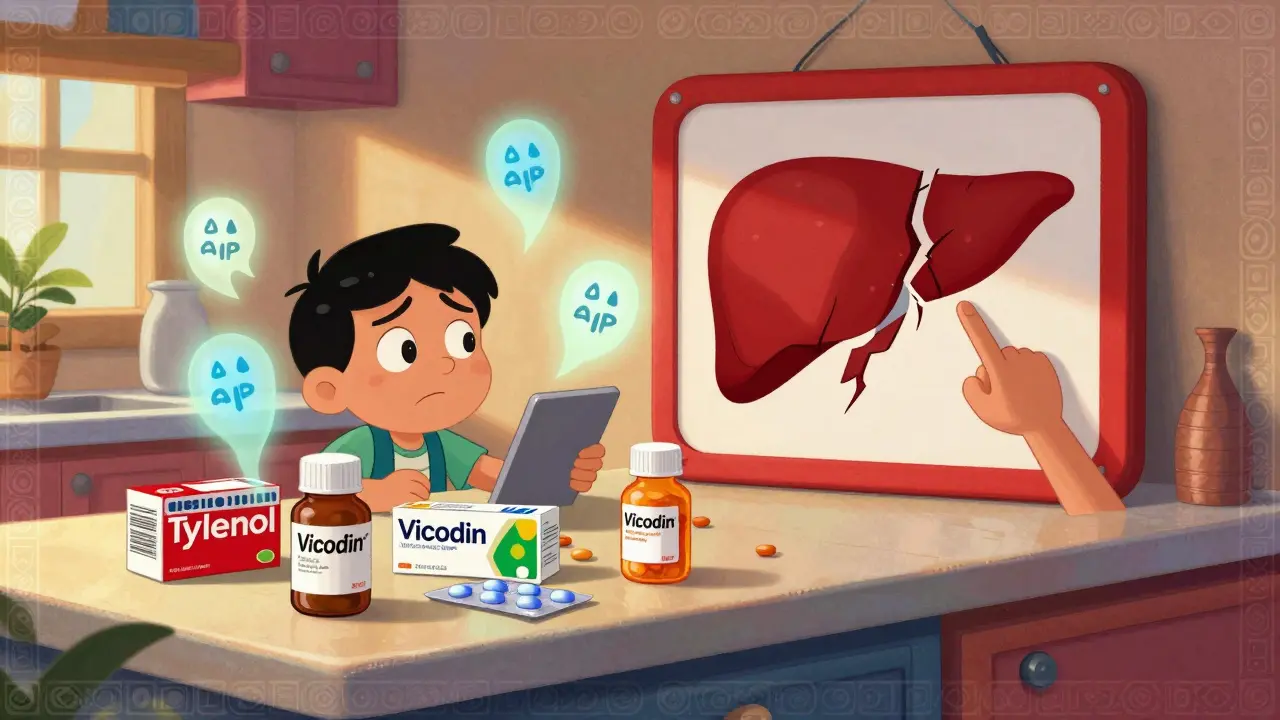
Every year, thousands of people end up in the hospital with severe liver damage-not from alcohol, not from viruses, but from something many think is completely safe: acetaminophen. The problem isn’t just taking too much at once. It’s taking small amounts of it over and over, across multiple medications, without realizing it’s all the same drug.
Why Combination Products Are Dangerous
Acetaminophen is in more than 600 medications. It’s in Tylenol, yes, but also in Vicodin, Percocet, Darvocet, and dozens of cold and flu remedies. When it’s mixed with opioids like hydrocodone or oxycodone, it helps boost pain relief. But that’s also where the danger hides. Most people don’t know that each pill or capsule contains acetaminophen. They take one for back pain, another for a headache, and maybe a cold medicine at night. All three have acetaminophen. Before they know it, they’ve hit 5,000, 6,000, even 8,000 milligrams in a single day. The safe limit? 4,000 mg for most adults. That’s just eight regular-strength Tylenol pills. Easy to hit by accident. The FDA stepped in back in 2014, requiring all prescription combination products to contain no more than 325 mg of acetaminophen per dose. That cut the risk-but didn’t eliminate it. A 2019 study in Hepatology found that nearly 3 out of 10 acetaminophen-related liver injuries still came from these combo drugs. And 7 out of 10 of those cases were unintentional. People weren’t trying to hurt themselves. They just didn’t know what they were taking.How Your Liver Breaks Down Acetaminophen
Your liver normally handles acetaminophen safely by turning it into harmless waste products through two main pathways: glucuronidation and sulfation. But when you take too much, those pathways get overwhelmed. That’s when a toxic byproduct called NAPQI builds up. NAPQI is nasty. It attacks liver cells, steals antioxidants like glutathione, and starts damaging mitochondria-the energy factories inside your cells. Once glutathione drops below 30% of normal levels, the damage becomes unstoppable. That’s when liver cells start dying, enzymes spike, and acute liver failure can follow. This isn’t magic. It’s chemistry. And it happens faster than you think. One study showed that people who took 7,000 mg of acetaminophen over 24 hours had measurable liver injury within 12 hours. No vomiting. No dizziness. Just silent, creeping damage.Who’s at Highest Risk?
Not everyone reacts the same way. Some people can take 4,000 mg without issue. Others get hurt at 2,500 mg. Why? People with alcohol use disorder are at higher risk. Alcohol lowers glutathione levels before they even take a pill. Malnourished people, older adults, and those with chronic liver disease also have less protective antioxidant capacity. Even short-term fasting can make your liver more vulnerable. For these groups, the safe dose isn’t 4,000 mg-it’s 2,000 to 3,000 mg. That’s not a suggestion. It’s a medical reality. Yet most patients never hear this from their doctors. A 2020 study found that Spanish-speaking patients were 2.3 times more likely to accidentally overdose. Language barriers, low health literacy, and lack of clear instructions all play a role. Even well-educated people get tripped up. A Consumer Reports survey found that only 28% of respondents knew the maximum daily dose of acetaminophen. That’s not ignorance-it’s a system failure.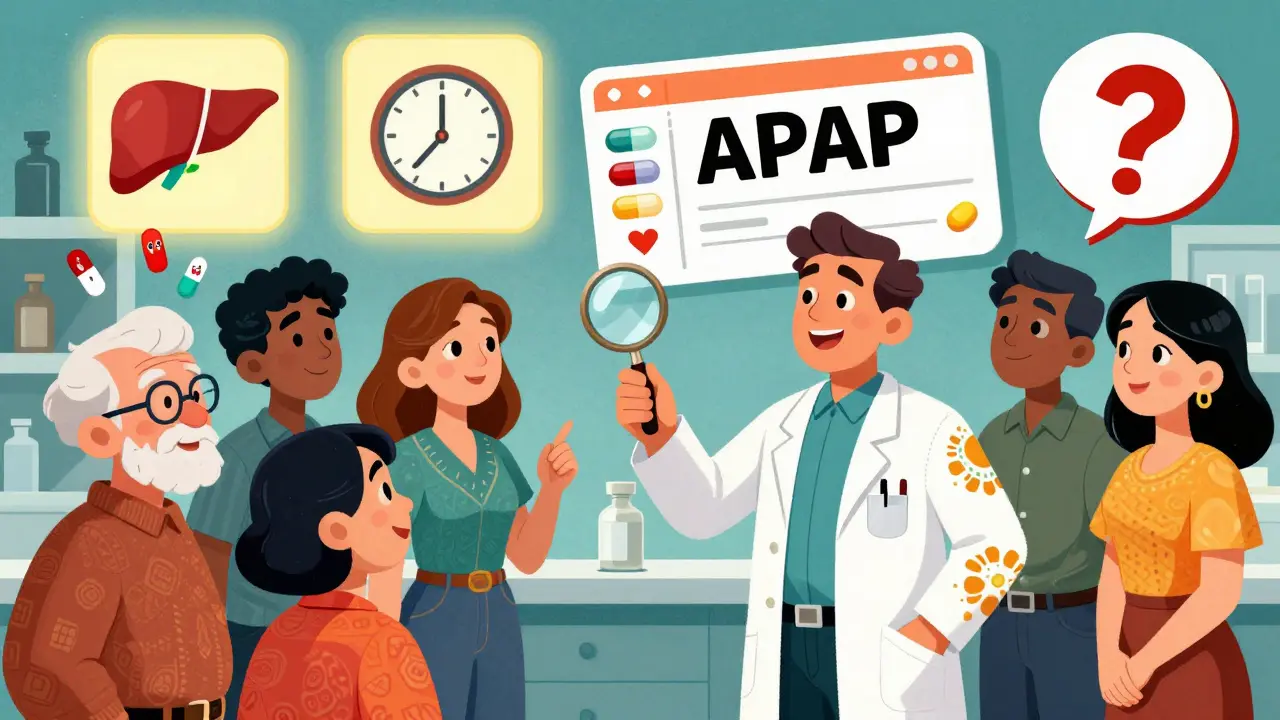
What Works: Real Prevention Strategies
The good news? We know what reduces these injuries. And it’s not just about telling people to “read the label.” 1. Know what’s in every pill you take. If you’re prescribed a painkiller like oxycodone/acetaminophen, write down the acetaminophen amount. Then check every other medication you’re taking-cold medicine, sleep aids, migraine pills-for acetaminophen. Look for “APAP” on the label-that’s acetaminophen’s chemical code. 2. Use only one acetaminophen product at a time. Never combine Tylenol with a prescription painkiller that already has it. If you need extra pain relief, use ibuprofen or naproxen instead. They don’t harm your liver the same way. 3. Ask your pharmacist to review all your meds. A 2021 study showed pharmacist-led counseling cut unintentional overdoses by 41%. Pharmacists see your full history. They can spot overlaps you miss. Ask them: “Does anything I’m taking have acetaminophen?” 4. Use the FDA’s multilingual medication guides. If you don’t speak English well, ask for the guide in your language. They’re available in 14 languages and explain dosage limits in plain terms. 5. Track your daily intake. Some pharmacies now offer dose-tracking apps. Others have QR codes on packaging that link to dosage calculators. The Acetaminophen Hepatotoxicity Prevention Consortium released a beta app in early 2023 that scans barcodes and sums up your total daily acetaminophen. It’s 89% accurate across 150 products.What Happens If You Overdose?
If you suspect you’ve taken too much-whether you meant to or not-don’t wait. Don’t hope it’ll pass. Call 911 or go to the ER immediately. The antidote is N-acetylcysteine (NAC). It works by restoring glutathione and protecting mitochondria. But timing matters. If you get NAC within 8 hours, your chances of avoiding liver damage jump dramatically. Even at 16 hours, it still helps. After 24 hours, the benefit drops sharply. Doctors use the Rumack-Matthew nomogram to decide if you need NAC. It’s a chart that plots your blood acetaminophen level against the time since ingestion. If you’re above the line, you get NAC. No debate. A new option arrived in 2021: fomepizole. It blocks the enzyme (CYP2E1) that turns acetaminophen into NAPQI. It’s not a replacement for NAC-but when used together, especially after 12 hours, it cuts severe liver injury by 32%. This is still emerging, but it’s now in major trauma centers.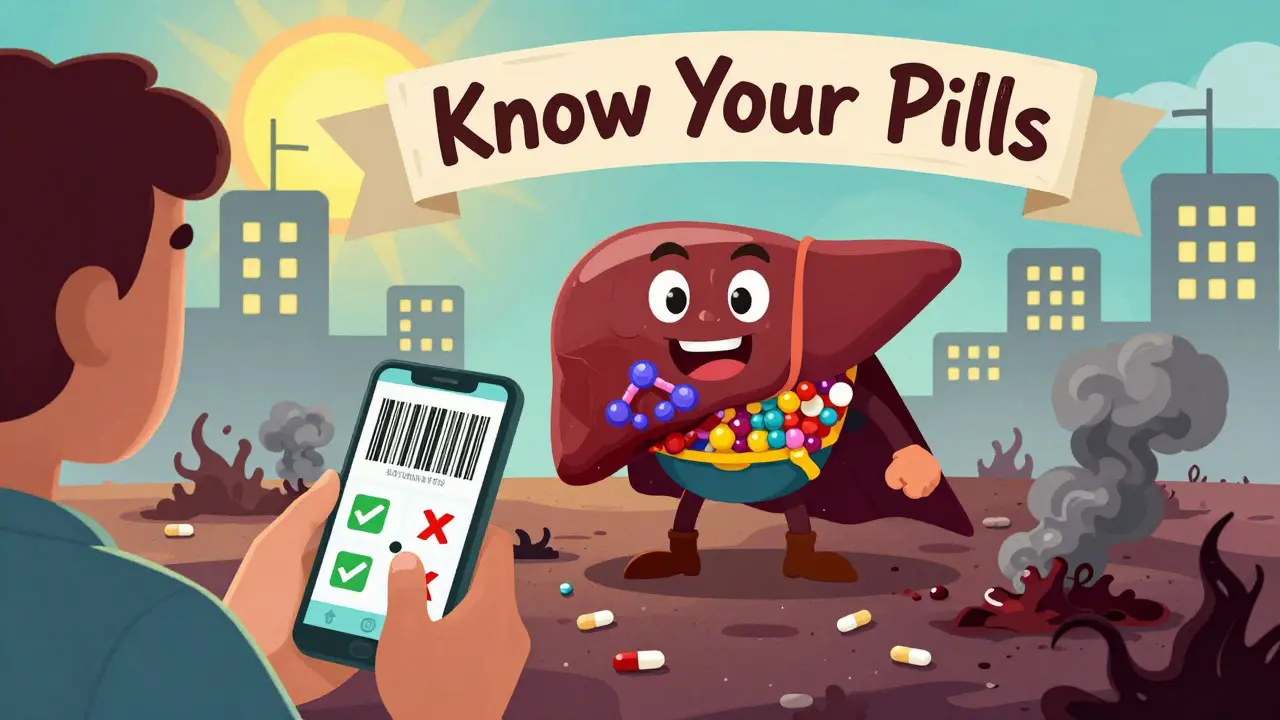
What’s Changing on the Horizon
The market is shifting. Prescriptions for opioid/acetaminophen combos have dropped 43% since 2010. That’s partly because of the opioid crisis-but also because doctors are learning to avoid mixing them. New OTC packaging is helping. Child-resistant caps, red bold warnings, and printed daily limits are now on 65% of bottles. One Amazon review from March 2023 said: “The new box had the acetaminophen warning in red bold letters. I checked all my other meds. I avoided an overdose.” Simple. Powerful. The FDA is now considering lowering the maximum OTC dose per pill from 1,000 mg to 650 mg. That would make it harder to accidentally hit 4,000 mg in a day. And a new extended-release NAC tablet, approved in February 2023, keeps therapeutic levels in your blood for 12 hours instead of 4-cutting the risk of missed doses during treatment. Researchers are even testing natural compounds like emodin (from rhubarb) that activate the body’s own antioxidant systems. In mice, it reduced liver injury by 57%. Human trials are coming.What Doesn’t Work
Adding protective agents directly into the pills-like antioxidants-isn’t the answer. Dr. Neil Kaplowitz warned in 2022 that it creates a false sense of safety. If people think the pill protects them, they might take more. Education still beats chemistry. And don’t rely on “natural” liver cleanses or milk thistle. They don’t stop NAPQI. They don’t replace glutathione. They’re distractions.Final Checklist: 5 Actions to Stay Safe
- Write down every medication you take, including OTCs and supplements.
- Look for “acetaminophen,” “APAP,” or “paracetamol” on every label.
- Never take more than one product containing acetaminophen at the same time.
- If you drink alcohol daily, limit acetaminophen to 2,000 mg per day-or avoid it entirely.
- When in doubt, ask your pharmacist or doctor: “Is this safe with my other meds?”
Acetaminophen isn’t dangerous because it’s toxic. It’s dangerous because it’s invisible. You don’t feel it building up. No warning signs until it’s too late. But you can control it. You just have to know what to look for.
Can I take acetaminophen if I drink alcohol?
If you drink alcohol regularly-even just a few drinks a week-you’re at higher risk for liver damage from acetaminophen. Alcohol lowers your liver’s natural defenses. The safest choice is to avoid acetaminophen entirely. If you must take it, do not exceed 2,000 mg per day and never take it while drinking.
How do I know if a cold medicine has acetaminophen?
Check the “Active Ingredients” section on the Drug Facts label. Look for “acetaminophen,” “APAP,” or “paracetamol.” Common brand names include Tylenol Cold, NyQuil, Theraflu, and DayQuil. If you’re unsure, ask a pharmacist or search the product name online with “ingredients” added to the search.
Is it safe to take acetaminophen for more than a few days?
Long-term daily use-even at normal doses-can harm your liver over time, especially if you have other risk factors like obesity, diabetes, or chronic pain. The FDA recommends using acetaminophen only as needed, not daily. If you need pain relief every day for more than 10 days, talk to your doctor about alternatives.
Can children overdose on acetaminophen from combination products?
Children rarely get acetaminophen from combination products like Vicodin or Percocet-they’re not prescribed to kids. But they can overdose from multiple children’s cold or fever medicines. Always use the dosing device that comes with the medicine, never a kitchen spoon. Never give two products with acetaminophen at once. Check labels carefully.
What should I do if I think I’ve taken too much acetaminophen?
Call Poison Control at 1-800-222-1222 or go to the emergency room immediately. Do not wait for symptoms. Liver damage can happen without nausea, vomiting, or pain. Bring all your medications with you so doctors can see what you’ve taken. Time is critical-the sooner you get treatment, the better your outcome.
Comments (10)
Niamh Trihy
Just wanted to say this is one of the clearest, most actionable posts I've read on acetaminophen risks. I'm a pharmacist in Dublin, and I see this exact scenario every week-people stacking cold meds with painkillers and thinking they're being careful. The barcode scanner app mentioned? I've been recommending it to patients for months. It's a game-changer.
Also, the point about Spanish-speaking patients being 2.3x more likely to overdose? That's not just a language issue-it's a systemic failure in health communication. We need more multilingual labeling, not just in the US but globally.
Darren Gormley
lol okay but who actually reads labels? 😂
People are dumb. They take NyQuil + Tylenol + their ‘prescription’ painkiller and then act shocked when their liver gives up. It’s not rocket science. Stop blaming the system and start taking responsibility. Also, NAC? Yeah sure, but if you’re taking 8k mg, you’re not ‘accidentally’ overdosing-you’re just bad at math.
Mike Rose
fr tho why do they even put this stuff in everything?? like i get it’s cheap and works but come on. i took a cold med last week and didn’t even know it had tylenol in it. then i took tylenol for a headache later and was like… wait.
also why is it called APAP? who thought that was a good idea??
Sazzy De
My mom took a combo painkiller for her back and didn’t realize it had acetaminophen. She took another Tylenol for a fever and ended up in the ER. She’s fine now but it scared the hell out of us.
Best thing we did? Made a little cheat sheet with all her meds and what’s in them. We keep it on the fridge. Simple. No apps needed.
Also-don’t trust the pharmacist to catch everything. Always double check yourself.
tl;dr-read the label. even if it’s boring.
Carolyn Whitehead
Thank you for writing this. I’ve been telling my friends for years not to mix meds but no one listens. I’m so glad someone finally broke it down like this.
Also the part about fasting making your liver more vulnerable? That’s wild. I’m gonna start asking my doctor about this before I do any fasts.
you’re doing god’s work here 🙏
Jodi Olson
The tragedy of acetaminophen is not its toxicity, but its banality. It is the quiet assassin of modern pharmacology-ubiquitous, unremarkable, and utterly invisible until it is too late.
We have constructed a medical ecosystem that assumes cognitive compliance from the patient, yet provides no structural support for that compliance. The burden of vigilance is placed entirely on the individual, while the industry profits from the opacity of its formulations.
And yet-we still reach for it. Because pain is urgent. And knowledge is slow.
Beth Beltway
People who don’t read labels deserve what they get. This isn’t a public health crisis-it’s a personal responsibility crisis. If you can’t count to 4000, maybe you shouldn’t be taking meds at all.
And why are we still using APAP? That’s not a code, that’s a joke. Someone at the FDA is laughing right now. Also-milk thistle? Please. It’s a placebo for people who think ‘natural’ means ‘safe.’
And don’t get me started on the ‘multilingual guides.’ If you can’t read English, maybe you shouldn’t be managing your own meds. Get a translator. Or a family member. Stop blaming the system.
Claire Wiltshire
Thank you for this. As a nurse who works in ER triage, I’ve seen too many patients come in with acute liver failure-none of them knew they were taking acetaminophen in three different pills. One woman took NyQuil for sleep, Vicodin for back pain, and Extra Strength Tylenol for a headache. She thought they were ‘different kinds of pain meds.’
Here’s what we do now: we hand every patient a laminated card that says ‘What’s in My Meds?’ with a checklist and a list of brand names that contain APAP. We keep them in every exam room. It’s not fancy, but it works.
Also-please, if you’re over 65 or drink alcohol, talk to your doctor about lowering your max dose. 4000mg isn’t safe for everyone. It’s just the ‘average’ number.
Yanaton Whittaker
AMERICA NEEDS TO STOP BEING SOFT. You want to take meds? Learn how to read. You want to drink? Don’t mix it with painkillers. You want to live? Take responsibility. This isn’t a ‘system failure’-it’s a failure of personal accountability.
And if you’re too lazy to check your meds, maybe you shouldn’t be allowed to buy them. No more ‘multilingual guides’-give people a dictionary and a warning label in bold. That’s all they need.
Also-NAC? Sounds like a scam. Just don’t overdose. It’s that simple.
Katie and Nathan Milburn
It’s worth noting that the 2023 extended-release NAC formulation has shown promising results in reducing the frequency of missed doses during treatment, particularly in outpatient settings. While NAC remains the gold standard, its pharmacokinetic limitations have long been a barrier to efficacy.
The new tablet, with its 12-hour sustained release, may significantly improve compliance and reduce the risk of rebound toxicity. This is a quiet revolution in hepatotoxicity management-one that deserves broader dissemination in primary care.
Still, prevention remains superior to intervention. Knowledge, not chemistry, saves lives.