
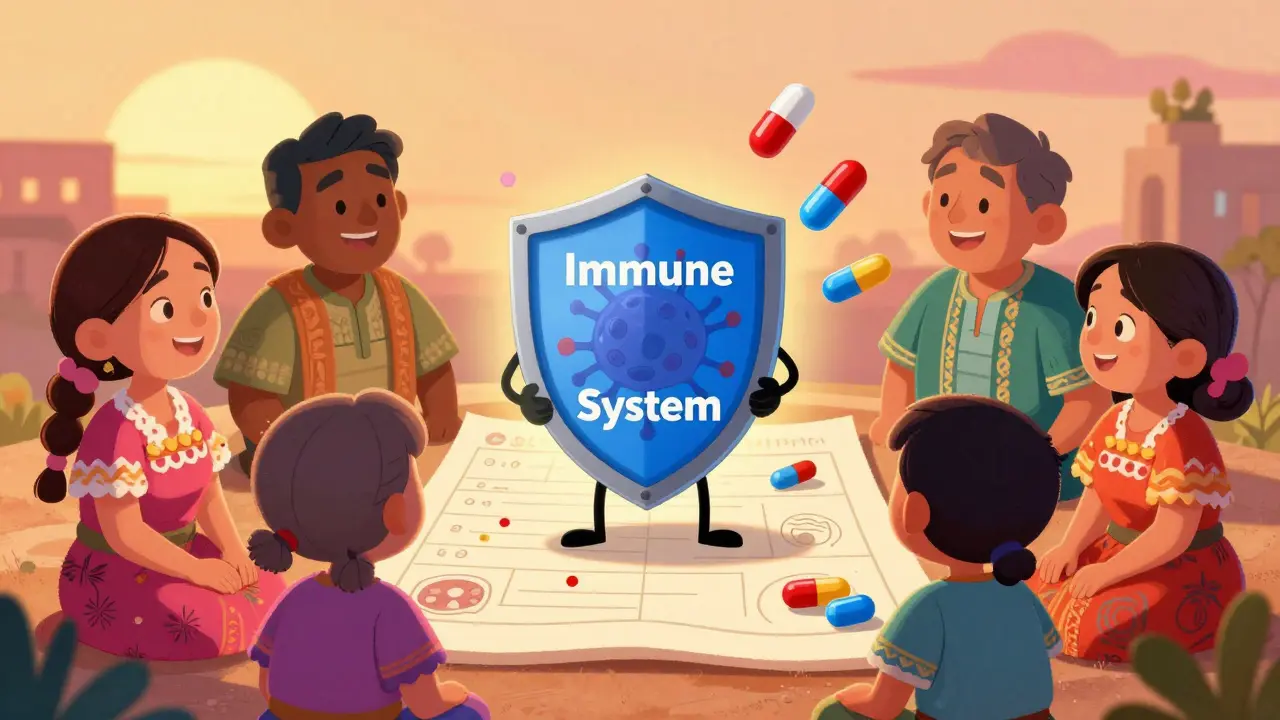
For years, doctors told patients with a history of cancer who also had autoimmune diseases like rheumatoid arthritis or Crohn’s disease: wait at least five years before starting immunosuppressants. The fear was simple-suppressing the immune system might let cancer come back. But that advice was never backed by solid evidence. Now, we know better.
Why the Fear Existed
The immune system doesn’t just fight infections. It also hunts down abnormal cells before they turn into tumors. That’s why doctors worried about drugs like methotrexate, azathioprine, or biologics like infliximab and adalimumab. If you’ve had cancer, especially melanoma or blood cancers, your body’s natural defenses are already on edge. Adding drugs that quiet the immune system seemed like a recipe for disaster. That thinking led to strict rules. Patients were told to delay treatment for autoimmune conditions until five years after cancer remission. Some never got back on their meds. Their joint pain, rashes, or digestive issues got worse. Their quality of life dropped. And for what? No real proof it helped.The Evidence That Changed Everything
In 2016, a massive study published in Gastroenterology looked at over 11,700 people with autoimmune diseases who had survived cancer. They compared those who took no immunosuppressants with those on anti-TNF drugs, traditional modulators like methotrexate, or combinations of both. The results? No meaningful difference in cancer recurrence rates. - No immunosuppression: 37.5 cases per 1,000 person-years - Anti-TNF therapy: 33.8 cases per 1,000 person-years - Traditional modulators: 36.2 cases per 1,000 person-years - Combination therapy: 54.5 cases per 1,000 person-years The differences weren’t statistically significant. That means the numbers could have happened by chance. The study didn’t find that any of these drugs made cancer more likely to return. That study was just the beginning. A 2024 update, analyzing over 24,000 patients and nearly 86,000 years of follow-up, confirmed it. Even newer drugs like ustekinumab, vedolizumab, and JAK inhibitors showed no increased risk. And here’s the kicker: whether you started immunosuppressants six months after cancer or six years later, the recurrence rate stayed the same. The five-year rule? It had no basis in science.What About Specific Cancers?
Not all cancers are the same. Melanoma, lymphoma, and leukemia have always raised red flags because they’re more sensitive to immune control. But even here, the data doesn’t support blanket bans. For example, patients with a history of melanoma who took anti-TNF drugs didn’t have higher recurrence rates than those who didn’t. The same held true for breast, lung, and colon cancers. The key isn’t the drug-it’s the cancer itself. Stage matters. Time since treatment matters. Whether the cancer was completely removed matters. One exception? Active blood cancers. If you’re still being treated for leukemia or lymphoma, or if your cancer returned recently, immunosuppressants aren’t safe. That’s not because the drugs cause recurrence-it’s because your body is still fighting an active, aggressive disease. Adding immune-suppressing drugs in that phase is risky.
What Doctors Are Doing Now
The American College of Rheumatology, the European League Against Rheumatism, and the FDA have all updated their guidelines. No more automatic five-year waits. Instead, doctors now make decisions based on:- What type of cancer you had
- How advanced it was
- How long it’s been since you finished treatment
- Whether you’re in full remission
- How badly your autoimmune disease is affecting your life
Monitoring After Starting Immunosuppressants
Even though the drugs don’t increase recurrence risk, you still need to stay vigilant. Cancer doesn’t vanish just because you’re on medication. Here’s what monitoring looks like:- Annual skin checks if you’ve had melanoma or are at high risk
- Regular blood tests and imaging based on your cancer type (e.g., mammograms, colonoscopies, CT scans)
- Keeping up with routine cancer screenings-don’t skip them because you’re on immunosuppressants
- Telling every doctor you see about your cancer history and current meds
What’s Still Unknown
Science doesn’t have all the answers yet. Two major studies are underway: - The RECOVER study (NCT04567821) is tracking IBD patients with prior cancer who are on biologics. Results are expected in mid-2026. - The RHEUM-CARE study (NCT04321987) is following 5,000 RA patients with cancer histories to see if certain drug combinations affect recurrence risk differently. We also don’t know yet if long-term use (10+ years) of JAK inhibitors has any subtle effect. But so far, no red flags.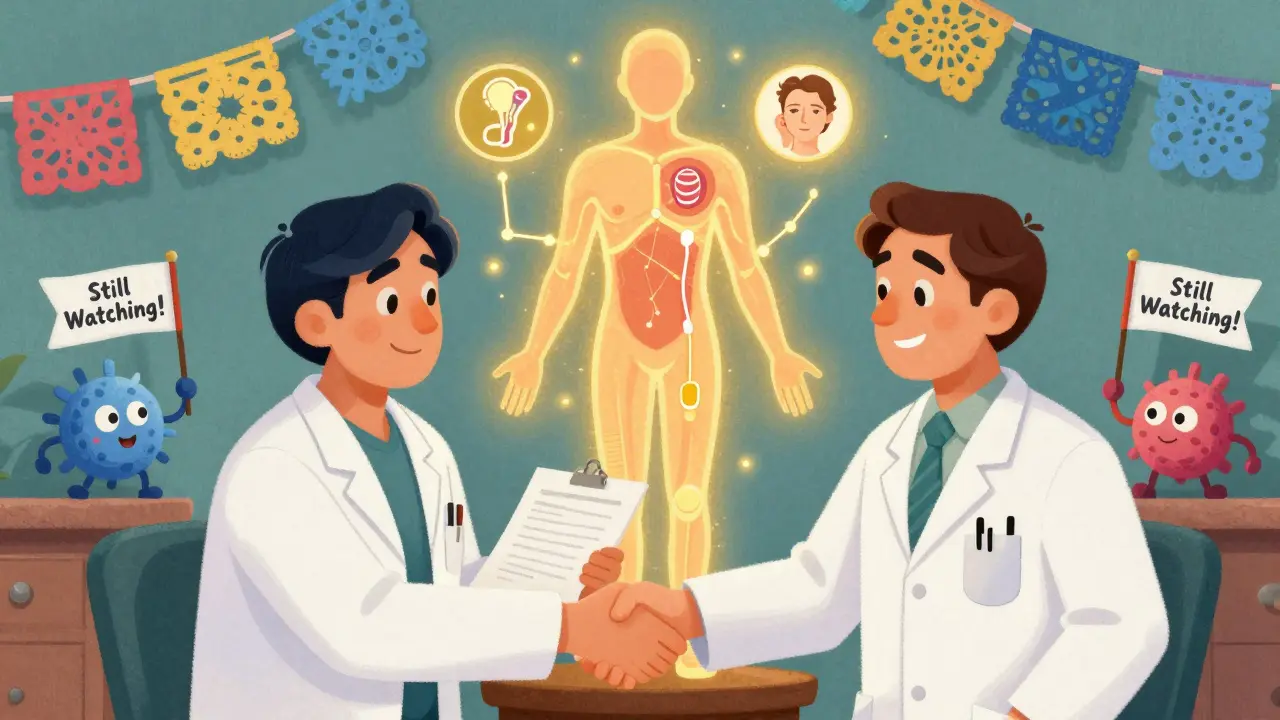
What This Means for You
If you’ve had cancer and now need immunosuppressants for an autoimmune disease, here’s what you should do:- Don’t assume you have to wait five years. That rule is outdated.
- Ask your doctor: What was the stage and type of my cancer? When was my last treatment? Am I in remission?
- Get a clear plan for cancer screening moving forward.
- Don’t refuse treatment out of fear. Uncontrolled inflammation can be just as dangerous as cancer recurrence.
- Work with both your rheumatologist and oncologist. Communication saves lives.
Key Takeaways
- Immunosuppressants do not increase cancer recurrence risk based on the best available evidence.
- The five-year waiting period after cancer is not supported by science.
- Timing of treatment initiation-whether soon after cancer or years later-does not affect recurrence rates.
- Combination therapy shows higher numerical recurrence rates, but not statistically significant.
- Newer biologics like ustekinumab and JAK inhibitors appear as safe as older drugs.
Frequently Asked Questions
Do immunosuppressants cause cancer to come back?
No. Large studies involving tens of thousands of patients show no increased risk of cancer recurrence with anti-TNF drugs, methotrexate, azathioprine, or newer biologics like ustekinumab. The immune system’s role in cancer surveillance is real, but suppressing it doesn’t automatically trigger relapse.
Should I wait five years after cancer before starting immunosuppressants?
No. That recommendation was based on caution, not evidence. Studies show cancer recurrence rates are the same whether you start treatment six months or six years after cancer diagnosis. The decision should be based on your cancer type, stage, remission status, and how severe your autoimmune disease is-not an arbitrary clock.
Are some immunosuppressants safer than others after cancer?
All major classes-anti-TNF agents, traditional modulators, and newer biologics-have similar recurrence rates. Some newer drugs like vedolizumab and ustekinumab showed slightly lower numbers in studies, but the differences weren’t statistically significant. The choice should be based on your disease, side effect profile, and response to past treatments-not cancer history.
What if I had melanoma or lymphoma?
Even with high-risk cancers like melanoma or lymphoma, studies show no increased recurrence with immunosuppressants. But caution is still needed if the cancer is recent, active, or high-grade. Your oncologist will help determine if you’re in stable remission. If you’re clear for over a year and your cancer was low-risk, starting treatment is generally safe.
Do I still need cancer screenings if I’m on immunosuppressants?
Yes, absolutely. Immunosuppressants don’t eliminate your cancer risk-they just don’t raise it. You still need regular mammograms, colonoscopies, skin checks, and blood tests based on your personal history. In fact, staying on schedule is even more important because your immune system is less able to catch early changes.
Comments (12)
Marian Gilan
lol so now the pharma giants are telling us it's safe? 🤡 next they'll say 5G cures cancer. i've seen too many people go on these drugs and disappear. they don't want you to know the real data is buried under 37 studies funded by abbvie and janssen. #bigpharma
Conor Murphy
This is such a relief to read. I was terrified to restart my adalimumab after my breast cancer remission. My joints were killing me, but i kept thinking 'what if it comes back?' Thank you for putting this out there. 💙
Conor Flannelly
The real tragedy here isn't the science-it's the decades of suffering people endured because doctors clung to fear instead of evidence. We've done this before with thalidomide, with statins, with hormone therapy. Medicine is slow to unlearn, even when the data screams. The five-year rule wasn't medical-it was ritual. And rituals hurt people. We need more humility in prescribing, not more dogma.
Patrick Merrell
You people are idiots. If you suppress your immune system you're asking for cancer. Period. The government and drug companies don't care about you. They want you on lifelong meds so they can keep selling. I know someone who died after starting infliximab. Coincidence? Maybe. Or maybe you're just too blind to see the truth.
Henry Jenkins
I’ve spent the last six months digging through every meta-analysis and cohort study I could find on this topic, and honestly? The data is surprisingly clean. The 2024 paper with 86,000 patient-years is the gold standard here. The only group that showed a slight uptick-combination therapy-is still within statistical noise. What’s more concerning is how many patients were denied care for years because of this myth. I’ve seen people with severe Crohn’s living on painkillers because they were told to 'wait.' That’s not medicine. That’s cruelty dressed up as caution.
TONY ADAMS
bro i just got off methotrexate last year after my skin cancer. they told me to wait 5 years. i waited 3 and started back up. no issues. my psoriasis is gone. life is good. don't let the fear guys scare you.
George Rahn
The erosion of medical prudence in the name of 'patient autonomy' is a hallmark of late-stage technocratic decay. To abandon a precautionary principle rooted in biological intuition-however imperfectly quantified-is not progress. It is surrender to the cult of speed. We have replaced wisdom with data points, and in doing so, we have disarmed the moral imagination of the healer. The patient is not a statistic. The immune system is not a dial to be turned.
Karen Droege
I’m a rheumatology nurse practitioner and I’ve been screaming this from the rooftops since 2018. Patients cry in my office because they’re in so much pain they can’t hold their kids, and we’re telling them to suffer because of a myth. I’ve had 14 patients restart biologics post-cancer-none had recurrence. One guy with stage 2 melanoma? Now runs marathons. Stop letting fear dictate care. We owe our patients better.
Napoleon Huere
Think about it: if immunosuppressants caused cancer recurrence, then why do organ transplant patients-on much stronger immunosuppression for decades-not all die of cancer? Why do we have 100,000+ transplant survivors alive today? The body doesn’t just need an immune system to fight cancer-it needs time, surveillance, and a functional environment. Suppressing it doesn’t magically wake up dormant cells. It just makes you vulnerable to infections. And yes, we should still screen. But fear? That’s the real enemy.
Neil Thorogood
So basically, the medical establishment spent 20 years making people miserable so they could sell more pills later? 😏 classic. Congrats, docs-you broke someone’s quality of life to protect your own ego. Now go fix it. And maybe apologize to the 300,000 people who suffered needlessly.
Jessica Knuteson
The recurrence rate is the same so it’s fine. But the study didn’t control for smoking, BMI, or alcohol. Also, JAK inhibitors were only tracked for 3 years. And what about epigenetic changes? You think a drug that alters cytokine signaling doesn’t leave a trace? This is science theater. They want you to feel safe so you’ll keep taking it.
Ashley Porter
The 54.5 per 1k for combo therapy is still higher numerically. That’s not noise-that’s a signal. We need stratified analysis by cancer type, drug half-life, and time-to-initiation. Also, are we accounting for concomitant steroid use? This feels like a preliminary analysis dressed as definitive. Still, the trend is promising. Just… don’t overinterpret.