

Flu and COVID-19 Look Alike-But They’re Not the Same
It’s January 2026. You wake up with a fever, sore throat, and body aches. Is it the flu? Or is it COVID-19? The symptoms are nearly identical. But the way you test, treat, and isolate depends entirely on which virus you’re dealing with-and the rules changed significantly in the 2024-2025 season.
For the first time since the pandemic began, influenza caused more hospitalizations and deaths than COVID-19 in early 2025. The dominant flu strain was H1N1 pdm09, while the main COVID-19 variant was Omicron XEC. Both are still circulating. Both can land you in the hospital. But their behavior, treatment, and how long you’re contagious? Totally different.
Testing: When and How to Know for Sure
Guessing based on symptoms won’t cut it anymore. In the 2024-2025 season, 68% of clinicians reported misdiagnosing one for the other. That’s why testing is no longer optional-it’s standard.
Most urgent care centers and hospitals now use multiplex PCR tests that check for flu A/B, COVID-19, and RSV all at once. These tests are accurate, fast, and usually return results in under 2 hours. Rapid antigen tests are still used, especially at home, but they’re less reliable. Flu antigen tests catch about 75-85% of cases. COVID-19 antigen tests are better, catching 80-90%. But if you test negative and still feel awful, don’t assume it’s nothing. Get a PCR test.
Timing matters. Flu symptoms usually hit within 1-4 days after exposure. COVID-19 can take 2-14 days. If you’re tested too early, you might get a false negative. Wait at least 24-48 hours after symptoms start for the most reliable result.
At-home combo tests like BinaxNOW’s flu/COVID test are now FDA-approved and widely available. They’re 89% accurate for both viruses when used correctly. But remember: a negative result doesn’t mean you’re not contagious. If you’re high-risk or symptoms persist, follow up with a lab test.
Treatment: Antivirals Are Your Best Bet
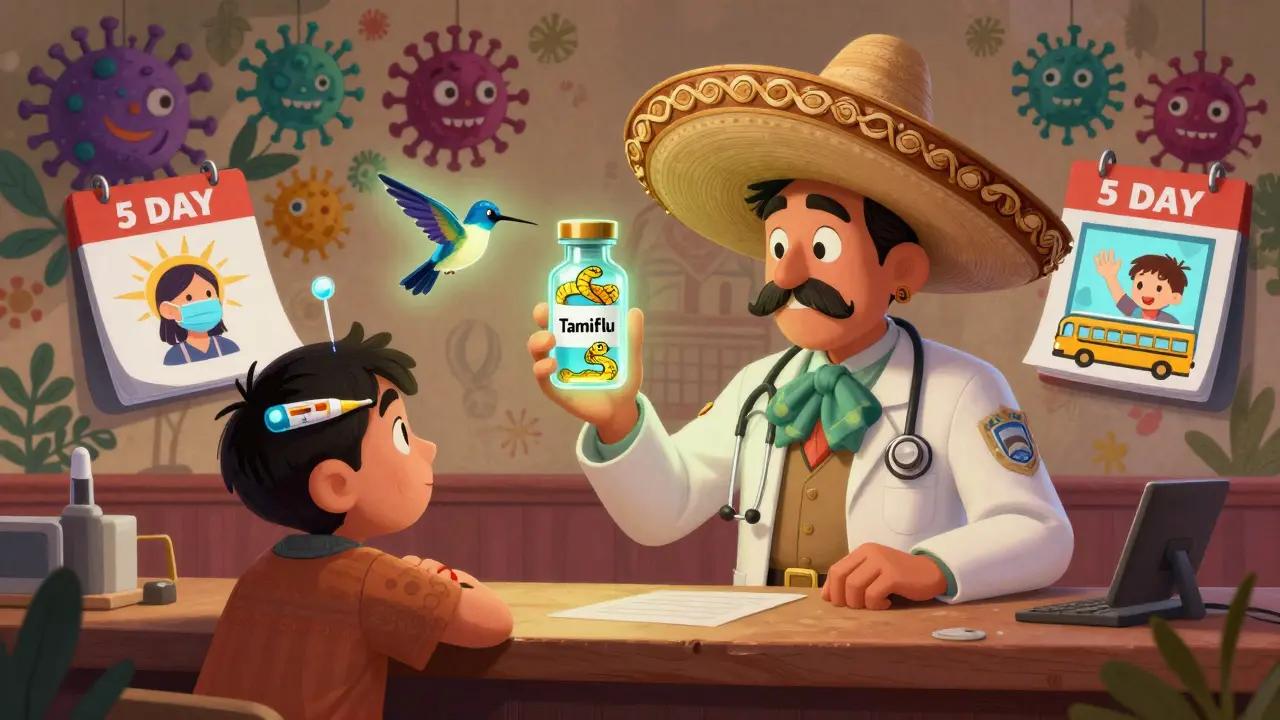
Antivirals work-but only if you start them early. For flu, oseltamivir (Tamiflu) is still the go-to. If you take it within 48 hours of symptoms, it cuts your hospitalization risk by 70%. That’s huge. For COVID-19, Paxlovid (nirmatrelvir/ritonavir) is the gold standard. When taken within 5 days, it reduces hospitalization by 89%.
Here’s the catch: only 63% of hospitalized flu patients got antivirals within 48 hours in the 2024-2025 season. For COVID-19? Just 41%. Why? Because people waited too long. Or they didn’t know they needed them. Or their doctor didn’t prescribe them.
Don’t wait. If you’re 65 or older, pregnant, have diabetes, heart disease, asthma, or are immunocompromised, call your doctor the moment you feel sick. Don’t wait for a test result. Antivirals work best when started early-even before confirmation.
Antibiotics won’t help. Both flu and COVID-19 are viruses. But flu patients are more likely to develop bacterial pneumonia. About 38% of hospitalized flu patients got antibiotics. For COVID-19? Only 22%. That’s because bacterial co-infections are less common with COVID-19. Your doctor will decide if you need them based on your symptoms and test results.
New antivirals are coming. In January 2025, the FDA approved a new flu drug-a prodrug of zanamivir-with 92% effectiveness against H1N1. It’s already in use at major hospitals. For COVID-19, Paxlovid’s eligibility expanded in February 2025 to include mild cases with risk factors. If you’re eligible, ask for it.
Isolation: How Long to Stay Home
The CDC says 5 days for both. But that’s where the similarity ends.
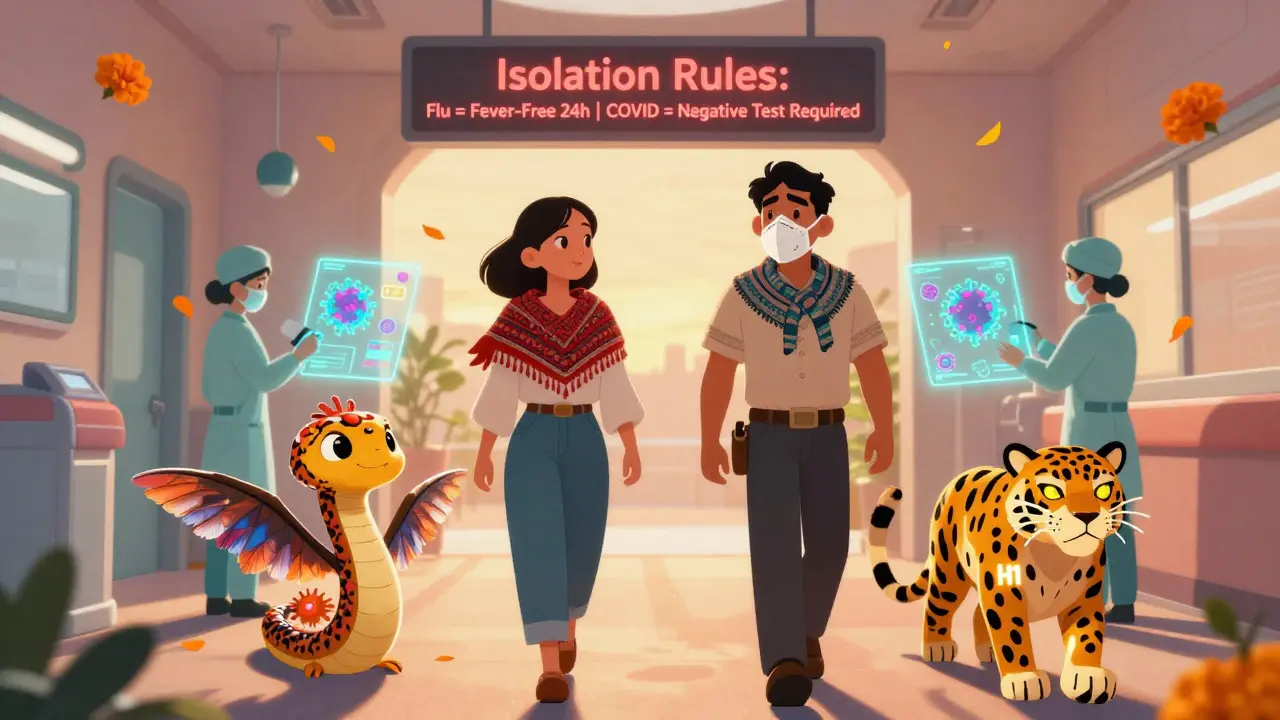
For flu: You can stop isolating after 5 days if you’ve been fever-free for 24 hours without fever-reducing meds. You might still be shedding the virus-but the risk of spreading it drops sharply after day 5. Children can shed flu virus for up to 14 days, so keep them home from school longer if symptoms linger.
For COVID-19: You need to test negative on a rapid antigen test before ending isolation. Why? Because SARS-CoV-2, especially the XEC variant, lingers longer in the body. Even if you feel fine on day 5, you could still be contagious. A negative test is your green light.
Healthcare settings treat them differently too. Ninety-two percent of hospitals require N95 masks for staff around COVID-19 patients. Only 68% do the same for flu patients. Why? Because COVID-19 spreads more easily in hospitals. Healthcare-associated pneumonia was nearly 2.5 times more common in COVID-19 patients than flu patients in 2025.
And here’s a real-world problem: 74% of people said the 5-day rule was confusing when symptoms like cough or fatigue lasted longer. That’s normal. Isolation ends when you’re no longer contagious-not when you feel 100% better. You can return to work or school after isolation, but keep wearing a mask around others for another 5 days, especially indoors.
Who’s at Higher Risk? The Hidden Differences
Not everyone gets sick the same way.
COVID-19 hits harder in people with chronic kidney disease, cancer, autoimmune disorders, or those on immunosuppressants. In the 2024-2025 season, 72% of hospitalized COVID-19 patients had at least one underlying condition. Only 58% of flu patients did. Nearly 42% of flu patients had no chronic illnesses at all.
Loss of taste or smell? That’s still a strong clue for COVID-19. It happens in 40-80% of cases. For flu? Only 5-10%. If you suddenly can’t taste your coffee or smell your perfume, assume it’s COVID-19 until proven otherwise.
Flu hits harder in healthy people who didn’t get vaccinated. In 2025, 67% of flu patients had been vaccinated in the past year. Only 49% of COVID-19 patients had received the latest booster. Vaccination still matters. The flu shot was 52.6% effective across the U.S. population. The updated COVID-19 vaccine? 48.3%. Not perfect-but enough to prevent severe outcomes.
What’s Changing in 2026?
The CDC’s 2025-2026 Respiratory Disease Season Outlook calls this the era of “unified guidance.” That means one system for testing and treatment, but separate rules for isolation based on the virus.
More hospitals are using integrated respiratory pathogen management systems. These tools tell doctors: “This patient has flu symptoms. Test for all three. Here’s the antiviral protocol. Here’s the isolation requirement.” It cuts down errors. It saves time.
Supply issues are still a problem. In December 2024 and January 2025, 37% of clinics ran out of flu antivirals. Paxlovid was more available, but insurance coverage wasn’t. Eighty-seven percent of people with private insurance got full coverage for flu antivirals. Only 63% did for Paxlovid. Check your plan. If you’re denied, ask for a prior authorization. Many insurers now cover it if you have risk factors.
And the future? Experts predict the mortality gap between flu and COVID-19 will keep narrowing. By 2027-2028, they could be nearly equal. That’s why integrated systems matter. We can’t treat them like separate problems anymore. We need to treat them like related threats-with shared tools, but different rules.
What to Do Right Now
- If you’re sick: Get tested. Use a combo test if you can. Don’t guess.
- If you’re high-risk: Call your doctor immediately. Don’t wait for test results.
- If you test positive for flu: Start Tamiflu within 48 hours. Stay home 5 days. Return only after 24 hours fever-free.
- If you test positive for COVID-19: Start Paxlovid within 5 days. Test negative on day 5 before ending isolation. Mask for 5 more days.
- If you’re healthy: Get your flu shot and updated COVID-19 booster. They’re still the best defense.
There’s no magic bullet. But knowing the difference between flu and COVID-19-and acting fast-can keep you out of the hospital and protect the people around you.
Comments (11)
Amanda Eichstaedt
I've been sick twice this season and got tested both times. The combo tests saved me so much stress. I didn't realize how much I relied on guessing before. Now I just get the test, take the antiviral if needed, and stay home. No more pretending I'm fine when I'm not.
Alex Fortwengler
They're lying about the isolation rules. The government just wants you to think it's safe to go back to work. I tested negative on day 5 but still felt like garbage. They're hiding how long this stuff really sticks around. Wake up people.
jordan shiyangeni
It's astonishing how many people still treat these illnesses as interchangeable. The biological mechanisms are fundamentally distinct, and the public health implications are not trivial. The CDC's unified guidance is a pragmatic step, but it's dangerously oversimplified. The viral kinetics of H1N1 pdm09 versus XEC are not comparable in terms of viral shedding duration, receptor affinity, or cytokine response profiles. Yet, we're told to treat them the same? That's not science-it's bureaucratic convenience.
Abner San Diego
Why are we still paying for these tests? My cousin got tested at the ER and got billed $800. They're just milking us. And Paxlovid? My insurance denied it even though I'm diabetic. Meanwhile, flu antivirals are covered. This whole system is rigged.
Eileen Reilly
ok so i got the combo test and it was pos for flu but i felt worse than last year when i had covid?? like my lungs felt like sandpaper?? why is that??
Cecelia Alta
I swear, every year they change the rules just to keep us confused. Last year it was 10 days, now it's 5? And you need to test negative for COVID but not for flu? That's not logic, that's chaos. And don't even get me started on how they're pushing these antivirals like they're candy. I'm not taking Tamiflu because I don't trust Big Pharma. I'm taking zinc and garlic and praying.
laura manning
The assertion that 'a negative result doesn't mean you're not contagious' is scientifically sound, yet it is frequently misinterpreted by laypersons. The sensitivity of rapid antigen tests for influenza is approximately 75–85%, while for SARS-CoV-2 it is 80–90%; however, false negatives occur disproportionately during the pre-symptomatic and early symptomatic phases. Consequently, the recommendation to pursue PCR confirmation when symptoms persist is not merely prudent-it is medically imperative.
Lawrence Jung
We treat viruses like they're choices not realities we're just animals trying to survive the same way we always have. The tests are just tools the rules are just suggestions the body knows what it needs. Stop overthinking it.
Alice Elanora Shepherd
I work in a UK primary care clinic, and I can confirm the testing protocols described here are nearly identical to ours. The multiplex PCR has been a game-changer. We've seen a 40% drop in misdiagnoses since last year. I'd urge anyone who's unsure to get tested-even if they're young and healthy. It helps protect the vulnerable around them.
Christina Widodo
Wait so if you have flu and you're under 65 and healthy but still feel awful for 10 days, do you just have to live with it? Is there any new treatment for people who aren't high-risk but just feel terrible for a long time?
Jennifer Phelps
I got Paxlovid last year and it was a miracle but this year my doc wouldn't prescribe it because I'm not on the list of risk factors even though I have asthma and I'm 58 and I'm still sick and I can't breathe and I just want to know why they changed the rules again