
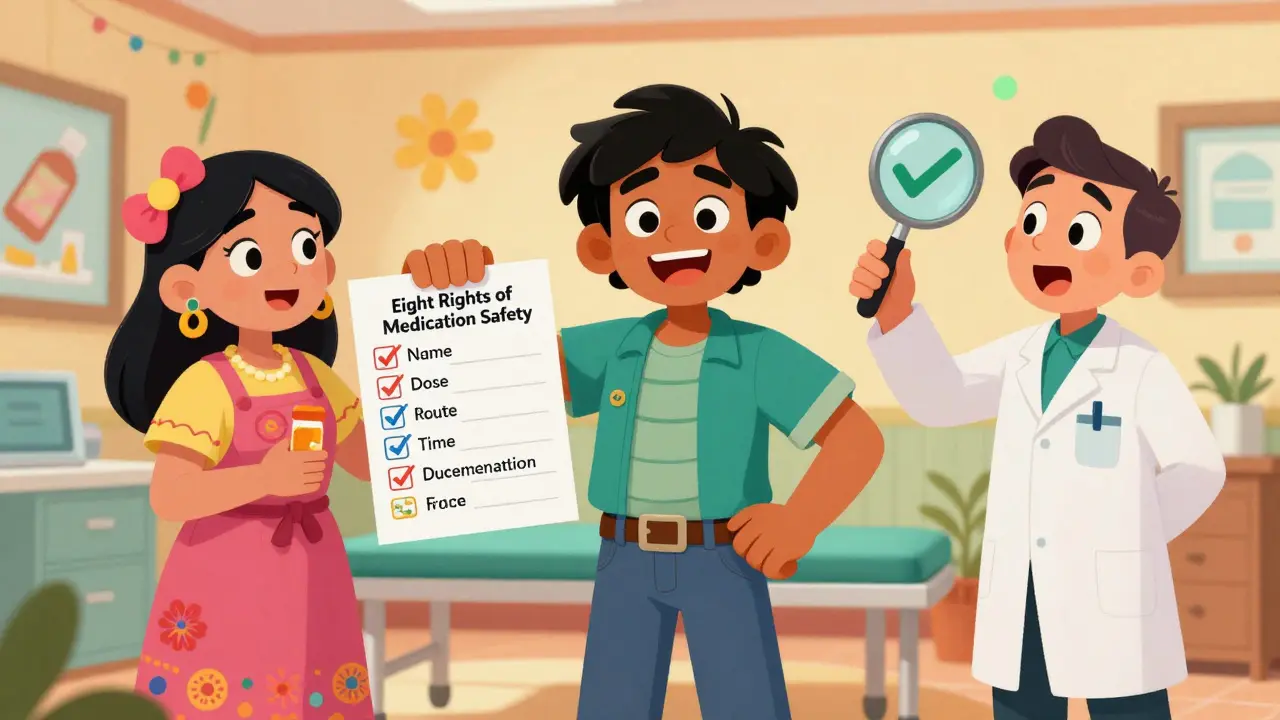
Every year, more than 1.5 million people in the U.S. end up in the emergency room because of medication mistakes. Many of these aren’t accidents-they’re preventable. The biggest reason? Patients don’t know the right questions to ask. You don’t need to be a doctor to protect yourself. You just need to know a few key terms-and how to use them.
What Are the Eight Rights of Medication Safety?
The foundation of medication safety isn’t a complex algorithm or a high-tech app. It’s a simple list: the Eight Rights. These aren’t suggestions. They’re your checklist to make sure you get the right medicine, the right way, every time.
- Right patient - They must confirm your name and date of birth. Not just your first name. Not just your last name. Both. If they only ask for one, say, "Can you check both?"
- Right medication - Ask for the generic and brand name. Many errors happen because drugs sound alike. Like hydralazine and hydroxyzine. One lowers blood pressure. The other treats allergies. Mix them up, and you could end up in the hospital.
- Right dose - Know how much you’re supposed to take. Liquid medicines? Double-check the units. Milligrams (mg) aren’t the same as milliliters (mL). Kids are especially at risk here-15% of pediatric errors come from wrong doses.
- Right route - Is this pill meant to be swallowed, injected, or put on your skin? If it says "IV" but you’re handed a pill, stop. Twelve percent of serious errors happen because the wrong route is used.
- Right time - Are you supposed to take it with food? Every 8 hours? Before bed? Use your phone to set reminders. Studies show people who track timing improve adherence by 42%.
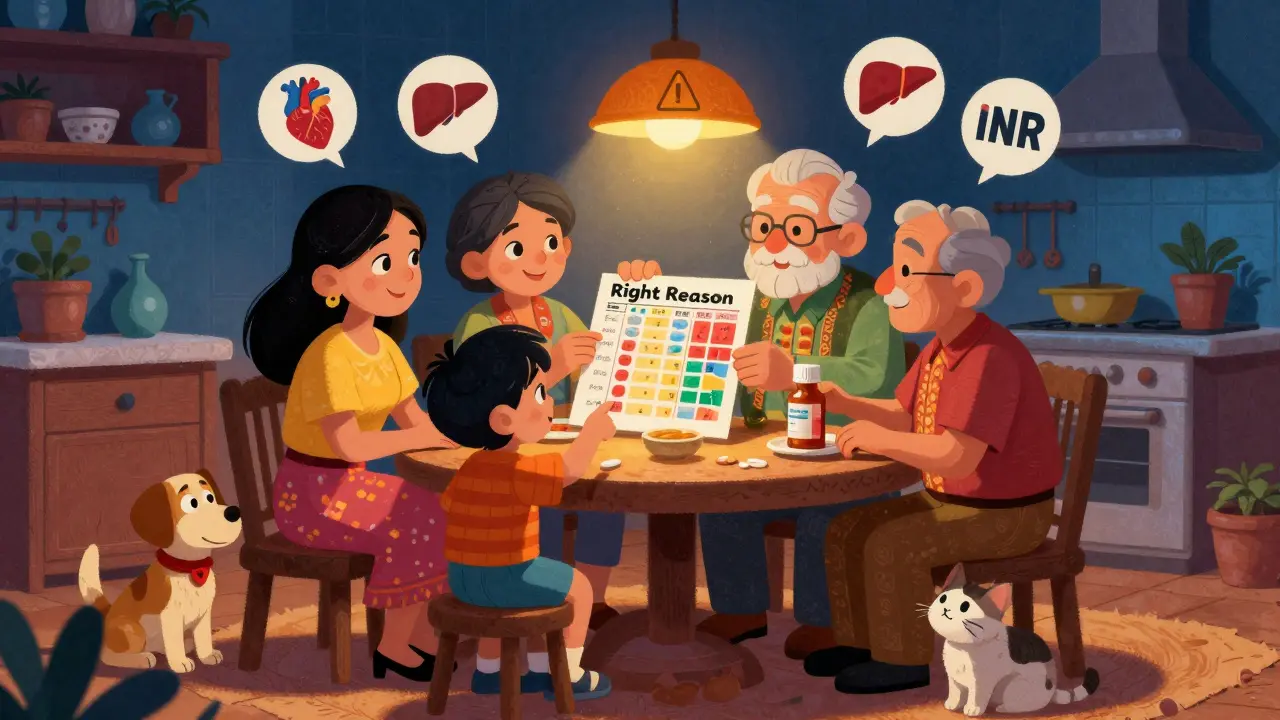
- Right reason - Why are you taking this? Don’t just accept, "It’s for your blood pressure." Ask, "What condition is this treating?" If you can’t explain it in your own words, you’re at risk. People who ask this question reduce inappropriate prescriptions by 28%.
- Right documentation - Make sure your doctor or nurse writes down what you were given. If you’re in the hospital and they don’t check your chart before giving you something, speak up.
- Right response - What should you feel? What side effects are normal? What’s a warning sign? If you start feeling dizzy after a new pill, write it down. Track it. Share it. Patients who monitor their responses cut severe reactions by 35%.
Adverse Drug Event (ADE) - Not Just a Side Effect
People confuse side effects with adverse drug events. A side effect is something expected-like drowsiness from an antihistamine. An adverse drug event (ADE) is when a medicine harms you. That could be an allergic reaction, an overdose, or a bad interaction with another drug.
The CDC calls ADEs a "preventable patient safety problem." And they’re not rare. One in five hospitalizations for older adults is linked to an ADE. You can spot the signs: rash, swelling, trouble breathing, sudden confusion, or extreme fatigue after starting a new medicine. If you notice any of these, call your doctor-or go to urgent care. Don’t wait.
High-Alert Medications - When You Need to Be Extra Careful
Some drugs are riskier than others. The Institute for Safe Medication Practices (ISMP) calls them high-alert medications. These aren’t dangerous because they’re bad drugs. They’re dangerous because even a small mistake can kill you.
Examples:
- Insulin
- Blood thinners like warfarin or apixaban
- Opioids like morphine or oxycodone
- IV potassium chloride
- Chemotherapy drugs
These make up 67% of fatal medication errors. If you’re on one of these, ask your provider: "What should I watch for?" And never skip your blood tests. For example, if you’re on warfarin, your INR level must be checked regularly. If you miss a test, you could bleed internally without knowing it.
Close Call - What Happens When You Almost Get Hurt
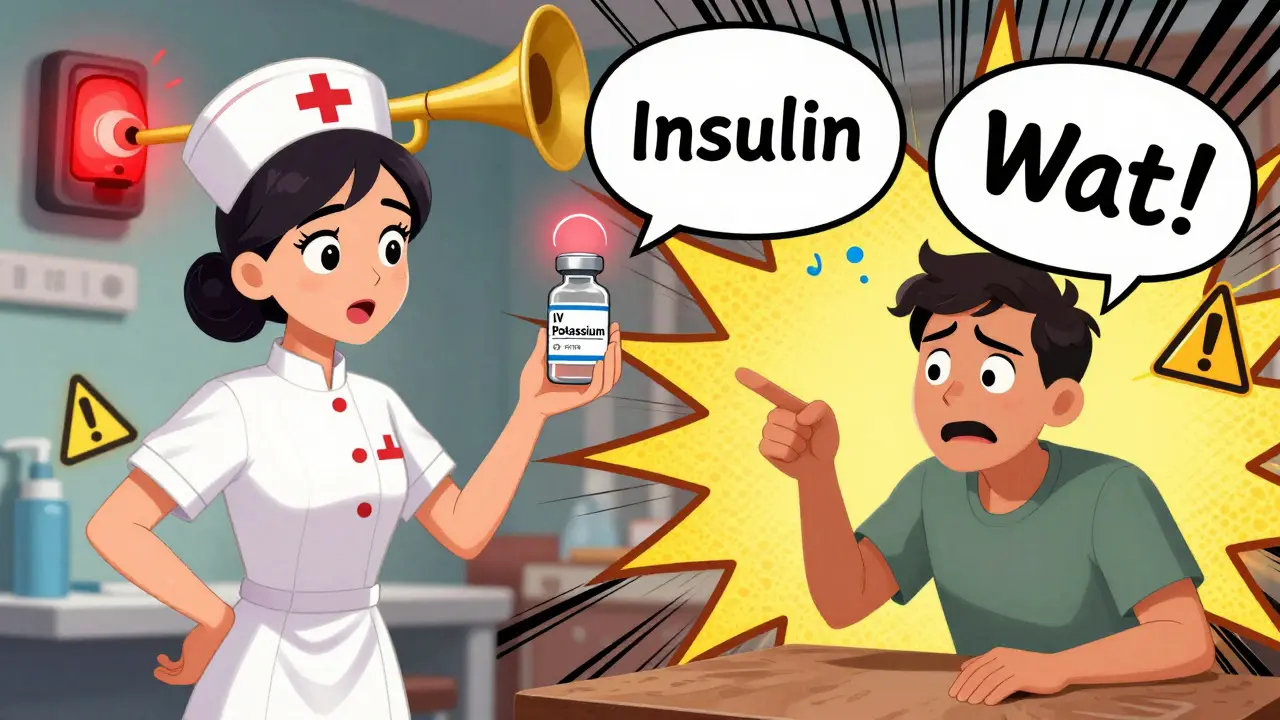
You might think, "I didn’t get hurt, so it’s fine." But that’s how mistakes grow. A close call is when something almost went wrong-but didn’t. Maybe the nurse caught the wrong dose before giving it. Maybe your pharmacist spotted a confusing label.
These moments are gold. They tell you what’s broken in the system. If you notice a close call-like a nurse handing you a pill that looks different than last time-say something. Hospitals track these to fix problems before someone gets hurt. Your voice helps.
Sentinel Events - When a Mistake Costs a Life
The Joint Commission defines a sentinel event as an unexpected death or serious injury caused by healthcare. Medication errors are one of the top causes. That includes giving the wrong drug, wrong dose, or wrong patient.
This isn’t theoretical. In 2023, over 2,000 sentinel events in U.S. hospitals were linked to medication mistakes. That’s 2,000 families changed forever. The good news? Most of these are preventable-with better communication.
How to Use These Terms in Real Life
Knowing the terms isn’t enough. You have to use them. Here’s how:
- Before you leave the doctor’s office, ask: "What’s the right reason for this medicine?" Write it down.
- At the pharmacy, ask: "Is this the generic or brand name? Can you show me the label?"
- When you get home, open the bottle. Does the pill look like the one you got last time? If not, call the pharmacy.
- Use a free app like Medisafe to track doses, times, and side effects. It’s used by over 8 million people.
- Bring your list of meds to every appointment-even if you think they have it. Many doctors never check your full list.
- If you’re in the hospital, ask every nurse: "Are you checking my name and date of birth before giving me anything?"
Why This Matters Now More Than Ever
In 2024, the Joint Commission made it mandatory for hospitals to teach patients these Eight Rights before discharge. The CDC and FDA set a goal: by 2030, 90% of patients should know at least five of these terms. Right now, only 43% do.
Why the push? Because we’re taking more medicines than ever. Older adults average six prescriptions. Some take over ten. Each one adds risk. And with telehealth, face-to-face time with doctors is shrinking. That means you have to be your own safety net.
Studies show that when patients use these terms, their risk of harm drops by up to 50%. That’s not a guess. That’s from the American College of Obstetricians and Gynecologists. It’s not magic. It’s clarity.
What If You Don’t Understand?
Health literacy is a real barrier. The National Assessment of Adult Literacy found only 12% of U.S. adults can easily understand complex medical instructions. If you struggle with medical terms, say so. Ask for simpler words. Ask for pictures. Ask for someone to repeat it.
Hospitals now offer materials in 15 languages. Many have patient advocates who can help you explain your meds to your family. Don’t be shy. Your life depends on it.
Start Today
You don’t need to memorize all eight rights at once. Pick one. Start with "right reason." Next time you get a new prescription, ask: "Why am I taking this?" Write the answer. Show it to a family member.
Then pick another. Maybe "right dose." Check your bottle. Is it the same as what your doctor said? If not, call the pharmacy.
Medication safety isn’t about trusting your provider. It’s about partnering with them. And the most powerful tool you have? Your voice.
What’s the difference between a side effect and an adverse drug event?
A side effect is a known, expected reaction to a medicine-like drowsiness from allergy pills. An adverse drug event (ADE) is harm caused by a medicine that shouldn’t have happened-like an allergic reaction, overdose, or dangerous interaction. ADEs are preventable. Side effects aren’t always.
Do I need to know all eight rights at once?
No. Start with the three most important: right patient, right medication, and right reason. Once you’re comfortable, add right dose and right route. These five cover 80% of common errors. The rest build on them.
What if my doctor gets annoyed when I ask questions?
A good doctor welcomes questions. If someone gets defensive, it’s a red flag. Medication safety is a shared responsibility. You have the right to understand your care. If you feel dismissed, ask for a second opinion or ask to speak with a patient advocate.
Are these terms used outside the U.S.?
Yes. The Eight Rights framework is used in Canada, Australia, the UK, and parts of Europe. While wording may vary slightly, the core ideas are the same. If you’re traveling or living abroad, these terms still apply.
Can I use these terms with my pharmacist?
Absolutely. Pharmacists are medication experts. Ask them: "Is this the right drug for my condition?" "Is this dose safe for my age?" "Are there any foods or other meds I should avoid?" They’re trained to help you avoid errors.
What if I’m taking supplements or vitamins?
Supplements count too. They can interact with prescriptions. For example, St. John’s Wort can make birth control or blood thinners less effective. Always list every supplement you take-on your meds list, at every appointment. Treat them like real medicine.
How do I know if my medication is high-alert?
Check the label. Many high-alert drugs have a red sticker or bold warning. Ask your pharmacist: "Is this a high-alert medication?" If yes, make sure you understand the risks and what to watch for. Never assume it’s safe just because it’s prescribed.
Comments (12)
Praseetha Pn
Okay but let’s be real-how many times has a nurse looked at your ID and said, "Oh, we’ve got two John Smiths today," and then just guessed? I’ve seen it. They don’t care. They’re overworked, yeah, but that’s not my problem. I’ve had insulin given to me because I looked "like the other diabetic lady." My blood sugar dropped to 32. I woke up in the ER. Now I carry a laminated card with my photo, DOB, meds, and allergies. And I make every single person read it aloud. If they roll their eyes? I ask for the supervisor. No apologies.
They think they’re saving time. They’re not. They’re just gambling with my life.
And don’t get me started on pharmacies. I once got metformin instead of metoprolol. Same damn letter count. Same color pill. I didn’t notice until I started having heart palpitations. That’s not a mistake. That’s negligence dressed up as a system failure.
They don’t want you to know the Eight Rights because if you did, you’d stop trusting them. And then they’d have to actually be careful.
So yeah. I’m paranoid. And I’m still alive.
Nishant Sonuley
Look, I get it-patients need to be proactive. But let’s not pretend this is just about individual responsibility. The real problem is that healthcare in this country is a profit-driven circus where nurses are expected to handle 15 patients at once while being yelled at by administrators to "reduce readmissions."
So yes, ask about the right route, the right dose, the right reason-but also ask why your doctor only had 7 minutes to review your 12 medications. Ask why the pharmacist didn’t catch that your warfarin dose was triple what it should be. Ask why the EHR system auto-populates the wrong drug because someone typed "hydro" and it auto-filled "hydroxyzine" instead of "hydralazine."
It’s not that you’re not asking enough questions. It’s that the system is designed to fail you. And now they’re putting the burden of fixing it on you-while still charging you $500 for a 10-minute visit.
So keep asking. But don’t be surprised when the system still breaks. And when it does? File a complaint. Not just with the hospital. With your state medical board. With the FDA. With Congress. This isn’t a patient problem. It’s a societal one.
And yes, I’m still mad about the time they gave my mom morphine instead of morphine sulfate. She was 82. She didn’t wake up for 36 hours. That wasn’t a close call. That was a near-death experience caused by a system that doesn’t care if you live or die-as long as the billing code is correct.
Emma #########
I really appreciate this breakdown. As someone who’s been caring for my mom with dementia, I’ve learned the hard way that if I don’t speak up, no one else will.
One time, the nurse handed her a pill that looked completely different from last week. I didn’t know the drug names, but I knew the shape and color. I asked, "This isn’t what she usually takes, right?" Turned out it was a different strength. They were about to give her a 2x dose.
I started keeping a little notebook-meds, times, side effects, even the pharmacy name. I take it to every appointment. My mom doesn’t remember anything, but I remember for her.
It’s exhausting. But it’s worth it. You’re not being difficult. You’re being her voice.
Thank you for making this so clear.
Tyler Myers
Oh great. So now we’re supposed to become medical experts just so the system doesn’t murder us? How convenient.
Let me guess-the next thing they’ll say is "Just check your INR at home with a $500 machine" or "Buy your own EKG monitor."
They’re outsourcing their job onto you. That’s not empowerment. That’s corporate cowardice.
And don’t even get me started on "high-alert meds." Why are these drugs even legal if one typo kills you? Shouldn’t they be banned? Or at least require a fingerprint scan and a blood oath before dispensing?
Also-why is it always the patient’s fault when the system fails? Why aren’t hospitals being fined millions every time this happens? Why aren’t pharmacists getting fired? Why are we the ones carrying laminated cards?
It’s not a safety issue. It’s a moral one.
And no, I’m not taking another pill until I see the original prescription in the doctor’s handwriting. And even then-I’m still skeptical.
Zoe Brooks
This is so important. I’m not a doctor, but I’ve learned more about meds in the last year than I ever did in med school (which I didn’t attend 😅).
I started with "right reason"-asked why I was on that statin, and turns out I didn’t even need it. My doctor was just following protocol. I got off it. No side effects. No regrets.
Now I use Medisafe and set alarms. I even showed my grandma how to use it. She’s 78. She calls me "the pharmacy whisperer."
It’s not about being scary or aggressive. It’s about being smart. And yes, it’s exhausting. But if you don’t do it, who will?
Small steps. One pill at a time. 💪
P.S. If you’re on insulin? Please, please, please check your numbers. I’ve seen what happens when you don’t.
Kristin Dailey
Americans are lazy. You think you deserve to be coddled? Get a clue. If you can’t read a pill bottle, you shouldn’t be taking pills. Simple.
Stop blaming doctors. Stop blaming pharmacies. Stop demanding hand-holding.
Learn. Or die. That’s life.
Wendy Claughton
Thank you for writing this. 🥹
I’ve been holding onto this for months after my uncle passed from a drug interaction no one caught. He was on 11 meds. His cardiologist didn’t even know he was taking St. John’s Wort. The pharmacist didn’t flag it. The ER didn’t ask. He just… stopped breathing.
I didn’t know any of these terms until it was too late.
So now I carry a laminated card for my parents. I’ve taught my siblings. I even made a simple PDF template and shared it on my neighborhood Facebook group.
It’s not enough. But it’s something.
And if you’re reading this? Please. Print it. Tape it to your fridge. Show it to your mom. Your dad. Your aunt. Your neighbor who’s always asking you how to take their blood pressure meds.
We can’t fix the system today.
But we can save one person.
One pill. One question. One life.
❤️
Jake Moore
As a former ER nurse, I’ve seen everything.
People think I’m harsh when I ask, "What’s this for?" But I’ve watched people die because they didn’t know they were taking two blood thinners at once.
Here’s the truth: 90% of the time, the error isn’t malicious. It’s a cascade of tiny failures-a rushed shift, a misread script, a missing allergy note.
But you? You’re the last line of defense.
Don’t wait for someone else to catch it.
Ask about the generic name. Check the pill color. Write down the side effects. Set a reminder. Bring a list. Say "I’m not sure about this"-even if you’re scared.
You’re not being difficult.
You’re being the hero.
And if you do this? You’re not just saving yourself.
You’re saving someone’s parent. Their child. Their spouse.
Keep going.
Danny Gray
Interesting. So now we’re told to become medical detectives while the government and Big Pharma quietly profit from our ignorance?
But here’s the twist: what if the system is designed to make you sick? What if the real goal isn’t health-it’s dependency?
Think about it. If you knew all eight rights, you’d question every prescription. You’d refuse unnecessary drugs. You’d demand alternatives. You’d stop taking pills that just mask symptoms.
And then? The machine would break.
So they give you a checklist. A feel-good list. So you think you’re empowered.
But you’re still just a consumer.
And the pills? Still being pushed.
So I ask: if you’re so concerned about ADEs, why isn’t anyone talking about the 80% of meds that are prescribed for conditions that don’t even exist?
Like "low testosterone" in men over 50.
Or "anxiety" diagnosed after one 10-minute visit.
Maybe the real problem isn’t that we don’t know the terms.
Maybe it’s that we’re being sold a disease we never had.
Just saying.
Stacey Marsengill
Ugh. I’ve been there. I’ve been the one who didn’t ask. I took the wrong pill. Ended up in the ER with a seizure because someone confused my seizure med with an antidepressant.
They said, "It was just a typo."
Typo. Like I was writing a grocery list.
Now I scream. I don’t whisper. I don’t say "Could you check?" I say, "STOP. WHAT IS THIS?"
And I don’t care if they think I’m crazy.
Because I’ve seen what happens when you’re polite.
People die when you’re polite.
So now? I’m loud. I’m angry. I’m tired.
And I’m not sorry.
Aysha Siera
They’re lying. The Eight Rights? A distraction.
They want you to think it’s about you being careful.
But the real truth? They’re hiding the fact that most of these drugs were approved with half the testing they should have had.
Insulin? Made in labs that don’t even test for long-term immune reactions.
Warfarin? A rat poison turned medicine. No one knows how it really works.
They don’t want you to know the truth.
They want you to think you’re safe if you ask the right questions.
But the system is rigged.
And you? You’re just a test subject.
Don’t trust the pills.
Don’t trust the labels.
Don’t trust the doctors.
Trust nothing.
Except your own gut.
And even then… be scared.
Praseetha Pn
^ This. Exactly this. I’ve been saying this for years. And now I’m getting calls from my sister’s doctor saying I’m "too aggressive."
Too aggressive? I almost died because they gave me a drug that was supposed to be for a 120-pound woman… and I’m 220.
They didn’t even check my weight.
So yeah. I’m aggressive.
And I’m not stopping.
Next time you hand me a pill? I’m asking for the batch number.
And I’m Googling it before I swallow.