

Every year, millions of people around the world take medicine they think is real - but it’s not. Counterfeit drugs look identical to the real thing. Same color. Same shape. Same packaging. But inside? They might have no active ingredient. Too little. Too much. Or worse - something toxic. And if you’re buying medicine online, from a street vendor, or even a pharmacy that seems legit, you could be at risk.
The World Health Organization estimates that 1 in 10 medicines globally are fake. In rich countries like Australia, the U.S., or Germany, that number is closer to 1%. But in places like parts of Africa, Southeast Asia, or Latin America, it’s as high as 1 in 3. That’s not a distant problem. Fake pills are crossing borders. They’re showing up in online orders. And they’re hitting homes - including yours.
Why Your Eyes Matter More Than You Think
Technology has tried to fix this. Barcodes. QR codes. Blockchain. Serialization. Every major drugmaker now puts a unique code on each pill box. In Europe, pharmacies scan every prescription before giving it to you. In France, digital leaflets replaced paper inserts - you have to scan a QR code to even see how to take your medicine.
But here’s the truth: none of that works if you don’t look. A 2022 study found that patients who checked their medicine carefully could spot 70-80% of counterfeits just by looking. No scanner needed. No app. Just your eyes.
Think about it. You’d notice if your favorite coffee suddenly tasted bitter. Or if your phone charger stopped working after one use. So why do so many people accept a pill that looks slightly off? A different shade of white? A misspelled word on the box? A seal that doesn’t snap shut? These aren’t small details. They’re red flags.
How to Check Your Medicine - The BE AWARE Method
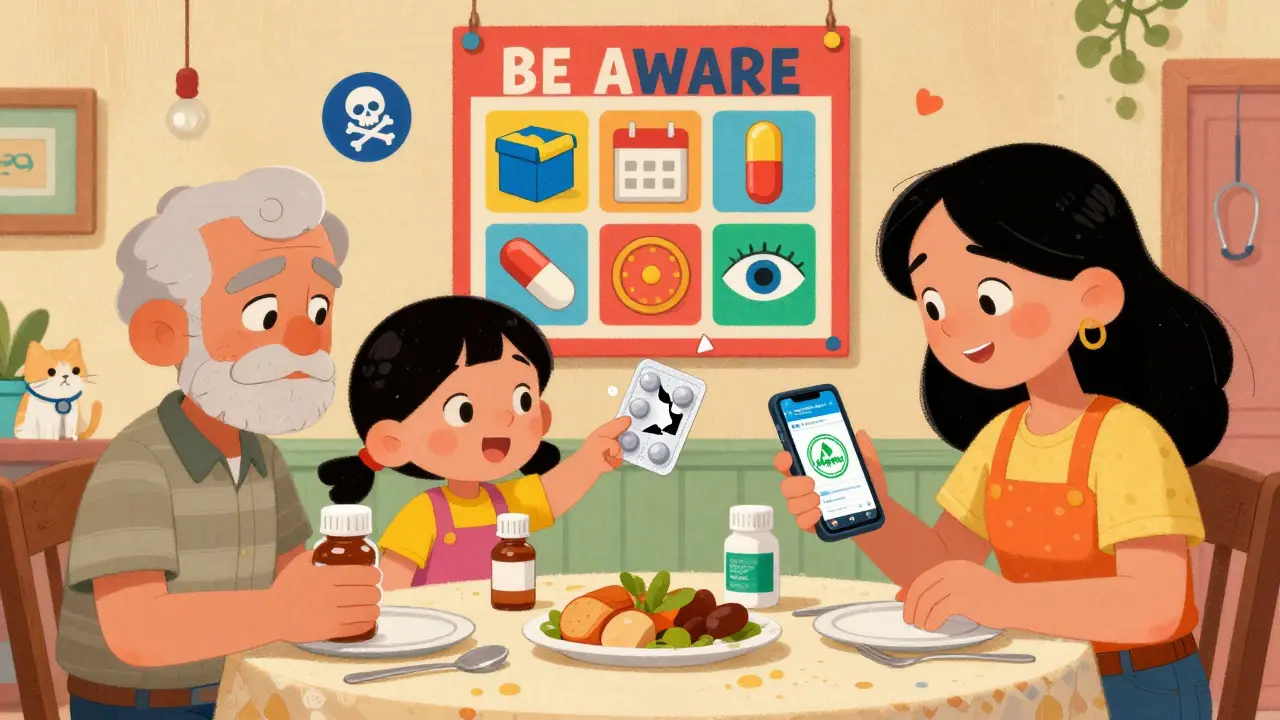
The World Health Professions Alliance created a simple tool called BE AWARE. It’s not rocket science. It’s just five things to look for every time you get a new prescription or buy over-the-counter medicine.
- B - Box: Is the packaging cracked? Faded? Does it feel cheap? Real medicine comes in sturdy, clean packaging. Fake ones often have blurry printing or mismatched colors.
- E - Expiration date: Is it faded? Smudged? Or worse - missing? Legitimate drugs always show this clearly. If it looks like someone wrote it in pen, walk away.
- A - Appearance: Look at the pill itself. Is it the same size, shape, and color as your last refill? Did the markings change? Even a tiny difference in the imprint (like a letter or number on the pill) can mean it’s fake.
- WARE - Seals and tamper-proof features: Does the blister pack have a foil seal? Does the bottle have a child-proof cap that clicks? Does the outer box have a security strip that’s broken or missing? If it doesn’t, it’s not safe.
That’s it. Five checks. Takes 30 seconds. Could save your life.
Where Fake Medicine Comes From - And How to Avoid It
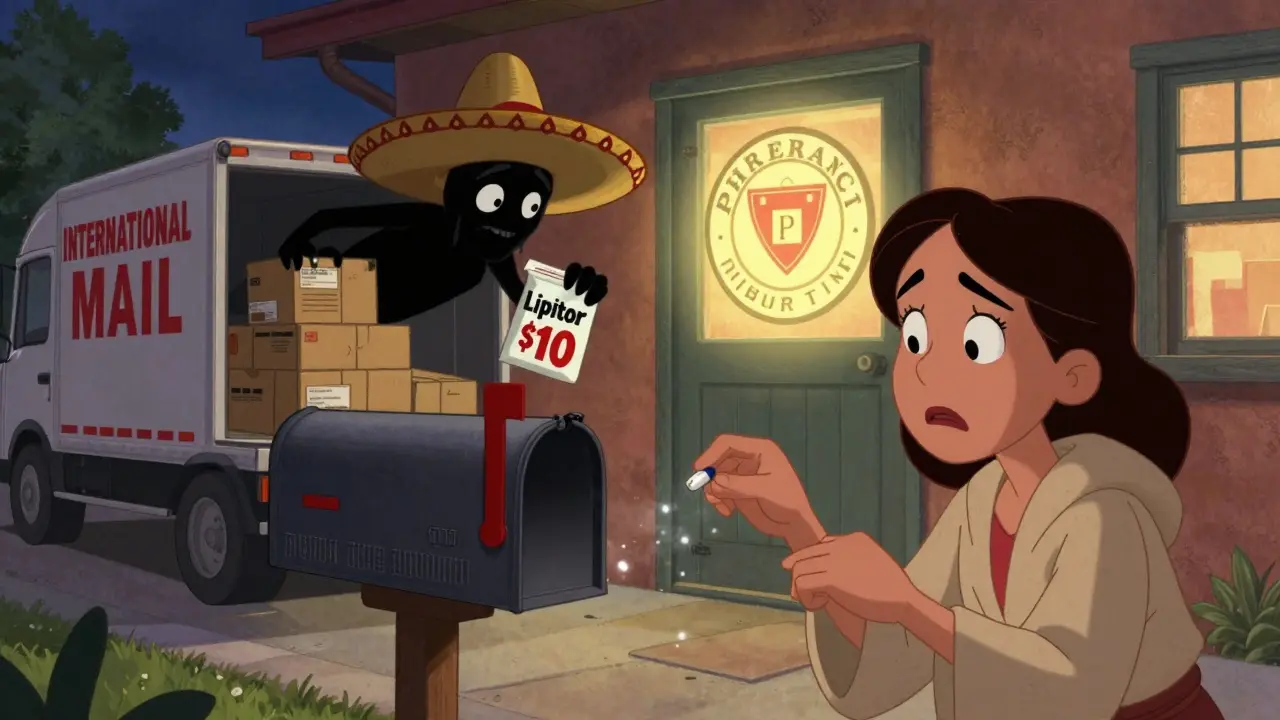
Most counterfeit drugs don’t come from shady alleyways. They come from websites that look real. You see a deal: “$10 for a 30-day supply of Lipitor?” That’s 90% cheaper than your pharmacy. Sounds too good to be true? It is.
According to Pfizer’s 2023 report, 89% of fake medicine is sold online. And 41% of U.S. consumers admitted they bought medicine from a website that didn’t have the official “.pharmacy” seal. That seal? It’s your guarantee. Only verified pharmacies can use it. If you don’t see it, don’t buy.
Even in Australia, where regulation is strong, fake drugs are sneaking in through international mail. A 2024 report from the Therapeutic Goods Administration found over 1,200 fake pills seized at borders - most from online orders shipped from Asia.
Here’s how to stay safe:
- Buy only from pharmacies you trust - the same one you’ve used for years.
- If buying online, check for the .pharmacy domain. In Australia, look for the TGA-registered pharmacy logo.
- Never buy from social media ads, Instagram sellers, or Amazon third-party vendors.
- If a price seems too low, it is. Real medicine costs money to make, test, and distribute.
What Happens When You Take a Fake Pill
People think fake medicine just doesn’t work. That’s not true. It’s far worse.
Take diabetes medication. If it has no metformin, your blood sugar spikes. You could end up in the hospital. Or worse.
Or take antibiotics. If they’re diluted, you don’t get cured. The infection spreads. And worse - bacteria start resisting real antibiotics. That’s how superbugs are born.
There are documented cases of people dying from fake cancer drugs, heart pills, and even malaria treatments. In Brazil, a woman in January 2024 noticed her father’s diabetes pills had a different imprint. She called the health authority. They tested them. They contained no insulin. Just sugar and chalk. He was lucky.
And here’s the scary part: many fake pills contain dangerous substances - rat poison, floor cleaner, or even fentanyl. The U.S. FDA has reported counterfeit pills laced with fentanyl that look exactly like oxycodone. People think they’re taking painkillers. They’re taking a death sentence.
What You Can Do - Even If You’re Not a Doctor
You don’t need a medical degree to fight fake medicine. You just need to be curious.
Here’s what works:
- Keep your old medicine boxes. Compare new ones side-by-side. If something looks off - even a little - stop and check.
- Download the WHO’s free “Medicines Safety” app. It helps you verify packaging and report suspicious products.
- Ask your pharmacist: “Can you scan this for me?” In Europe and Australia, pharmacists are required to verify serialization. Use that service.
- If you spot something fake, report it. In Australia, contact the TGA. In the U.S., use the FDA’s online portal. Pfizer alone got 14,000 consumer reports in 2023 - and shut down 217 counterfeit operations.
- Talk to your family. Especially older relatives who might not know how to check. A quick 5-minute chat could save their life.
One study found that after just three purchases, people who practiced these checks became 80% better at spotting fakes. It’s not hard. It’s just habit.
The Limits of Vigilance - And Why It Still Matters
Let’s be honest: vigilance isn’t perfect. Sophisticated counterfeits now copy packaging so well that even trained pharmacists struggle. Some fake pills have the right chemical formula - but wrong dosage. Others are perfect until you test them in a lab.
And here’s the ethical problem: in poor countries, people buy fake medicine because they can’t afford the real thing. Putting the burden on patients in those areas isn’t fair. It’s a symptom of broken health systems.
But here’s the flip side: if you live in a country with good access to medicine - Australia, the U.S., Canada, the UK - then your vigilance isn’t just helpful. It’s essential. Because every fake pill you catch means one less that reaches someone else.
Pharmaceutical companies, regulators, and law enforcement can’t be everywhere. But you can be. In your home. In your pharmacy. In your online cart.
As Dr. Margaret Hamburg, former FDA commissioner, said: “No technology can replace the human element of patient observation.”
Final Checklist: Your Anti-Counterfeit Routine
Make this part of your next medicine routine. Print it. Stick it on your fridge. Share it.
- Buy only from trusted pharmacies - physical or verified online (.pharmacy).
- Check the packaging: no cracks, no smudges, no missing seals.
- Compare pill appearance to your last refill - color, shape, imprint.
- Verify expiration date - if it’s faded or missing, don’t take it.
- Use the WHO Medicines Safety app or scan QR codes if available.
- Report anything suspicious - even if you’re not sure.
It’s not paranoia. It’s protection.
How common are counterfeit medicines in Australia?
Counterfeit medicines are rare in Australia, making up less than 1% of the market. However, fake drugs are increasingly arriving through online orders from overseas. The Therapeutic Goods Administration (TGA) seizes hundreds of fake pills each year at borders, mostly from unverified websites. While the risk is low, the consequences are high - so vigilance still matters.
Can I trust online pharmacies that offer big discounts?
No. Legitimate pharmacies don’t offer 80% off prescription drugs. Fake websites use low prices to lure people in. In 2023, the FDA found that 78% of people who bought fake medicine did so because the price seemed too good to be true. Always check for the .pharmacy domain or a TGA-registered logo before buying.
What should I do if I think I took a fake pill?
Stop taking it immediately. Contact your doctor or pharmacist. Report the medicine to your national health authority - in Australia, that’s the TGA. Keep the packaging and pill. If you feel unwell, seek medical help. Even if you feel fine, report it. Your report could prevent someone else from being harmed.
Are QR codes on medicine boxes reliable?
Yes - if they’re from a legitimate source. Countries like France and Brazil now require QR codes that link to official government databases. Scanning them shows you the drug’s origin, batch number, and expiration date. But fake QR codes exist too. If the website looks unprofessional, or asks for personal info, don’t enter anything. Stick to official health authority sites.
Do all medicines have serialization codes?
Not yet - but most prescription drugs in Europe, Australia, and the U.S. do. Since 2019, the EU required unique codes on every prescription package. Australia is moving toward this. Over-the-counter medicines and supplements often don’t have them yet. Always check the packaging for a barcode or code, and ask your pharmacist if you’re unsure.
Comments (15)
Serena Petrie
I just checked my blood pressure pills. The imprint was slightly off. I tossed 'em. Never buying online again.
Stephanie Paluch
This made me check my mom’s diabetes meds 🥺 Turns out the box was cracked and the expiration was smudged. I took her to the pharmacy today. So glad I read this. 💯
Elsa Rodriguez
I can’t believe people still buy meds off Instagram. Like, are you serious? I had a cousin die from fake heart pills. They looked EXACTLY like the real ones. The packaging was pristine. The QR code scanned fine. But the pills? Just powdered chalk and fentanyl. I’m still traumatized. Why do people ignore the signs? It’s not rocket science. If it’s too cheap, it’s poison. End of story.
tynece roberts
so i bought my zoloft from canada last year bc it was half price. it looked fine. no issues. but now im paranoid. like… what if? i dont even know how to check the seal. or the imprint. is there like a video? or something? i just wanna be sure. also i hate my pharmacist. he always looks at me like im a drug addict. so i dont ask. but now i kinda wish i did.
Hugh Breen
This is one of those posts that should go viral. Seriously. Imagine if every person who took meds checked their pills once a month. Fake drug networks would collapse overnight. We need a public health campaign - like anti-smoking ads - but for counterfeit medicine. I’m sharing this with my entire family. And my book club. And my yoga class. 🌍❤️
Byron Boror
Fake meds? That’s what you get when you let foreigners run your healthcare. We’ve got the best pharma in the world here. If you’re buying from some sketchy website, you’re asking for it. Stop being lazy. Go to CVS. Pay full price. It’s not that hard.
Lorna Brown
It’s fascinating how vigilance becomes a moral act. We’re told to trust institutions - but when institutions fail, the burden falls on the individual. Is that fair? Or is it just the cost of a system that prioritizes profit over protection? I don’t have answers. But I do know this: if I’m going to be the one checking my pill’s imprint, then I deserve a system that doesn’t make me do it.
Rex Regum
They say fake medicine kills. But let’s be real - the real killer is the government letting this happen. If they’d just regulate the internet like they regulate liquor, we wouldn’t have this mess. And don’t get me started on the WHO. They’re always so nice and diplomatic. Meanwhile, people are dying. Wake up. This isn’t a ‘public awareness’ problem. It’s a criminal negligence problem.
Kelsey Vonk
I used to think this was a problem for other people. Then my dad got prescribed a new blood thinner. I noticed the pill was a little lighter. I called the pharmacy. They scanned it. Turned out it was a different batch. They replaced it immediately. I’m so glad I didn’t just assume it was fine. Sometimes the smallest thing saves you. 🤍
Emma Nicolls
i just checked my ibuprofen and the seal was kinda loose?? i didnt even think about it before but now im so nervous. i think i need to go to the pharmacy but i dont wanna look dumb. like what if its fine?? but what if its not?? omg i cant stop thinking about it
Jimmy V
I work in pharma logistics. I’ve seen fake meds. The new ones? They’re terrifying. Laser-printed labels. Holograms. Even the smell of the plastic is copied. But here’s the giveaway: the blister pack’s edge is too smooth. Real ones have a slight ridge from the heat seal. You feel it. You don’t see it. And if you’re buying online? You can’t feel it. So don’t buy.
Sabrina Sanches
I’m gonna start keeping my old pill bottles... just in case... you never know... maybe it’ll help... i hope it helps...
Buddy Nataatmadja
I’m from Indonesia. We have this problem everywhere. People buy fake meds because they can’t afford real ones. I get it. But I also know someone who died from fake malaria pills. So I tell my family: if you can’t afford it, go to the public clinic. Don’t risk it. It’s not worth it.
mir yasir
The phenomenon of counterfeit pharmaceuticals represents a profound systemic failure in global supply chain governance. While individual vigilance is commendable, it is neither a sustainable nor an equitable solution. The onus must be placed upon multinational regulatory harmonization, robust traceability infrastructure, and the dismantling of illicit e-commerce ecosystems through transnational legal cooperation. To localize responsibility onto the patient is to absolve the culpable.
Shruti Chaturvedi
My sister in Delhi buys medicine from local shops. She says its cheaper and she trusts the shop owner. I showed her this. She cried. Now she only goes to the government hospital. Small change. Big difference.