
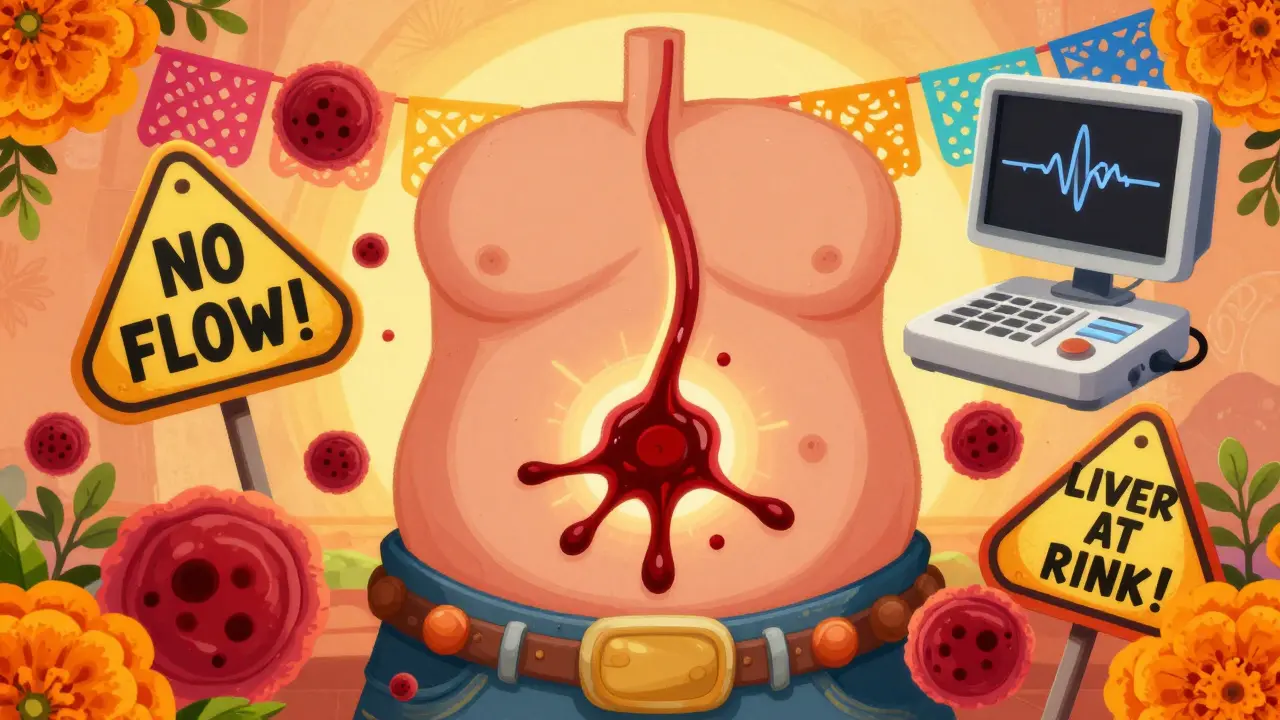
Portal vein thrombosis isn't a common condition, but when it happens, it can quickly turn dangerous-especially if missed. This is when a blood clot blocks the portal vein, the main vessel carrying blood from your intestines to your liver. Without treatment, it can lead to serious complications like intestinal damage, worsening liver disease, or even make you ineligible for a liver transplant. The good news? When caught early and treated right, most people recover well. The key is knowing what to look for and how to act.
What Exactly Is Portal Vein Thrombosis?
Portal vein thrombosis (PVT) means a clot has formed inside the portal vein or one of its branches. It’s not just a simple blockage-it’s a dynamic process. The clot can be new (acute, under 2 weeks old) or long-standing (chronic, over 6 weeks). Acute PVT often causes sudden pain, fever, or nausea. Chronic PVT might show no symptoms at all, but silently changes the liver’s blood flow, leading to collateral vessels called cavernous transformation.
It doesn’t happen out of nowhere. Common triggers include liver cirrhosis, abdominal infections, recent surgery, cancer (especially liver or pancreatic), or inherited blood clotting disorders. About 25-30% of non-cirrhotic cases have an underlying thrombophilia-like Factor V Leiden or prothrombin gene mutation-that makes blood more likely to clot. In cirrhotic patients, the problem often starts with slowed blood flow and damaged vessel walls, two of the three factors in Virchow’s classic triad of clotting.
How Is It Diagnosed?
Diagnosis starts with imaging. Ultrasound is the first test because it’s fast, cheap, and accurate-detecting portal vein clots in 89-94% of cases. A Doppler ultrasound doesn’t just show the clot; it shows whether blood is still flowing through the vein. If there’s no flow, that’s a red flag.
Doctors classify the clot by how much it blocks the vein:
- Minimally occlusive: less than 50% blockage
- Partially occlusive: 50-99% blockage
- Completely occlusive: 100% blockage
If the ultrasound is unclear or the case is complex, a CT or MRI scan with contrast (portography) gives a detailed 3D view of the portal system. These are especially useful if the vein has been blocked for a long time and has developed collateral channels-what’s called cavernous transformation.
But imaging alone isn’t enough. You also need to know why the clot formed. That means checking liver function with Child-Pugh and MELD scores, testing for cancer, screening for infections like appendicitis or diverticulitis, and running a thrombophilia panel if the patient doesn’t have cirrhosis. Missing the root cause means you’re just treating the symptom, not the problem.
Why Anticoagulation Is the Standard of Care
For years, doctors were afraid to give blood thinners to people with liver disease. The fear was bleeding-especially from swollen veins in the esophagus (varices). But research has flipped that thinking. Today, major guidelines from the American Association for the Study of Liver Diseases (AASLD) and the European Association for the Study of the Liver (EASL) agree: anticoagulation is the standard of care for most acute PVT cases, even in cirrhotic patients-if managed carefully.
The goal isn’t just to prevent the clot from getting bigger. It’s to dissolve it. Studies show that when anticoagulation starts within 6 months of diagnosis, 65-75% of patients achieve full or partial recanalization-meaning the vein reopens. If you wait longer, that number drops to just 16-35%.
And the survival difference is stark. Patients treated early have an 85% five-year survival rate. Untreated? Much lower. The clot can extend into the mesenteric veins, cutting off blood to the intestines. That’s a medical emergency-sometimes fatal.
Choosing the Right Anticoagulant
Not all blood thinners are the same for PVT. The choice depends on liver function, kidney health, and whether the patient has varices.
For non-cirrhotic patients: Direct oral anticoagulants (DOACs) are now first-line. Rivaroxaban (20 mg daily), apixaban (5 mg twice daily), and dabigatran work just as well as older drugs but are easier to manage. No need for frequent blood tests. A 2020 Blood Advances study showed DOACs led to recanalization in 65-75% of cases, compared to 40-50% with warfarin.
For cirrhotic patients (Child-Pugh A or B): Low molecular weight heparin (LMWH), like enoxaparin, is still preferred. Why? It’s cleared by the kidneys, not the liver, so it’s more predictable. Dosing is weight-based: 1 mg/kg twice daily or 1.5 mg/kg once daily. Target anti-Xa levels should be 0.5-1.0 IU/mL. Studies show LMWH gives better recanalization (55-65%) than warfarin (30-40%) in this group.
Warfarin (VKAs) is still used, especially where DOACs aren’t available or affordable. But it needs regular INR checks, and the target is 2.0-3.0. It’s harder to keep stable in people with liver disease, which is why it’s falling out of favor.
DOACs are not safe in Child-Pugh C cirrhosis. The FDA has black box warnings for this group. In advanced liver failure, the liver can’t metabolize these drugs properly, raising bleeding risk.
When Anticoagulation Is Too Risky
There are clear red flags that make anticoagulation dangerous:
- Recent variceal bleeding (within 30 days)
- Uncontrolled ascites
- Child-Pugh class C cirrhosis
- Platelet count below 30,000/μL (unless transfused)
In cirrhotic patients, the biggest fear is variceal bleeding. That’s why experts now recommend endoscopic band ligation before starting anticoagulation. A 2022 UCLA study of 89 patients showed this cut major bleeding from 15% down to 4%.
Also, don’t start anticoagulation if the patient is actively septic or has an ongoing infection. The clot might be a reaction to inflammation-and treating the infection could resolve it.
How Long Should Treatment Last?
It’s not one-size-fits-all.
- Provoked PVT: If the clot was triggered by something temporary-like recent surgery, infection, or pregnancy-treat for at least 6 months. Then reassess. If the trigger is gone and the vein is open, you might stop.
- Unprovoked PVT: If no clear cause is found, especially in non-cirrhotic patients, treat for at least 12 months. Many will need lifelong therapy, especially if a thrombophilia is found.
- With cancer: Lifelong anticoagulation is needed. The cancer itself keeps the blood hypercoagulable.
- Before liver transplant: Anticoagulation improves transplant outcomes. One 2021 study showed 85% one-year survival in anticoagulated transplant candidates versus 65% in those who weren’t treated.
What If Anticoagulation Doesn’t Work?
Some clots don’t respond. Or they’re too large. Or the patient can’t tolerate blood thinners. That’s when other options come in.
Transjugular Intrahepatic Portosystemic Shunt (TIPS): This procedure creates a tunnel inside the liver to bypass the blocked vein. It works in 70-80% of cases. But it comes with a 15-25% risk of hepatic encephalopathy-confusion, drowsiness, even coma. It’s a last resort after failed anticoagulation.
Percutaneous thrombectomy: A catheter is inserted to physically remove the clot. Immediate recanalization rates are 60-75%. But this is only available in specialized centers. It’s usually paired with local clot-busting drugs (thrombolysis) and followed by anticoagulation.
Surgical shunts: Rare today. Too invasive. Reserved for young patients with no other options.
Most patients still do best with anticoagulation. The other options are for complex cases or failures.
Real-World Outcomes and Challenges
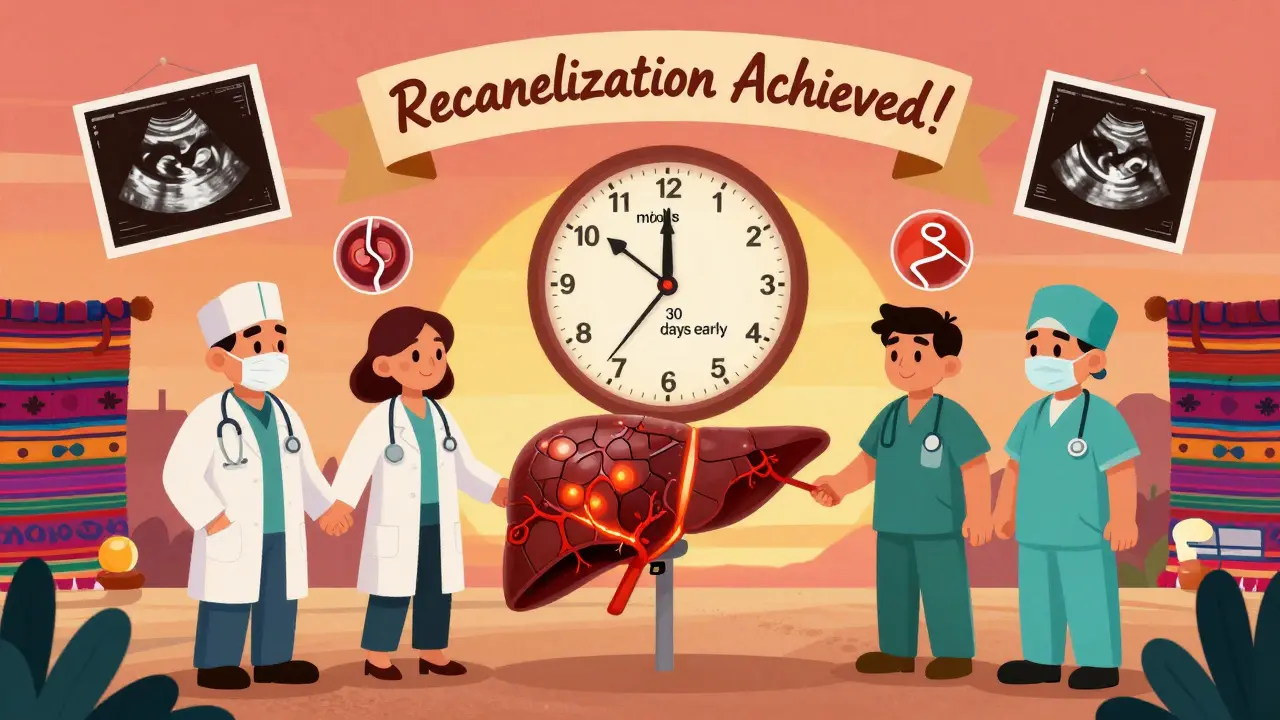
At Mayo Clinic, 78% of patients treated within 30 days of diagnosis saw partial or full recanalization. Only 42% did if treatment was delayed. At UCSF, anticoagulation cut the number of liver transplant candidates ruled out due to PVT from 22% to 8%.
But challenges remain. One major issue is timing. Many patients aren’t diagnosed until they’re already in crisis-like with abdominal pain and vomiting from intestinal ischemia. Massachusetts General Hospital found 22% of those patients died. Promptly treated? Just 5% mortality.
Another issue is access. Only 35% of general gastroenterologists feel confident managing PVT anticoagulation. That’s why multidisciplinary teams-hepatologists, radiologists, transplant surgeons, and nurses-are critical. Johns Hopkins reported a 35% drop in complications when they used a team-based approach.
What’s New in 2025?
The field is moving fast. In January 2024, AASLD updated its guidelines to allow DOACs in Child-Pugh B7 patients, based on the CAVES trial showing similar results to LMWH. And in 2023, the FDA approved andexanet alfa-a reversal agent for rivaroxaban and apixaban-which gives doctors a safety net if bleeding happens.
Two big studies are underway:
- A 500-patient trial comparing rivaroxaban vs. enoxaparin in cirrhotic PVT (results due late 2025)
- A phase 2 trial of abelacimab, a new anticoagulant that targets factor XI (NCT05214572)
Genetic testing is also becoming more common. If a patient has Factor V Leiden or prothrombin mutation, they’re 80% more likely to benefit from long-term anticoagulation. Precision medicine is coming to PVT.
Getting Started: A Simple Action Plan
If you suspect PVT, here’s what to do:
- Get a Doppler ultrasound-this is your first step.
- Check liver function with Child-Pugh and MELD scores.
- Screen for varices with endoscopy-if cirrhotic, do band ligation before starting anticoagulation.
- Test for thrombophilia if no clear cause and no cirrhosis.
- Start anticoagulation immediately if acute and no contraindications.
- Use LMWH for cirrhotic patients (Child-Pugh A/B), DOACs for non-cirrhotic.
- Reimage at 3-6 months to check for recanalization.
- Plan long-term therapy based on cause and response.
Don’t wait. Early action saves lives. And remember-this isn’t just about a clot. It’s about protecting the liver, the gut, and the future.
Can portal vein thrombosis be cured?
Yes, in many cases. With early anticoagulation, 65-75% of patients achieve full or partial recanalization-meaning the clot dissolves and blood flow restores. Success depends on timing: treatment started within 6 months has much higher success than delayed treatment. Chronic PVT is harder to reverse, but anticoagulation still prevents complications and improves survival.
Is anticoagulation safe for people with cirrhosis?
It can be, but only in compensated cirrhosis (Child-Pugh A or B). In advanced cirrhosis (Child-Pugh C), anticoagulation is dangerous due to high bleeding risk. The key is screening for varices first-band ligation before starting blood thinners reduces major bleeding by more than 70%. LMWH is preferred over warfarin or DOACs in this group because it’s more predictable.
Do I need lifelong anticoagulation for portal vein thrombosis?
Not always. If the clot was caused by a temporary issue like surgery or infection, 6 months of treatment is often enough. But if you have an inherited clotting disorder (like Factor V Leiden), cancer, or no clear cause (unprovoked PVT), lifelong anticoagulation is usually recommended. Your doctor will reassess based on imaging and risk factors after initial treatment.
Can portal vein thrombosis lead to liver failure?
It doesn’t directly cause liver failure, but it worsens it. A blocked portal vein increases pressure in the liver, leading to more scarring, fluid buildup (ascites), and varices. In cirrhotic patients, untreated PVT can accelerate progression to decompensated liver disease. It also makes liver transplant more difficult-if the clot extends into the hepatic artery or causes portal hypertension, transplant eligibility drops.
What are the signs of a worsening portal vein thrombosis?
Warning signs include sudden abdominal pain (especially after eating), fever, nausea, vomiting, or bloody stools. These could mean the clot has spread to the mesenteric veins, cutting off blood to the intestines-a condition called mesenteric ischemia. This is a medical emergency. If you have cirrhosis and develop new or worsening ascites or confusion, it could signal worsening portal hypertension or hepatic encephalopathy due to the clot.
Can I take over-the-counter painkillers if I have PVT?
Avoid NSAIDs like ibuprofen or naproxen-they increase bleeding risk and can harm the liver. Acetaminophen (paracetamol) is safer, but stick to the lowest effective dose-no more than 2,000 mg per day if you have liver disease. Always check with your doctor before taking any new medication, even if it’s sold without a prescription.
Comments (8)
shivam seo
This is why we need to stop letting big pharma dictate liver care. Anticoagulants? More like profit-driven poison. I’ve seen patients get worse after being put on these drugs. The real solution is detox diets and liver cleanses. Why are we ignoring traditional medicine? The system is rigged.
Andrew Kelly
Let me be clear: if you're prescribing DOACs to cirrhotic patients without a full thrombophilia panel, you're not a doctor-you're a gambler. The FDA black box warning exists for a reason. And yet, here we are, turning medical guidelines into a game of Russian roulette with people's livers. This isn't science. It's corporate negligence dressed up as progress.
Anna Sedervay
I must say, the linguistic precision of this article is profoundly inadequate. One must question the epistemological foundations of 'recanalization' as a clinical metric-especially when it is operationalized without accounting for microvascular reperfusion heterogeneity. Moreover, the omission of quantum hemodynamic modeling in the discussion of portal flow dynamics is, frankly, intellectually indefensible. This is not medicine. It is narrative fiction masquerading as evidence.
Ashley Bliss
I just cried reading this. I lost my brother to PVT. They told him it was 'just a clot.' Just a clot?! He was 34. They waited three weeks because his INR was 'fluctuating.' He bled out in the ER while they argued over whether to give him heparin. Now I watch every medical article like a hawk. If you're not screaming about early anticoagulation, you're part of the problem. This isn't a blog. It's a eulogy.
Mahammad Muradov
In India, we don't have access to DOACs. We use warfarin. And we manage. You Americans think your drugs are superior, but the truth is, with proper monitoring, warfarin works. Also, most PVT cases here are due to TB or hepatitis-something you rarely mention. Your guidelines are irrelevant to the global south.
holly Sinclair
There's something deeply poetic about the portal vein-it's not just a conduit, it's a metaphor. The river of nutrients from the gut to the liver, the body's silent lifeline, choked by a clot. We treat it like a mechanical failure, but isn't it also a spiritual rupture? The body screaming, 'I am overwhelmed.' Anticoagulation isn't just chemistry-it's a surrender to the inevitability of decay, and yet, in that surrender, we find grace. To restore flow is to restore harmony. To ignore it is to deny the body's wisdom.
Monte Pareek
Listen up everyone. If you're still hesitating on anticoagulation for PVT you're costing lives. I've seen it too many times. Cirrhotic patient with Child-Pugh B? Band ligation first. Then LMWH. Done. No drama. No waiting. No 'let's run more tests.' Time is liver. If you're reading this and you're a GI doc in a small town-you can do this. You don't need a fancy hospital. You need courage. Start the heparin. Call the transplant center. Save the person. That's your job. Not your ego. Not your fear. The person. Do it.
Tim Goodfellow
Bloody brilliant breakdown. This is the kind of clarity that makes me want to high-five every hepatologist in the room. Anticoagulation isn't just treatment-it's rebellion against the slow death of overlooked patients. And that TIPS stat? 70-80% success? That’s not medicine. That’s magic. But the real hero here? The nurse who catches the subtle drop in platelets. The radiologist who spots the cavernous transformation on a tired 2am scan. These are the unsung warriors. Let’s not forget them.