
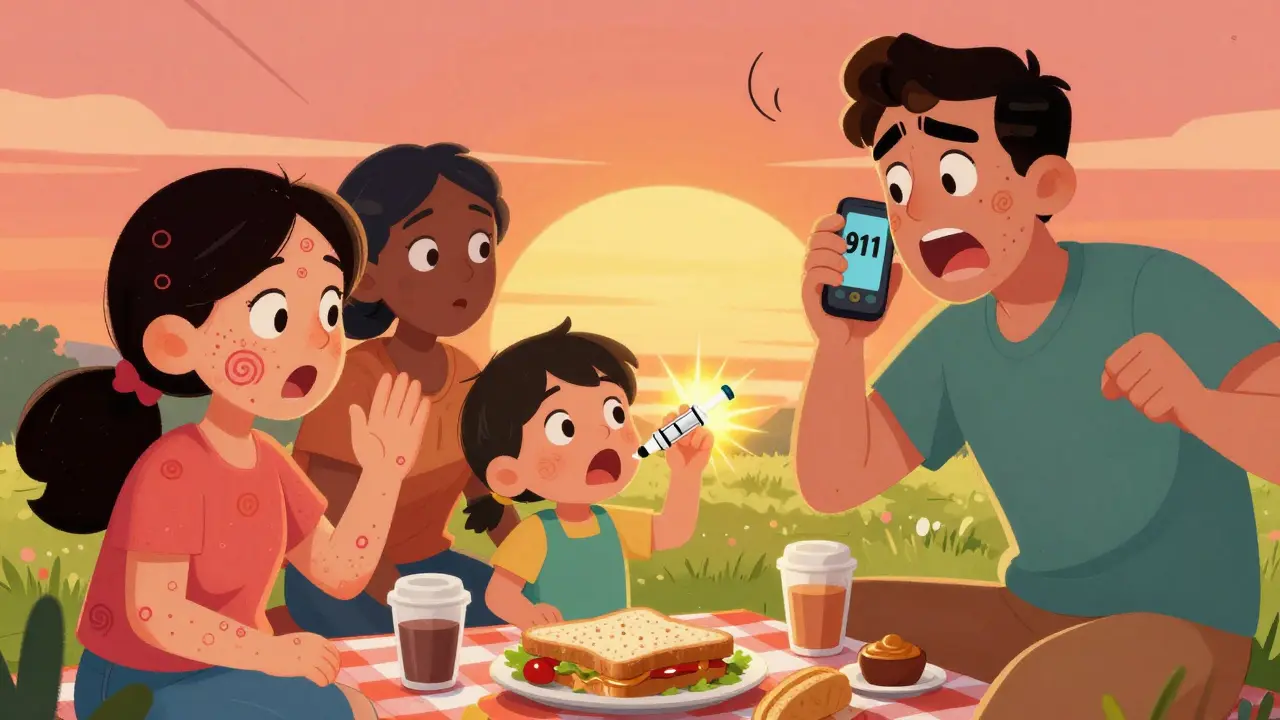
When your body overreacts to something harmless-like a peanut, a bee sting, or a medication-it can turn deadly in seconds. This is anaphylaxis a sudden, life-threatening allergic reaction that affects multiple body systems and requires immediate treatment with epinephrine. It doesn’t wait for permission. It doesn’t care if you’re having a quiet lunch or driving to work. If you don’t act fast, it can shut down your breathing or stop your heart.
What Happens During an Anaphylactic Reaction?
Anaphylaxis isn’t just a bad rash or a stuffy nose. It’s a full-body emergency. Within minutes, your immune system releases a flood of chemicals that cause blood vessels to leak, airways to swell, and your blood pressure to crash. You might feel your throat closing, your chest tightening, or your stomach churning. Skin reactions like hives or swelling are common-but they’re not always the first sign.
The official diagnostic criteria from the Resuscitation Council UK (2021) say anaphylaxis is likely if you have:
- Sudden onset of illness (within minutes to hours)
- Plus skin or mucosal symptoms (like hives, swelling of lips or tongue) AND one of these: trouble breathing, low blood pressure, or organ dysfunction
- Or, two or more of these after exposure to a likely allergen: skin symptoms, breathing problems, low blood pressure, or ongoing stomach pain/vomiting
Most people (80-90%) get skin symptoms first. But in 10-20% of cases, breathing or heart problems show up before any rash. That’s why you can’t wait to see a rash before acting. If you feel like you’re going to pass out, can’t catch your breath, or your voice sounds strange-epinephrine is needed now.
Why Epinephrine Is the Only Treatment That Works
You’ve probably heard that antihistamines like Benadryl help with allergies. They do-for mild reactions. But when it comes to anaphylaxis? They’re useless on their own. A Cochrane Database review from 2012 found zero evidence that antihistamines can stop anaphylaxis. Steroids? They might help prevent a second wave of symptoms later-but they do nothing in the moment.
Only one drug saves lives right away: epinephrine. It works in three ways:
- It tightens blood vessels to raise your blood pressure
- It opens your airways so you can breathe
- It stops the flood of dangerous chemicals your body is releasing
Studies show that when epinephrine is given within the first few minutes, 85% of people start feeling better in under five minutes. If you wait longer-say, 15 minutes or more-your chance of dying rises sharply. Emergency medicine specialists agree: epinephrine is the only first-line treatment for anaphylaxis, and there is no substitute.
How to Use an Epinephrine Auto-Injector
Most people carry epinephrine in a device called an auto-injector. Brands like EpiPen, Auvi-Q, and Adrenaclick look different but work the same way. Here’s how to use one:
- Remove the safety cap (usually blue or gray)
- Place the injector firmly against the outer thigh-through clothing if needed
- Press hard until you hear a click
- Hold it in place for 3 seconds
- Remove and massage the area for 10 seconds
Why the thigh? Because the muscle there absorbs the drug fastest-peak levels hit your bloodstream in about 8 minutes. Injecting in the arm or butt takes much longer, and could cost you time.
For adults and teens over 30 kg (about 66 lbs), the dose is 0.3 mg. For kids between 15-30 kg (33-66 lbs), it’s 0.15 mg. Never guess. Use the one prescribed for you.

What to Do After the Injection
Even if you feel better after the shot, you still need to call emergency services. Anaphylaxis can come back-sometimes hours later. This is called a biphasic reaction, and it happens in up to 20% of cases.
Here’s what you must do after using epinephrine:
- Call 911 or your local emergency number immediately
- Go to the ER-even if symptoms improve
- Stay under observation for at least 12 hours if you have asthma, heart disease, or needed more than one dose
- Bring your used injector with you-it helps doctors understand what happened
Don’t drive yourself. Don’t wait to see if it gets worse. The risk of a second wave is real, and it’s unpredictable.
Common Mistakes That Cost Lives
Surveys show that 43% of people delay epinephrine because they think the reaction isn’t “bad enough.” That’s the biggest killer. Another 22% avoid using it because they’re scared of the needle. And 68% of people who try to use an auto-injector for the first time get the technique wrong.
Here are the top mistakes-and how to avoid them:
- Mistake: Waiting for a rash. Solution: If you have trouble breathing, dizziness, or throat tightness-inject immediately.
- Mistake: Using expired devices. Solution: Check the expiry date every month. Most last 12-18 months. Replace them before they expire.
- Mistake: Storing in the car or fridge. Solution: Keep it at room temperature (20-25°C). Extreme heat or cold can ruin the medicine.
- Mistake: Never practicing. Solution: Use a trainer device once a month. Many pharmacies give them out for free.
One Australian study found that people who practiced with trainers were 3 times more likely to use the real device correctly during an emergency.
Who Needs an Epinephrine Auto-Injector?
You don’t have to have had a full-blown reaction before to need one. If you’ve had a moderate reaction-like swelling after eating peanuts, or trouble breathing after a bee sting-you’re at higher risk for a worse one next time. Doctors recommend carrying epinephrine if:
- You’ve had anaphylaxis before
- You have food allergies (especially to peanuts, tree nuts, shellfish)
- You’ve had a reaction to insect stings
- You’re allergic to medications like penicillin
- You have asthma and any allergy-this doubles your risk
Food allergies alone affect 1 in 10 children in the U.S., and the numbers keep rising. Peanut allergies have tripled since the 1990s. That’s why schools in all 50 U.S. states now keep stock epinephrine on hand. It’s not just for kids with prescriptions-it’s for anyone who needs it.
Cost, Access, and New Options
Epinephrine auto-injectors still cost a lot. In 2023, the average out-of-pocket price in the U.S. was $185 for a two-pack-down from $325 in 2016. Generic versions now cover 70% of prescriptions, which helps. But in Australia and other countries, access varies. Some people skip refills because of cost. That’s dangerous.
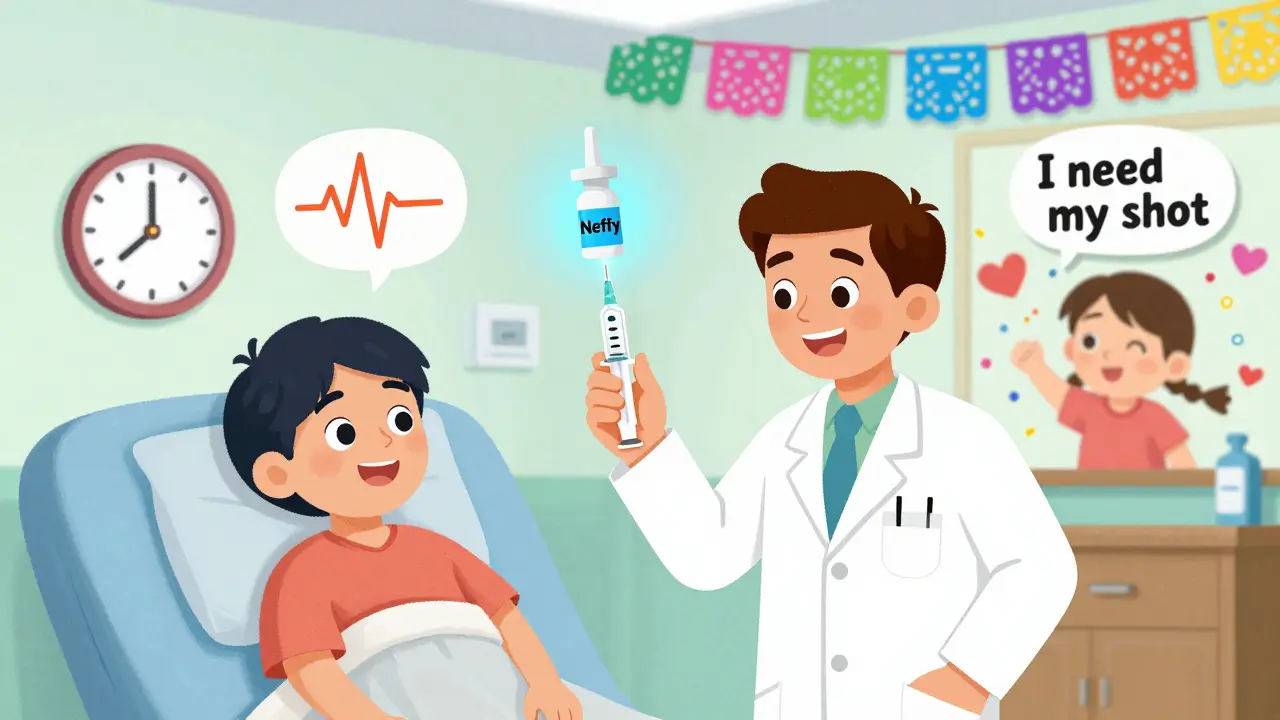
There’s good news on the horizon. In August 2023, the FDA approved Neffy, a nasal spray version of epinephrine. It’s needle-free, easy to use, and works just as fast. It’s already available in the U.S. and may reach other countries soon.
Smart injectors are also in development-devices that beep when used, send alerts to your phone, or even call emergency services automatically. These aren’t mainstream yet, but they’re coming.
What You Need to Remember
Anaphylaxis is rare-but it’s deadly if ignored. Epinephrine is simple, fast, and lifesaving. You don’t need to be a doctor to use it. You just need to act.
Here’s your checklist:
- Know your triggers
- Carry your injector at all times
- Check the expiry date monthly
- Practice with a trainer every month
- Tell family, coworkers, teachers how to use it
- Call emergency services after every use-no exceptions
If you’re the parent of a child with allergies, teach them to say: “I need my shot.” If you’re an adult with a history of reactions, don’t wait for symptoms to get worse. Inject early. Save your life.
What are the early signs of anaphylaxis?
Early signs include hives, swelling of the lips or tongue, itching in the mouth, a feeling of warmth, nausea, or dizziness. Breathing problems like wheezing or tightness in the throat often follow quickly. Don’t wait for a rash to appear-any combination of these symptoms after exposure to a known allergen means you need epinephrine now.
Can you use someone else’s epinephrine injector?
Yes. If someone is having anaphylaxis and you have an injector-even if it’s not prescribed to them-you should use it. Epinephrine is safe for most people, and the risk of not acting far outweighs the risk of giving it. There’s no legal liability for using it in an emergency. Save the life first.
Why is the thigh the best place to inject?
The thigh muscle (vastus lateralis) has rich blood flow, so epinephrine gets absorbed quickly-within 8 minutes. Injecting in the arm or buttocks delays absorption by up to 20 minutes, which can be deadly. Even through clothing, the thigh is the most reliable spot for fast delivery.
Do antihistamines or steroids help during anaphylaxis?
No-not as the first treatment. Antihistamines like Benadryl do nothing to stop airway swelling or low blood pressure. Steroids may help prevent a second reaction hours later, but they take hours to work. Epinephrine is the only drug that works fast enough to save a life during anaphylaxis. Use them only after epinephrine, if directed by a doctor.
What if I’m not sure it’s anaphylaxis?
If you’re unsure but suspect an allergic reaction-especially if breathing or circulation is affected-give the epinephrine. It’s safer to use it when not needed than to delay it when it’s needed. Epinephrine has a wide safety margin. Side effects like a racing heart or shaking are temporary. Death from delayed treatment is permanent.
Comments (10)
Melissa Starks
Look I get it, epinephrine saves lives but like... why do we treat this like it’s some magic bullet when the real issue is that we let allergens run rampant in food systems? Peanuts in everything, shellfish in sauces, dairy in kids’ snacks - we’re literally engineering allergies into society. And then we hand out pens and say ‘just inject yourself’ like it’s a band-aid on a hemorrhage. Someone needs to regulate the damn food industry, not just teach people how to poke their thigh.
I’ve seen kids in school with EpiPens like they’re carrying a bomb. No one teaches them how to live with it, just how to survive it. We need prevention, not just emergency kits. This whole system feels like putting a fire extinguisher in every room but leaving the gas stove on full blast.
Kal Lambert
Correct. Epinephrine is the only thing that works. No debate. Antihistamines? Useless. Steroids? Too slow. Delay = death. Period.
Emily Hager
While I appreciate the clinical precision of this article, I must express my profound concern regarding the normalization of self-administered pharmaceutical intervention as a societal default. The reliance on auto-injectors, while ostensibly pragmatic, reflects a disturbing erosion of systemic medical oversight. One cannot help but wonder: are we cultivating a generation of individuals who are medicated into survival rather than educated into prevention? The psychological burden of perpetual readiness - the constant vigilance, the social stigma, the financial strain - is rarely acknowledged in these narratives. Is this truly progress, or merely a technocratic bandage on a systemic wound?
Lauren Volpi
lol at all this science. epinephrine? yeah right. did you know the real cause of anaphylaxis is 5G towers and CDC mind control? they made peanut allergies worse so people would buy more epipens. pharma is running the show. i saw a guy on youtube with 2M subs say the thigh injection is just a distraction - the real treatment is drinking apple cider vinegar and screaming into a pillow. also, why is it always the thigh? what if you’re in a wheelchair? they don’t tell you that. #epipensareascam
Melissa Stansbury
I had anaphylaxis once. Didn’t even know I was allergic until I passed out at a birthday party. They gave me the shot. I woke up in the ER. The scariest part? Not the swelling. Not the choking. It was realizing no one around me knew what to do. One guy tried to give me a Benadryl. Another called my mom. No one thought to grab the EpiPen from my purse. I’ve been carrying two now. I taught my coworkers. I made a poster. I don’t care if it’s awkward. I’d rather be the weirdo who saved a life than the one who didn’t say anything.
cara s
It is fascinating, is it not, how modern medicine has transformed what was once a fatal physiological event into a procedural, almost mundane, act of self-intervention. The auto-injector, a marvel of pharmaceutical engineering, has rendered the once-mysterious and terrifying phenomenon of anaphylaxis into a predictable, manageable condition - yet paradoxically, this very normalization has bred complacency. The ritual of monthly trainer practice, the inspection of expiry dates, the dissemination of protocols - all of these are necessary, yes, but they are also symptoms of a deeper cultural failure: we have outsourced our biological vulnerability to a plastic device. And we are not merely patients anymore. We are technicians of our own survival.
One wonders, in the long arc of medical history, whether future generations will view this era as one of profound innovation - or of tragic surrender.
Amadi Kenneth
Wait… wait… wait. So you’re telling me that the FDA approved a NAsAL spray version of epinephrine? That’s a RED FLAG. Why? Because the government doesn’t want us to use injectors - they want us to use nasal sprays so they can track usage through microchips embedded in the packaging. I’ve seen the patents. There’s a GPS chip in Neffy. And the ‘smart injectors’? They’re sending data to the WHO. They’re building a database of allergic people to control population mobility. You think schools keep stock epinephrine for kids? No. They’re collecting DNA samples under the guise of ‘safety.’ I’ve got a cousin who works at a pharmacy - he says they’re labeling allergic patients as ‘high-risk bio-templates.’ This is not medicine. This is surveillance. Don’t trust the needle. Don’t trust the spray. Trust your gut.
Shameer Ahammad
Let me be very clear: this entire narrative is dangerously misleading. Epinephrine is not a ‘lifesaver’ - it is a temporary bandage applied by people who refuse to address root causes. Why are peanut allergies increasing? Because of glyphosate in soil, GMO contamination, and the industrialization of food. Instead of fixing the system, we give people a shot and call it progress. This is not healthcare - this is corporate capitalism disguised as public safety. The fact that you’re being told to ‘check expiry dates’ while the price of epinephrine remains exorbitant proves the system is designed to profit from fear. And you? You’re just a consumer in this sick game. Wake up.
Alexander Pitt
Agreed with Kal. Epinephrine is the only first-line treatment. No alternatives. No exceptions. If you’re unsure - use it. Side effects are temporary. Death is not. Practice with a trainer. Teach others. Carry two. Check expiry. Call 911. That’s it.
Manish Singh
I’m from India, and I’ve seen how this plays out differently here. In rural areas, people don’t even know what an EpiPen is. They use herbal remedies - neem paste, turmeric milk, sometimes even cow urine. I’m not saying those work - but I am saying access isn’t just about education, it’s about equity. In the U.S., you can buy two injectors for $185. In rural Bihar? You’d need to sell your goat. The fact that Neffy is available in the U.S. but not in most of the Global South? That’s not innovation - that’s inequality dressed up as science. We need global distribution, not just better needles.
Also - the thigh thing? I’ve seen a guy inject into his butt because he was in a wheelchair. He survived. The guidelines say thigh, but life doesn’t always follow guidelines. Flexibility matters. Rigidity kills.