
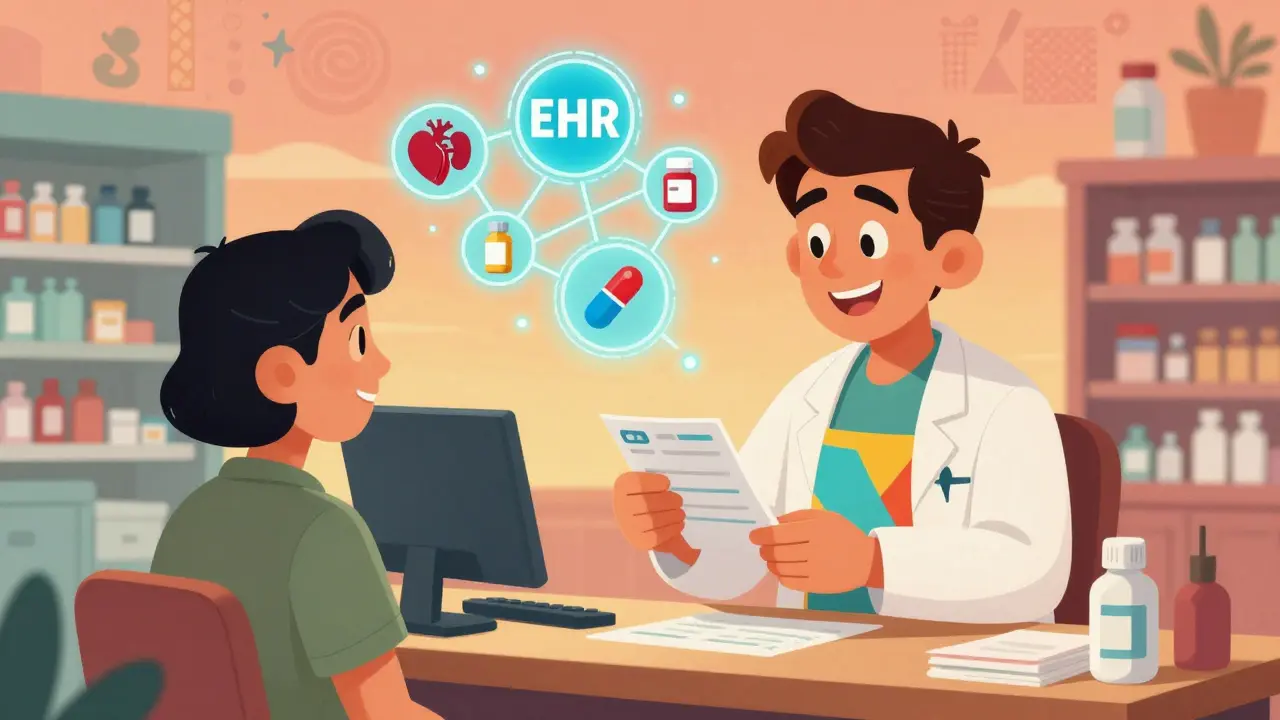
Imagine this: a patient walks into a pharmacy with a new prescription. The pharmacist checks the bottle, runs a quick scan, and spots a dangerous interaction with a medication the patient is already taking. But here’s the catch - the doctor who wrote the script never knew the patient was on that other drug. That’s not a rare mistake. It’s the norm in most community pharmacies today - and it’s costing lives.
That’s where EHR integration changes everything. When a pharmacy’s system talks directly to a doctor’s electronic health record (EHR), prescriptions stop being isolated paper trails and become part of a living health story. This isn’t science fiction. It’s happening right now - in clinics, hospitals, and even small-town pharmacies - and it’s cutting errors, saving money, and giving pharmacists real power to protect patients.
How EHR Integration Actually Works
EHR integration means two systems - a doctor’s EHR and a pharmacy’s management software - share data securely and automatically. It’s not just about sending a prescription. It’s about sharing medication histories, lab results, allergies, and even care plans. The magic happens through two key standards: NCPDP SCRIPT for sending prescriptions, and HL7 FHIR for everything else - like seeing if a patient’s kidney function has dropped, or if their blood pressure meds were changed last week.
When a doctor writes a script in Epic or Cerner, it doesn’t just go to the pharmacy. It goes into a digital pipeline that checks for duplicates, interactions, and dosing errors before it even prints. The pharmacy then sends back updates: “Patient picked up the antibiotic. They’re allergic to sulfa. We switched them to azithromycin.” That note appears in the doctor’s chart - in real time. No phone calls. No faxes. No waiting.
This isn’t guesswork. In a 2021 study by EnlivenHealth and the University of Tennessee, pharmacists using integrated systems flagged and resolved 1,847 medication issues across 12 pharmacies. Providers accepted 92% of those suggestions. That’s not luck. That’s precision.
The Real Benefits: Less Errors, Fewer Hospital Visits
The numbers don’t lie. When EHRs and pharmacies talk to each other:
- Medication errors drop by 48%
- Prescription processing time falls from 15 minutes to under 6 minutes
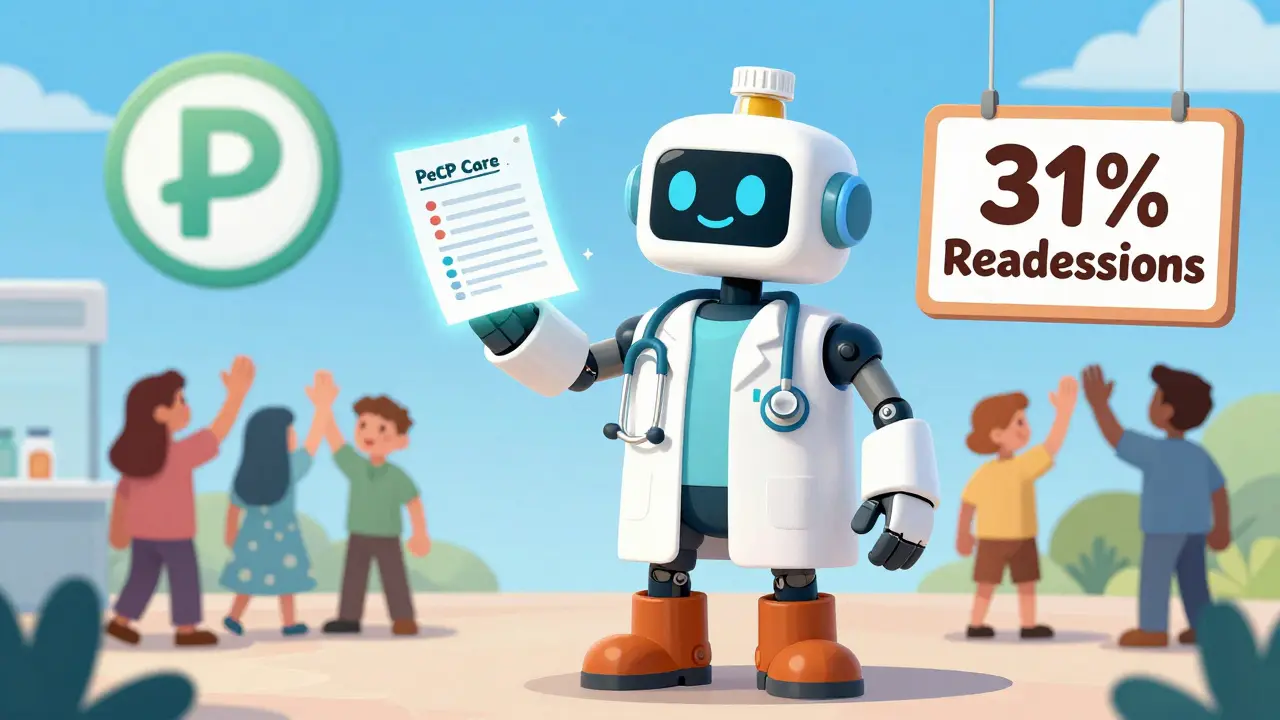
- Hospital readmissions due to bad meds drop by 31%
- Patients stick to their meds 23% more often
- Pharmacists spot 4.2 medication problems per patient - up from just 1.7 without integration
In Australia, the My Health Record system cut preventable hospital stays by 27% after linking pharmacy data with clinical records. In the U.S., the University of Wisconsin found that patients with integrated care had 31% fewer readmissions within 30 days of discharge. That’s not just better care - that’s fewer ICU beds used, fewer families stressed, and millions saved.
And it’s not just about avoiding harm. It’s about catching things early. One pharmacist in Ohio told me her system flagged a patient’s rising creatinine levels - a sign of kidney damage - after a new blood pressure drug was added. She called the doctor. They switched the med. The patient avoided dialysis. That’s the kind of thing that only happens when pharmacists can see the full picture.
Why Most Pharmacies Still Don’t Have It
So why aren’t all pharmacies using this? Because it’s expensive, messy, and underpaid.
Independent pharmacies face $15,000 to $50,000 just to get started. Then there’s $5,000 to $15,000 a year just to keep it running. For a small business that barely makes a profit on prescriptions, that’s a hard sell. And even if they pay, they often get locked into systems that don’t talk to the doctor’s software. There are over 120 EHR platforms and 50 pharmacy systems in the U.S. - and most don’t speak the same language.
Then there’s the time problem. Pharmacists average just 2.1 minutes per patient. That’s not enough to dig through EHRs, even if they’re allowed in. A 2021 survey of 347 pharmacists found 68% said they simply didn’t have time to review patient records - even when they had access.
And here’s the kicker: only 19 states pay pharmacists for the time they spend reviewing EHRs and adjusting meds. In 48 states, pharmacists can prescribe - but if they spot a problem and fix it, they often can’t get reimbursed. That’s like having a mechanic fix your engine but not being allowed to charge for it.
Who’s Doing It Right
Some players are making it work.
Surescripts processes over 22 billion transactions a year - from e-prescribing to prior authorizations. They connect 97% of U.S. pharmacies to providers. Their Medication History tool alone saves pharmacists hours chasing down old records. But even they can’t fix the payment problem.
Smaller tools like SmartClinix and DocStation offer pharmacy-specific EHRs with built-in integration. SmartClinix starts at $199/month and integrates directly with Epic and Cerner. Users praise the seamless flow - but complain about the steep learning curve. DocStation’s strength? Billing and provider networks. But it doesn’t do specialty pharmacy well.
Big pharmacy chains? CVS and Walgreens have been running pilot programs with AI that scans integrated EHR data to predict which patients are at risk for bad reactions. Early results show a 37% jump in intervention accuracy. That’s not just automation - it’s prevention at scale.
The Future Is Here - If We Pay for It
The government is pushing hard. The 21st Century Cures Act bans information blocking. Medicare Part D now rates plans on how well they integrate medication therapy management. California’s SB 1115 requires EHR integration for MTM by 2026. CMS wants 80% of Medicare Part D plans to have full pharmacy integration by 2025.
And the tech is getting smarter. The new Pharmacist eCare Plan (PeCP) standard, set to roll out in late 2024, will let pharmacists send structured care plans directly into EHRs - like a doctor’s note, but from the pharmacist’s perspective. It includes lab trends, adherence notes, and even patient-reported symptoms.
The real bottleneck? Money. Without reimbursement, integration stays a luxury for big health systems. Only 3 out of 127 community pharmacies in Wisconsin had formal EHR access agreements. That’s 2.3%. The rest? Left out.
Dr. Lucinda Maine of the American Association of Colleges of Pharmacy put it bluntly: “Without sustainable payment models, EHR integration will remain a luxury rather than a standard of care.” And she’s right. We’ve built the highway. But we’re not paying the drivers to use it.
What You Can Do - Whether You’re a Pharmacist, Patient, or Provider
If you’re a pharmacist: Ask your vendor if they support FHIR and NCPDP SCRIPT. Demand integration. Push your local clinic to share data. Don’t wait for permission - start the conversation.
If you’re a doctor: Ask your EHR vendor if they connect with community pharmacies. If they don’t, demand it. Your patients are getting prescriptions filled somewhere - and you’re flying blind.
If you’re a patient: Ask your pharmacist if they can see your full medication history. If they can’t, ask why. You have the right to your data. Push for access.
This isn’t about technology. It’s about trust. Pharmacists are the most accessible health professionals - they’re in every town, every neighborhood. But right now, they’re working with one hand tied behind their back. EHR integration doesn’t just make prescriptions safer. It gives pharmacists the tools to be the care coordinators they’ve always wanted to be.
The data is clear. The tech exists. The need is urgent. The only thing missing is the will - and the payment.
What is EHR integration for pharmacies?
EHR integration for pharmacies means connecting a pharmacy’s system directly to a doctor’s electronic health record. This allows real-time sharing of medication lists, allergies, lab results, and care plans - so pharmacists can catch errors, adjust doses, and prevent bad reactions before they happen.
How does EHR integration reduce medication errors?
Integrated systems automatically check for drug interactions, duplicate prescriptions, and incorrect dosages using real-time patient data. One study showed a 48% drop in errors because pharmacists could see a patient’s full history - not just the new script. They also get alerts for kidney or liver issues that could make a drug dangerous.
Why don’t all pharmacies use EHR integration?
Cost is the biggest barrier. Independent pharmacies pay $15,000-$50,000 to install it, plus $5,000-$15,000 yearly to maintain it. Many systems don’t talk to each other, and pharmacists often lack time to use the data. Worse, only 19 states pay pharmacists for the extra work integration enables.
What standards do pharmacies use for EHR integration?
The NCPDP SCRIPT standard (version 2017071) handles electronic prescriptions. HL7 FHIR Release 4 (R4) carries broader clinical data like lab results and care plans. The new Pharmacist eCare Plan (PeCP), built on FHIR, lets pharmacists send structured care notes directly into EHRs.
Can patients access their own EHR-pharmacy data?
Yes - through initiatives like CARIN Blue Button 2.0, launched in January 2024. Patients can now download their medication history from insurers and share it with any pharmacy or provider. This gives patients control and helps fill gaps when provider systems don’t talk to each other.
What’s the future of pharmacy EHR integration?
The next wave is AI. CVS and Walgreens are using machine learning to predict which patients are at risk for bad reactions based on integrated data. The PeCP standard version 2.0, launching in late 2024, will add smarter clinical decision support. By 2027, the U.S. government aims for 50% of community pharmacies to have bidirectional EHR integration - if funding follows.
Comments (10)
Kevin Lopez
EHR integration isn’t optional anymore-it’s a clinical imperative. NCPDP SCRIPT + HL7 FHIR is the baseline. If your pharmacy system can’t ingest real-time allergy flags or renal dosing adjustments, you’re operating in the stone age.
Jim Rice
Yeah right. Everyone says this saves lives. But I’ve seen pharmacies integrate and still miss 3 out of 5 interactions because the EHR feed is delayed by 4 hours. This is vaporware dressed up as progress.
Henriette Barrows
I’m a pharmacy tech and I just want to say-this article made me cry. I’ve spent years begging for access to patient histories, and finally someone’s saying what we’ve been screaming into the void. Thank you.
Alex Ronald
Just to add-FHIR’s Patient Resource is the unsung hero here. It standardizes medication lists across systems so pharmacists don’t have to guess if a ‘Metformin’ in Epic is the same as ‘Metformin HCl’ in NextGen. The real win? Structured data. Not just connectivity.
Teresa Rodriguez leon
It’s all just a scam. Pharmacies get paid pennies per script. Now you want them to hire IT staff, train staff, and monitor feeds? No way. This is corporate greed disguised as patient safety.
Manan Pandya
While the technical standards are robust, the human factor remains critical. Pharmacists require not only system access but also protected time to interpret data. Without workflow redesign, integration becomes another administrative burden rather than a clinical enabler.
Aliza Efraimov
I’ve seen it happen. A patient came in with a new oxycodone script. Our system flagged a 400mg/day morphine equivalent from a provider we hadn’t seen in 8 months. We called. Turns out the doc forgot to taper. The patient almost OD’d. This isn’t theory. This is life or death.
Nisha Marwaha
PeCP is the future. Structured care plans authored by pharmacists, encoded in FHIR, consumed by EHRs-that’s the paradigm shift. But let’s be real: without interoperability between vendor ecosystems, we’re just building siloed islands of excellence. We need a unified API layer, not 50 proprietary plugins.
Paige Shipe
Let’s be honest-this is all just a ploy to make pharmacists look like doctors. We don’t need more paperwork. We need more staff. And if you think a 2.1-minute visit can handle FHIR data review, you’re delusional.
Kevin Lopez
@6398 You’re missing the point. The 2.1 minutes is pre-integration. With FHIR, it’s 0.8 minutes. Automation isn’t replacing pharmacists-it’s removing the grunt work so they can do clinical work. Stop blaming the tool. Fix the payment model.