
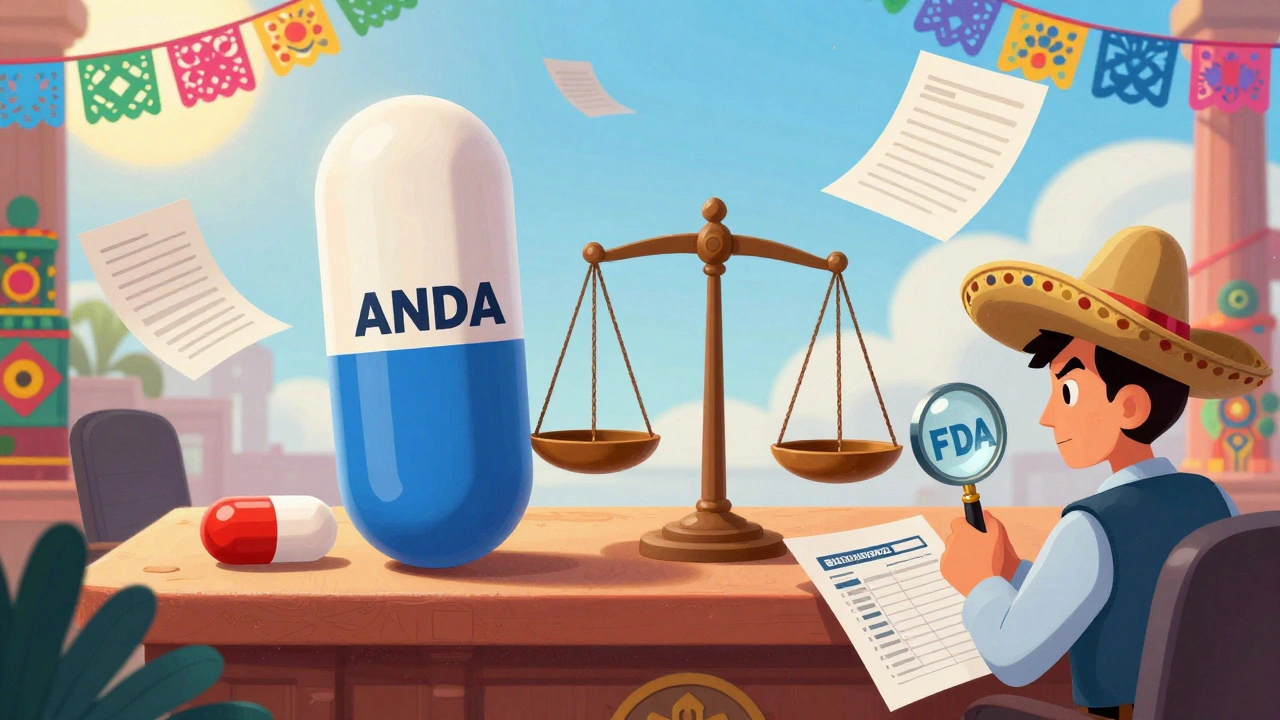
The ANDA process is the backbone of generic drug approval in the United States. It’s how companies get FDA permission to sell cheaper versions of brand-name drugs-without repeating expensive clinical trials. But it’s not just about saving money. It’s about meeting strict legal and scientific standards that ensure generic drugs are just as safe and effective as the originals. If you’re a manufacturer, a regulator, or even a patient wondering why your prescription costs less now, understanding the ANDA process is key.
What Is the ANDA Process?
The Abbreviated New Drug Application (ANDA) is the legal pathway created by the Hatch-Waxman Act of 1984. This law was designed to balance two goals: protecting innovation by giving brand-name drug makers patent rights, and making affordable medicines available to the public. The word “abbreviated” is crucial here. Unlike a full New Drug Application (NDA), which requires years of clinical testing, an ANDA skips those studies. Instead, it relies on the FDA’s prior approval of the brand-name drug, called the Reference Listed Drug (RLD).
Since 1984, over 16,892 ANDAs have been approved. By October 2023, the FDA had approved 1,147 generic applications that year alone. Today, 90% of all prescriptions filled in the U.S. are for generics. That’s not accidental-it’s the result of a well-defined legal framework.
Core Legal Requirements for ANDA Approval
To get an ANDA approved, manufacturers must prove four things under federal law:
- Identical active ingredient: The generic must contain the same active pharmaceutical ingredient (API) as the RLD. No substitutions. If you want to change the salt form or add a new excipient, you need a suitability petition under Section 505(j)(2)(C) of the FD&C Act.
- Same dosage form, strength, route, and conditions of use: If the brand is a 10mg tablet taken orally once daily, the generic must match exactly. No “slightly different” versions allowed without extra review.
- Bioequivalence: This is the scientific heart of the ANDA. The generic must show it releases the same amount of drug into the bloodstream at the same rate as the RLD. The FDA requires pharmacokinetic studies showing that the 90% confidence interval for Cmax (peak concentration) and AUC (total exposure) falls within 80-125% of the RLD. This isn’t a suggestion-it’s a legal requirement under FDA Guidance for Industry: Bioequivalence Studies (2023).
- Identical labeling: The package insert must be the same as the brand’s, except for minor differences like the manufacturer’s name or the “AB” therapeutic equivalence code. Any deviation requires FDA approval.
These aren’t guidelines. They’re enforceable legal standards. Failure to meet any one of them can lead to a refusal to receive (RTF) or a complete response letter (CRL), which can delay approval by years.
Manufacturing and Quality Control Rules
The law doesn’t stop at what’s in the pill-it demands how it’s made. All ANDA submissions must include detailed Chemistry, Manufacturing, and Controls (CMC) documentation. This means:
- Full description of the manufacturing process, including equipment, steps, and controls
- Quality control tests for raw materials, intermediates, and final product
- Stability data showing the drug won’t degrade over time under real-world conditions
- Validation of the container-closure system (e.g., bottles, blisters, vials)
Manufacturing facilities must follow Current Good Manufacturing Practices (cGMP). The FDA inspects these sites-often without notice. In 2022, 68% of FDA Form 483 observations (which document violations) came from overseas facilities. If your factory fails inspection, your ANDA won’t be approved, no matter how perfect the science is.
And you can’t just make a few test batches. The FDA requires exhibit batches that are at least 10% of your planned commercial batch size-or 100,000 dosage units, whichever is larger. This ensures your production line can consistently make safe, effective medicine at scale.
Filing Requirements and Fees
Submitting an ANDA isn’t just about paperwork-it’s a legal and financial commitment. All applications must be submitted electronically in eCTD format. Paper submissions are rejected. You must also file Form FDA-356h (the application form) and Form FDA-3674 (the user fee cover sheet).
For fiscal year 2024, the fee for an original ANDA is $129,500. A prior approval supplement (for changes after approval) costs $5,000. These fees are mandated by the Generic Drug User Fee Amendments (GDUFA), which funds the FDA’s review process. Paying the fee doesn’t guarantee approval-but not paying it guarantees rejection.
There’s also a timeline. Under GDUFA III (2023-2027), the FDA aims to review standard ANDAs in 10 months and priority ones in 8 months. But that’s the goal, not the rule. In 2022, the average review time was 36 months, up from 30 months in 2015. Why? Complex products-like inhalers, injectables, and topical creams-are harder to review. Only 42% of complex generic applications pass on the first try.
Patent Certification and Legal Hurdles
One of the most complex parts of the ANDA process is navigating patents. When you file, you must certify how your product relates to existing patents listed in the FDA’s Orange Book. There are four types:
- Paragraph I: No patent listed
- Paragraph II: Patent has expired
- Paragraph III: Patent will expire on a specific date (you delay launch until then)
- Paragraph IV: Patent is invalid or won’t be infringed (this triggers litigation)
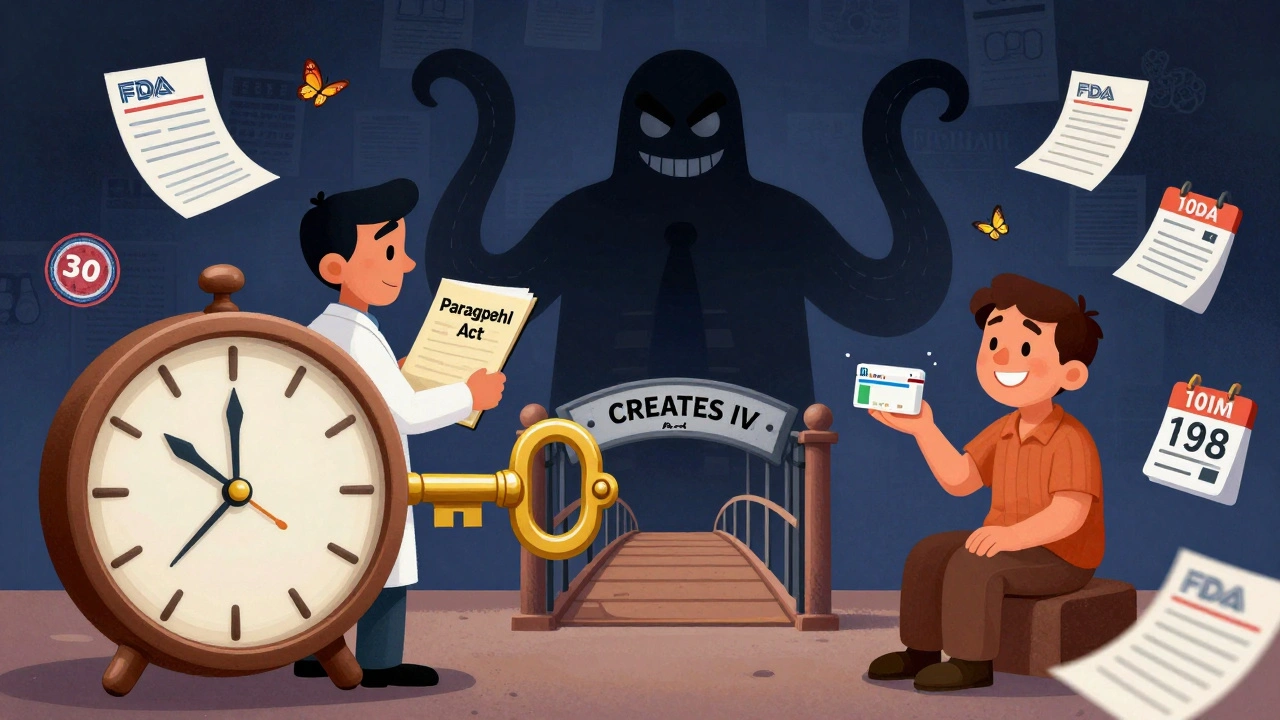
Paragraph IV certifications are the most controversial. They’re often used to challenge weak or evergreen patents. But if you file one, the brand-name company can sue you. If they do, the FDA must delay approval for up to 30 months. That’s not a review delay-it’s a legal stay. In 2023, one company reported a 41-month delay after a Paragraph IV filing, even though their drug was bioequivalent.
The CREATES Act of 2019 was passed to stop brand companies from blocking access to samples needed for testing. But many manufacturers still report delays in obtaining reference products, forcing them to delay ANDA submissions.
Why Some ANDAs Fail-and How to Avoid It
According to FDA data, 58% of first-time ANDA reviews result in deficiency letters. The top reasons?
- Incomplete bioequivalence protocols (28% of refusals)
- Inadequate CMC information (23% of refusals)
- Poorly written labeling (12% of refusals)
- Failure to validate container closure systems (a frequent issue in Reddit and RAPS forums)
One regulatory affairs specialist shared on Reddit: “We had three ANDAs rejected because we didn’t properly validate the bottle seal.” That’s not a scientific failure-it’s a paperwork failure. The fix? Pre-ANDA meetings with the FDA. In 2022, there were 1,842 such meetings. They’re not free-consultants charge $250-$400/hour-but they can save millions in delays.
Who Benefits-and Who Pays the Price?
The public saves billions. Generic drugs saved U.S. consumers $2.2 trillion over the past decade. A generic version of a brand drug typically costs 80-85% less after one generic enters the market, and 90% less after multiple generics arrive.
But the cost isn’t just financial. For small manufacturers, the legal and technical burden is enormous. A single ANDA can cost $5-$10 million and take 3-5 years. Teva spent $28 million and 42 months getting approval for a generic version of Advair Diskus. Meanwhile, Lupin got approval for a generic version of Jardiance in just 9.5 months-because they submitted a “clean application” with perfect CMC data.
The system works best when manufacturers invest in expertise. Regulatory affairs professionals with RAC certification earn an average of $125,000 a year-not because they’re overpaid, but because the stakes are so high.
What’s Next for the ANDA Process?
The FDA is pushing to modernize. GDUFA III aims to improve review speed, reduce deficiencies, and support complex generics. In 2024, $15 million is being allocated to develop better scientific tools for testing inhalers, nasal sprays, and other tricky products.
There’s also growing pressure to limit “patent thickets”-when brand companies file dozens of minor patents to block generics. The Affordable Prescriptions for Patients Act of 2023 could change that. And while AI-assisted document review is still experimental, the FDA’s long-term plan includes using it to speed up ANDA reviews.
But the core hasn’t changed. The ANDA process remains the most reliable way to bring affordable, safe generics to market. It’s not easy. It’s not quick. But it’s legal. And for millions of patients, it’s life-changing.
What is the difference between an ANDA and an NDA?
An NDA is for new brand-name drugs and requires full clinical trials to prove safety and efficacy. An ANDA is for generic versions of already-approved drugs and relies on the FDA’s prior findings. ANDAs don’t need clinical data-they only need to prove bioequivalence and manufacturing quality.
Can a generic drug have different inactive ingredients?
Yes, but only if the inactive ingredients don’t affect safety or effectiveness. The FDA allows minor differences in fillers, dyes, or preservatives as long as they don’t alter how the drug works. If the change could impact absorption or cause an allergic reaction, a suitability petition is required.
How long does it take to get an ANDA approved?
The FDA’s goal under GDUFA III is 10 months for standard ANDAs and 8 months for priority ones. But in practice, it often takes 30-36 months due to deficiencies, patent litigation, or complex product reviews. Simple generics may get approved faster; complex ones like inhalers can take over 4 years.
What happens if my ANDA gets refused to receive?
A refusal to receive (RTF) means your application wasn’t even reviewed because it’s incomplete or improperly formatted. You’ll get a letter listing the deficiencies. You must fix them and resubmit. RTFs can delay approval by 6-12 months. Common causes include missing forms, incorrect eCTD structure, or incomplete bioequivalence protocols.
Are all generic drugs approved through the ANDA process?
Most are-but not all. Some drugs use the 505(b)(2) pathway if they’re modified versions of existing drugs (e.g., new dosage forms or combinations). Biologics use a different pathway called 351(k). ANDAs are only for small-molecule, chemically identical generics.
Comments (8)
Lynette Myles
The FDA’s ANDA process is a legal fiction. They claim generics are ‘equivalent,’ but the bioequivalence window of 80-125% means a drug can be 25% weaker or stronger and still pass. That’s not medicine-that’s gambling with patient safety.
Annie Grajewski
lol so the government says ‘trust us’ but the real reason generics are cheap is because they’re made in some basement in bangladesh with chalk and hope. i mean, i took a generic omeprazole once and felt like my stomach was being judged by a monk. also, who wrote this? it’s got more commas than a twitter thread.
Jimmy Jude
Let me tell you something about power. The ANDA process isn’t about patients. It’s about control. The FDA, Big Pharma, and the GDUFA fee structure? They’re all part of the same machine. You think you’re saving money? You’re just paying for the privilege of being medicated by someone else’s compromise.
Every pill you swallow is a silent surrender to bureaucracy. And yet-you still take it. Why? Because you’ve been taught to trust the system. But trust is just another word for fear in a lab coat.
Mark Ziegenbein
What’s truly staggering is how little the public understands the sheer engineering precision required to replicate a molecule’s behavior in vivo. The CMC section alone-chemistry manufacturing and controls-is a 200-page symphony of regulatory compliance that demands isotopic purity, particle size distribution, and polymorph control at levels most people can’t even pronounce. And yet we treat this like a grocery store price tag. The fact that 58% of first submissions get rejected isn’t incompetence-it’s the natural consequence of amateurs treating pharmacology like a DIY project. If you think your $4 generic is ‘just as good,’ you’ve never read a 483 inspection report from a Chinese facility that used recycled plastic for vials.
Norene Fulwiler
I’ve worked with patients who can’t afford brand-name insulin. The ANDA system isn’t perfect, but it’s the only thing standing between them and rationing pills. I’ve seen people cry when their generic became available. Don’t reduce this to bureaucracy-it’s life or death for millions.
William Chin
While I appreciate the comprehensive overview presented herein, I must formally note that the omission of explicit reference to 21 CFR Part 314, Subpart H, regarding post-approval changes constitutes a material deficiency in the regulatory context. Furthermore, the failure to cite the 2023 FDA Guidance Document on Bioequivalence Studies (Docket No. FDA-2023-D-0123) undermines the authoritative integrity of the exposition. I respectfully recommend revision and resubmission.
Ada Maklagina
My uncle’s generic blood pressure med saved his life. No drama. Just pills. And yeah, the system’s messy but it works. Also, the FDA doesn’t inspect every factory, but they inspect enough to scare the crap out of bad actors.
Harry Nguyen
90% of prescriptions are generics? That’s why America’s falling apart. We don’t value innovation anymore. We want cheap. We want fast. We want the government to make everything free. Meanwhile, the real scientists in the U.S. are being pushed out by overseas factories that don’t even have running water. This isn’t progress-it’s surrender.