
When you buy a bottle of medicine, a jar of baby food, or a tube of face cream, you expect it to be safe. You don’t think about the air in the factory, the floor near the filling line, or the condensation dripping from a pipe above the packaging area. But those things matter-more than most people realize. In manufacturing, especially in regulated industries like pharmaceuticals, food, and cosmetics, environmental monitoring is the quiet system that keeps contamination out of your products before it ever gets close to you.
Why Environmental Monitoring Isn’t Optional
Environmental monitoring isn’t just a checklist item. It’s a defense system. The U.S. Food and Drug Administration (FDA) and the European Medicines Agency (EMA) treat it as a core part of quality control. Without it, a single mold spore, a smear of Listeria, or a metal fragment from a worn machine part can turn a batch of medicine or food into a health hazard. In 2022, the USDA estimated that foodborne illnesses tied to environmental contamination cost the U.S. economy $77.7 billion. That’s not just lost sales-it’s hospital stays, lost workdays, and lives changed. The CDC says 87% of those outbreaks could’ve been prevented with proper environmental sampling. That’s not a small number. It’s the difference between running a clean facility and risking a recall, a lawsuit, or worse.How Contamination Gets In: The Zones
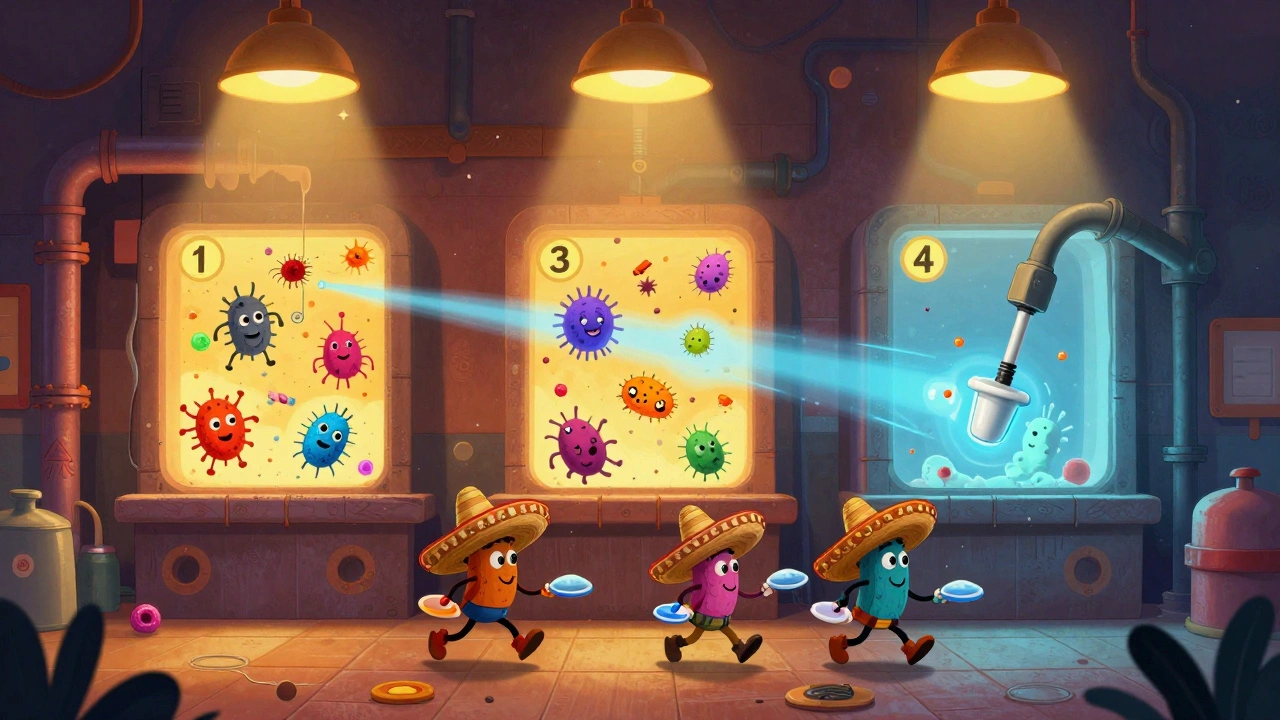
Not all surfaces are created equal. That’s why every serious manufacturing facility uses a zone system to prioritize where and how often to test. Think of it like a security perimeter, but for germs and particles.- Zone 1: Direct food or product contact surfaces. Think slicers, mixers, filling nozzles, conveyor belts. These are the highest risk. If something contaminates here, it goes straight into your product.
- Zone 2: Surfaces near Zone 1 but not in direct contact. Equipment housings, refrigeration units, nearby tools. Contamination here can drift, splash, or fall into Zone 1.
- Zone 3: Areas close to production but not directly involved. Forklifts, storage racks, maintenance carts. People forget these-but they carry dirt, microbes, and debris from outside.
- Zone 4: Everything else. Hallways, restrooms, offices. Low risk, but still monitored because problems here can signal bigger issues.
What They’re Testing For
It’s not just about dirt. The targets are specific and dangerous:- Microbes: Listeria monocytogenes, Salmonella, E. coli, molds, yeasts. These are the big ones in food and pharma. Listeria is especially scary-it grows in cold, wet places like drains and refrigerators.
- Particulates: Tiny bits of metal, plastic, or fibers. In injectable drugs, even a speck can cause a reaction.
- Chemicals: Residues from cleaners, lubricants, or packaging materials. These are tracked using chromatography (HPLC, GC).
- Metals: Lead, mercury, nickel. Detected with ICP (Inductively Coupled Plasma) testing. Common in machinery wear.
- Water quality: Purified water in pharma must meet USP <645> standards. Conductivity and TOC (Total Organic Carbon) levels are checked constantly.
How Testing Works: The Tools
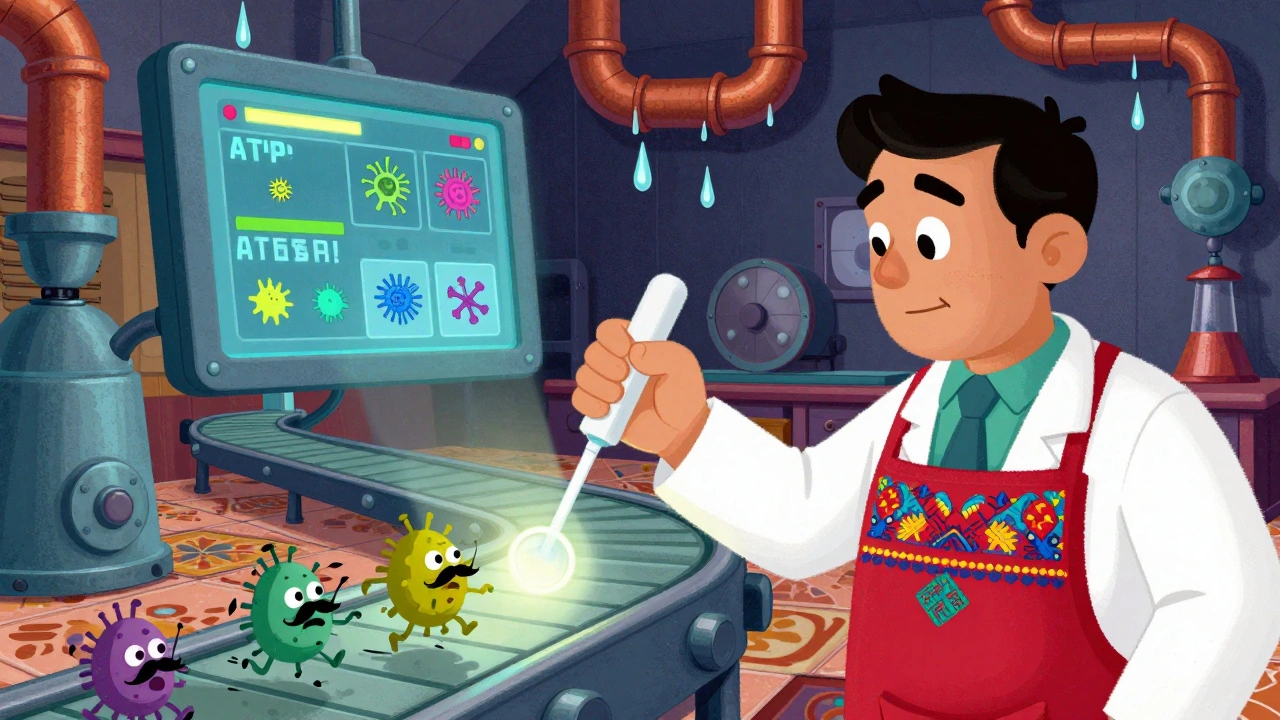
Sampling isn’t just swabbing a surface and sending it off. It’s science with precision.- Swabs and sponges: Used on surfaces. Sterile, pre-moistened, and handled with gloves to avoid adding contamination.
- Air samplers: Liquid impingers pull air through liquid to trap microbes. Solid impactors (slit or sieve types) catch particles on a plate. Results are measured in CFU/m³-colony-forming units per cubic meter of air.
- ATP testing: A fast check. Adenosine triphosphate is in all living cells. A handheld device gives a reading in seconds-no waiting 48 hours. Facilities using ATP see 32% faster turnaround between production runs.
- Water testers: Measure conductivity and TOC. If the numbers spike, the water system is contaminated.
- Next-gen sequencing: Newer labs use DNA analysis to identify microbes in hours instead of days. The FDA is pushing this for faster response times.
Regulations That Shape the Process
You can’t just make up your own rules. You follow strict standards:- Pharma: EU GMP Annex 1 (2023 update) requires real-time monitoring of air quality, temperature, and humidity in cleanrooms. ISO Class 5 (EU Grade B) is the standard for sterile product areas.
- Food: USDA’s Listeria Rule (9 CFR part 430) forces RTE (ready-to-eat) food plants to test Zone 1 weekly for Listeria. The FDA’s Food Safety Modernization Act (FSMA) makes environmental monitoring mandatory for all food facilities.
- Cosmetics: Less strict than pharma, but still regulated under FDA’s Good Manufacturing Practices. Mold in lotion? That’s a recall waiting to happen.
What Goes Wrong-And How to Fix It
Even with good rules, things fail. Here’s what breaks most often:- Inconsistent zone classification: One manager says a pipe is Zone 1 because it drips. Another says it’s Zone 3 because it’s not touched. That leads to missed testing.
- Improper sampling technique: Using a non-sterile swab, touching the sample area with bare hands, or letting the sampler sit too long before testing. The CDC says this happens more than you think.
- Understaffing: Medium-sized food plants need 2-3 full-time staff just for environmental monitoring. Many small facilities skip it because they can’t afford it.
- Ignoring data trends: One positive result? Maybe a fluke. Five in a row? That’s a pattern. AI tools now help spot these trends before they become outbreaks.
What’s Next: The Future of Monitoring
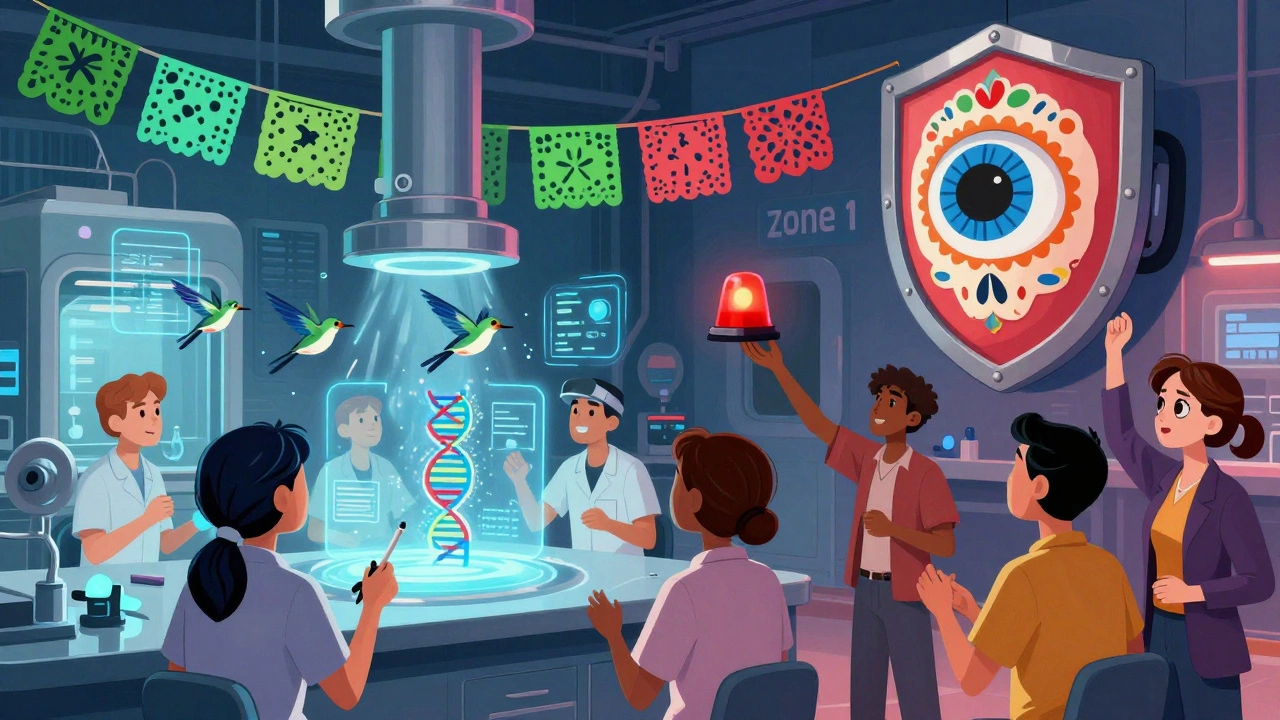
The future is faster, smarter, and more connected.- Real-time sensors: Air and surface monitors that send data to a dashboard. If a particle count spikes, an alert goes out immediately.
- AI and machine learning: Systems that learn from past data to predict where contamination is likely. MarketsandMarkets predicts 38% of facilities will use AI-powered monitoring by 2027.
- Metagenomics: Instead of waiting days to grow a culture, labs now sequence all DNA in a sample. They can identify unknown pathogens in under 24 hours.
- Antimicrobial resistance: The CDC found 19% of Listeria strains from food plants now resist multiple antibiotics. Monitoring now tracks not just presence-but resistance.
Final Thought: It’s Not About Perfection-It’s About Control
You won’t eliminate every microbe. You don’t need to. The goal is control. A clean environment isn’t sterile-it’s managed. A good environmental monitoring program doesn’t just catch problems. It tells you where to look next. It shows you if your cleaning schedule works. If your staff is following protocol. If your equipment is wearing out. It’s the invisible layer that keeps your product safe. And if you’re in manufacturing, it’s not a cost center. It’s your most important quality tool.What is environmental monitoring in manufacturing?
Environmental monitoring in manufacturing is the systematic process of testing air, surfaces, water, and equipment for contaminants like microbes, particles, chemicals, and metals. It’s used to prevent contamination in products before they reach consumers, especially in industries like pharmaceuticals, food, and cosmetics.
Why are zones important in environmental monitoring?
Zones classify areas by contamination risk. Zone 1 includes direct product contact surfaces (highest risk), Zone 2 is nearby surfaces, Zone 3 is remote but production-adjacent areas, and Zone 4 is general facility areas. This helps prioritize testing frequency and resources-focusing on where contamination is most likely to impact the product.
What’s the difference between ATP testing and microbiological testing?
ATP testing detects adenosine triphosphate, a molecule found in all living cells, giving results in seconds to confirm surface cleanliness. Microbiological testing grows microbes in a lab to identify specific organisms like Listeria or Salmonella, which takes 24-72 hours. ATP is fast and useful for quick checks; microbiological testing is definitive and required for compliance.
Which industries require environmental monitoring the most?
Pharmaceuticals lead because sterile products can’t tolerate any microbes. Food processing, especially ready-to-eat products, follows closely due to risks like Listeria. Cosmetics also require monitoring to prevent mold and bacterial growth in creams and lotions. All three are regulated by the FDA and similar agencies.
How often should environmental monitoring be done?
Frequency depends on the zone and industry. Zone 1 surfaces in food plants are tested daily to weekly. Zone 2 is tested weekly to monthly. Zones 3 and 4 are tested monthly to quarterly. Pharmaceutical cleanrooms often monitor air quality continuously. Regulatory rules (like USDA’s Listeria Rule) may require specific frequencies for high-risk pathogens.
Can small manufacturing facilities afford environmental monitoring?
Yes, but it requires smart planning. Small facilities may not need full-time staff-they can train existing workers and use cost-effective tools like ATP swabs. Outsourcing lab testing is common. The key is focusing on high-risk zones and using data to avoid over-testing. USDA data shows only 48% of small facilities (<50 employees) have fully compliant programs, meaning many are falling short-not because they can’t afford it, but because they don’t know where to start.
What happens if a facility fails environmental monitoring?
Failure can lead to regulatory action: warning letters, production holds, or product recalls. The FDA and USDA can shut down a facility if contamination is repeated or linked to illness. Beyond legal consequences, there’s reputational damage. Consumers lose trust. A single Listeria outbreak can end a food brand. Monitoring isn’t just about compliance-it’s about survival.
Is environmental monitoring the same as quality control?
It’s part of it. Quality control checks the final product. Environmental monitoring checks the environment that produces it. You can have a perfect product but a dirty facility-and that’s a ticking time bomb. Environmental monitoring is proactive; quality control is reactive. Together, they form a complete safety net.
Comments (14)
Audrey Crothers
OMG this is so important!! I never thought about how a dripping pipe could ruin my baby food 😱 Seriously, after reading this, I’m gonna check my local food factory’s inspection reports now. We need more awareness like this!!
Levi Cooper
Typical overregulation. The FDA doesn’t need to micromanage every swipe of a swab. We used to make food without all this tech-and people didn’t drop dead. Let the market decide, not bureaucrats in lab coats.
Laura Weemering
Zone 3… Zone 4… it’s all just a performative ritual, isn’t it? We’re collecting data to *feel* safe, not because it actually prevents anything. The real contamination happens in the boardroom, where cost-cutting decisions are made. The swabs? Just theater. 🤡
Reshma Sinha
Love this breakdown! In India, small pharma units are starting to adopt ATP testing-it’s a game changer. Cheaper, faster, and non-destructive. We’re seeing 40% fewer batch rejections since we switched. The future is real-time!
Lawrence Armstrong
ATP is great for quick checks, but don’t confuse it with real microbiological data. It tells you ‘something’s alive’-not what it is. I’ve seen facilities rely on ATP and miss Listeria because it wasn’t in the ATP range. Always confirm with culture. 🧪
Adam Everitt
the thing is… no one really talks about how most of this is just… expensive paperwork. i mean, sure, it’s good in theory, but in practice? the same 3 people do all the swabbing, log it in excel, and then it’s forgotten until the audit. real-time sensors? yeah right. budget says no.
sandeep sanigarapu
Environmental monitoring is not optional. It is the silent guardian of public health. In developing nations, lack of infrastructure leads to preventable tragedies. This system, though complex, is a moral imperative. Let us not forget: every product carries the responsibility of its maker.
Nathan Fatal
People think contamination is about dirt. It’s not. It’s about systems failing quietly. The real failure isn’t a positive swab-it’s when no one connects the dots between ATP spikes, humidity logs, and maintenance logs. We need integrated platforms, not siloed spreadsheets. AI isn’t the future-it’s the baseline now.
Robert Webb
One thing I’ve noticed in my work at a mid-sized cosmetic lab: Zone 4 is where culture lives. People think it’s just hallways and restrooms, but if your janitorial staff doesn’t understand cross-contamination, your Zone 1 is doomed. Training isn’t a one-time seminar-it’s weekly reminders, visual cues, and accountability. I’ve seen facilities cut training to save $10k… and lose $2M in recalls. The math doesn’t lie.
nikki yamashita
This made me cry. I used to work in a baby food plant. We had a leaky pipe above the filling line. No one fixed it for months. One day, a mom emailed us saying her daughter got sick. We found mold in the drain. I quit that week. Please, someone fix the pipes.
wendy b
Let’s be honest-this whole system is a scam. The FDA benefits from the fear. They don’t care about your child’s health-they care about your compliance fees. And don’t even get me started on how they charge $200k for a single audit. It’s a money grab disguised as safety.
Rob Purvis
Wait-so if Zone 3 and 4 account for 62% of alerts, why are we still focusing so much on Zone 1? We’re treating symptoms, not root causes. The real issue is workflow design: why are forklifts rolling through clean zones? Why are drains under equipment? It’s not the swabs-it’s the architecture. We need to redesign spaces, not just test them.
Stacy Foster
They’re lying. The real reason they test so much? So they can blame YOU when something goes wrong. They don’t want to prevent outbreaks-they want to cover their asses. You think they care about your baby? No. They care about lawsuits. This is all about liability, not safety. The system is rigged.
Nathan Fatal
Stacy, you’re missing the point. Compliance isn’t about blame-it’s about prevention. If you’re not testing, you’re gambling with lives. The FDA doesn’t profit from recalls-they get sued. The data isn’t a shield for corporations-it’s a lifeline for consumers. You can’t fight science with paranoia.