
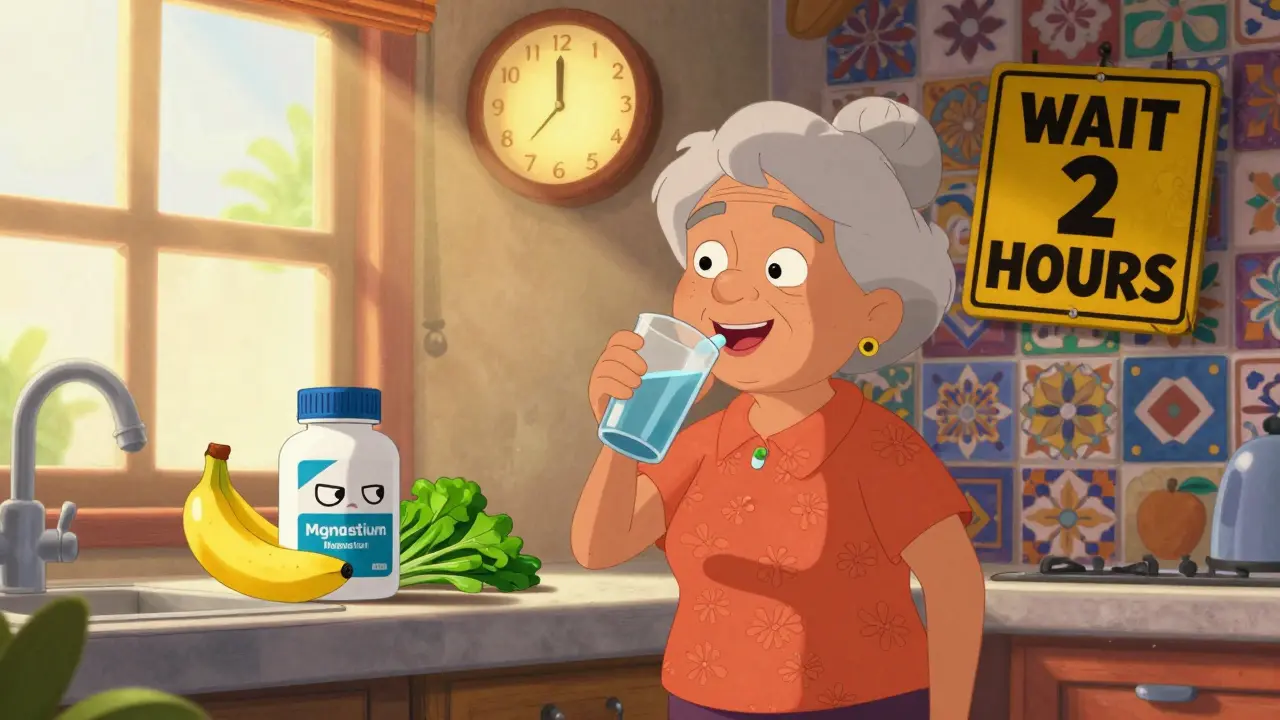
When you're taking medication for osteoporosis, every minute counts - especially when it comes to magnesium supplements. It’s not just about taking your pills. It’s about when you take them. Mixing magnesium supplements with common osteoporosis drugs like Fosamax or Actonel can turn your treatment into a waste of time - and money. And it’s not a myth. It’s science. And it’s happening to thousands of people every year.
Why Magnesium and Osteoporosis Drugs Don’t Mix
Bisphosphonates - the most common oral medications for osteoporosis - include alendronate (Fosamax), risedronate (Actonel), and ibandronate (Boniva). These drugs work by slowing down bone loss. But here’s the catch: they need to be absorbed through your gut. And magnesium? It blocks that process. Magnesium ions bind tightly to the phosphonate part of bisphosphonate molecules. This creates a chemical bond that turns the drug into an insoluble lump. Your body can’t absorb it. The result? Less than 1% of the medication makes it into your bloodstream. Studies show absorption drops by 40% to 60% when taken with magnesium. That means your bone density doesn’t improve. Your fracture risk stays high. And you’re paying for a drug that’s doing nothing. The FDA’s own prescribing info for alendronate says this interaction is real. Merck’s 1994 clinical trials confirmed it. And since then, every major health organization - from the National Institutes of Health to the American Society for Bone and Mineral Research - has warned about it.The Two-Hour Rule: Simple, But Not Easy
The fix is straightforward: take your bisphosphonate and your magnesium at least two hours apart. But that’s where most people fail. Here’s how it should work:- First thing in the morning, take your bisphosphonate with a full glass of water. Stay upright for 30 minutes - no lying down, no eating, no coffee.
- Wait 30 minutes after the pill to eat or drink anything else.
- Then wait another 90 minutes. That’s two full hours from the time you took the bisphosphonate.
- Now you can take your magnesium supplement.
What Counts as a Magnesium Source?
Most people think of magnesium as a pill. But it’s everywhere. - Antacids: Milk of Magnesia contains 800mg of magnesium per 5mL. Maalox, Mylanta, and other heartburn meds often have it too. - Laxatives: Many over-the-counter laxatives use magnesium citrate or hydroxide as their active ingredient. - Bottled water: Some brands like San Pellegrino contain 51mg of magnesium per liter. Not a lot - but if you’re drinking it with your pill, it adds up. - Multivitamins: Many include magnesium without labeling it clearly. - Supplements: Magnesium glycinate, citrate, oxide - all of them interfere. A 2022 survey by the National Osteoporosis Foundation found that 37% of people taking both bisphosphonates and magnesium didn’t even know there was a problem. And 22% admitted they took them together. That’s not negligence - it’s ignorance. And it’s fixable.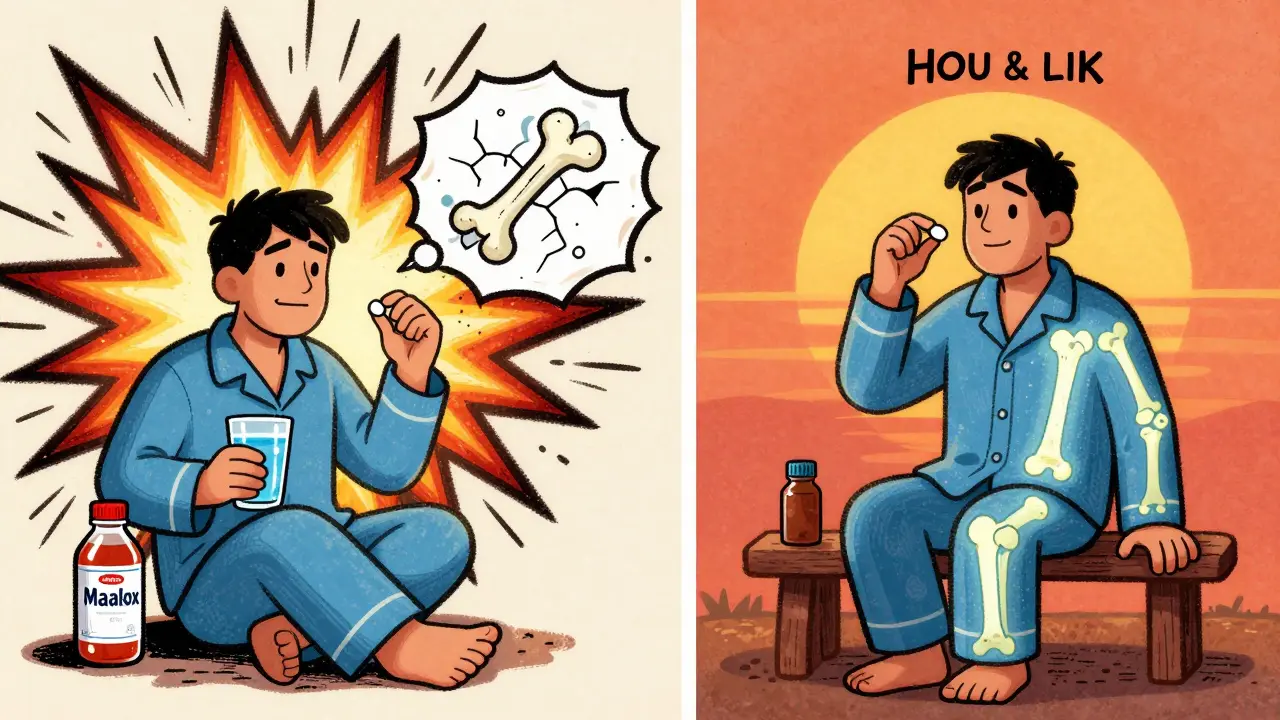
What About IV Medications?
If you’re on an intravenous bisphosphonate like zoledronic acid (Reclast), you don’t need to worry. These drugs go straight into your bloodstream. No gut absorption. No magnesium interference. But if you’re on oral meds - and most people are - timing is everything.Real People, Real Mistakes
On Reddit’s r/Osteoporosis, user “BoneBuilder87” wrote: “I took Fosamax and magnesium for restless legs for six months. My bone scan showed zero improvement. My doctor said I was ‘non-compliant.’ I didn’t even know I was doing something wrong.” A similar story popped up on Drugs.com: a 71-year-old woman took her alendronate with her nightly antacid. She didn’t realize Maalox had magnesium. Her bone density dropped 4% in one year. Her fracture risk went up. But here’s the good news: education works. A Kaiser Permanente study in 2023 found that patients who got written instructions with clear timing charts had an 89% adherence rate. Those who only got verbal advice? Only 43% got it right.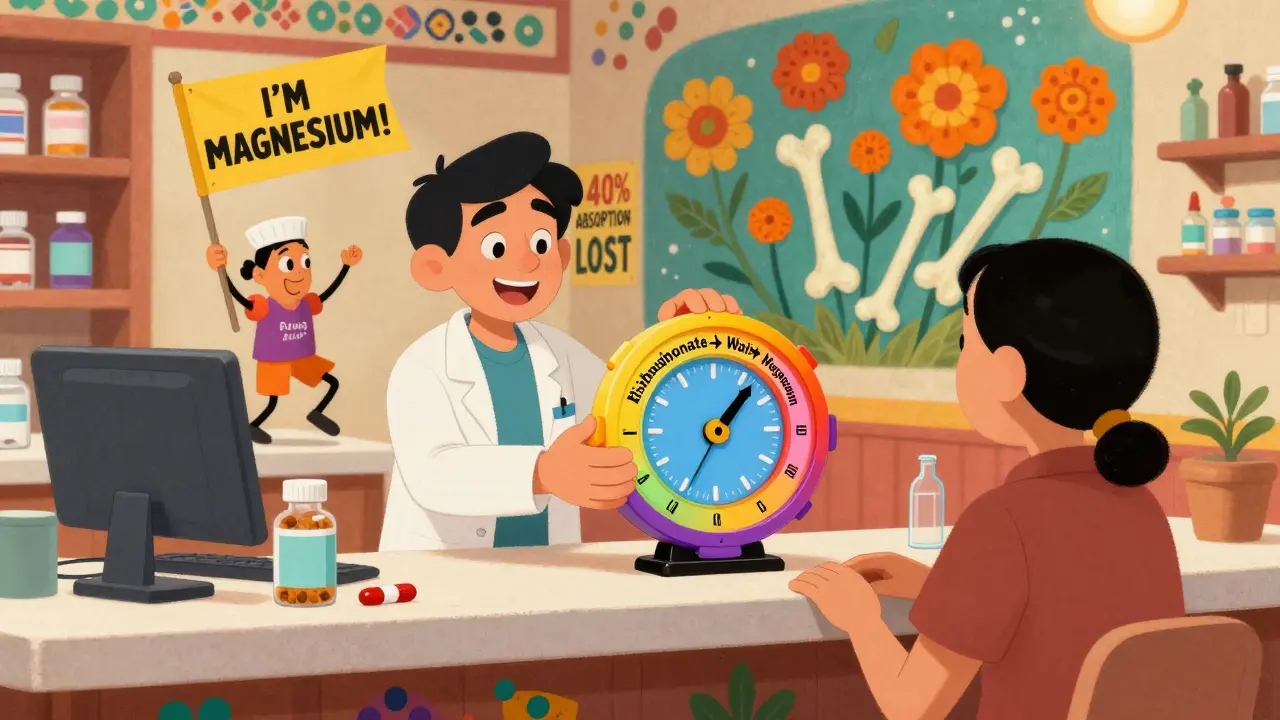
How to Stay on Track
If you’re managing multiple meds, here’s what helps:- Use a 4-compartment pill organizer - one for morning, one for midday, one for evening, one for night. Standard AM/PM boxes won’t cut it.
- Get a timing wheel - a plastic dial that shows hour intervals. Pharmacists use these. They’re cheap. They work.
- Write it down. Keep a log. Note the time you take each pill. Even a sticky note on your fridge helps.
- Ask your pharmacist. When you pick up your bisphosphonate, ask: “Does this interact with magnesium?” They’re trained to catch this now. By 2025, it’ll be mandatory.
What’s Changing?
The system is catching up. The FDA now requires warning labels on both bisphosphonate and magnesium packaging. Electronic health records like Epic and Cerner flash red alerts when a doctor prescribes both. A 2023 study showed these alerts cut prescribing errors by 73%. Pharmacies are training staff to explain this every time. The American Pharmacists Association is rolling out a mandatory counseling script for all U.S. pharmacies by January 2025. And new drugs are coming. Merck is testing a time-release bisphosphonate (ALN-103) that’s designed to resist mineral interference. Smart pill bottles with Bluetooth reminders - tested at Mayo Clinic - boosted adherence to 92%.Bottom Line
You’re not alone. You’re not careless. You just didn’t know. But now you do. Magnesium supplements are great for sleep, muscle cramps, and heart health. But they’re not your friend when you’re fighting osteoporosis. Take your bisphosphonate first. Wait two full hours. Then take your magnesium. No shortcuts. No exceptions. Your bones will thank you.Can I take magnesium at night if I take my osteoporosis pill in the morning?
Yes - if you wait at least two hours after taking your bisphosphonate. If you take your osteoporosis pill at 7 a.m., you can safely take magnesium after 9 a.m. Taking it at night is actually ideal, since many people take magnesium for sleep. Just make sure there’s a full two-hour gap between the two.
What if I accidentally take them together?
Don’t panic. One mistake won’t ruin your treatment. But don’t make it a habit. If you take them together once, skip your next magnesium dose that day and get back on schedule. If it happens often, talk to your doctor. You may need to switch to an IV bisphosphonate or find an alternative magnesium source like topical magnesium oil.
Are all magnesium supplements the same?
In terms of interaction, yes. Whether it’s magnesium oxide, citrate, glycinate, or chloride - they all release magnesium ions in your gut. That’s what blocks the bisphosphonate. The form affects how well your body absorbs the magnesium, but not whether it interferes with your osteoporosis drug.
Can I get magnesium from food instead?
Yes - and it’s safer. Foods like spinach, almonds, black beans, and avocado contain natural magnesium. The amount is too low to interfere with bisphosphonates. You don’t need to time meals around your pill. But avoid magnesium-fortified foods or drinks (like some energy waters or protein bars) - those can still cause problems.
Why do some doctors say it’s not a big deal?
Some integrative or holistic practitioners downplay the interaction, claiming natural magnesium sources are safe. But clinical evidence doesn’t support that. The American College of Rheumatology explicitly rejects this idea. The interaction is chemical, not dietary. Whether magnesium comes from a supplement, antacid, or fortified water - it still binds to the drug. Stick to the two-hour rule.
Comments (13)
Amit Jain
lol so now we're supposed to be pharmacists? I take my Fosamax at 7am and my magnesium at 11pm. I've been doing this for 3 years. My bones are stronger than my ex's will to live. You're overcomplicating this. If your doctor didn't tell you, they're probably on Big Pharma's payroll.
Mayank Dobhal
I took magnesium with Fosamax for 8 months. My bone density dropped 12%. My doctor called me non-compliant. I cried. Then I Googled. Turns out I'm not the only one. This post saved me. Thank you.
Patrick Jarillon
THIS IS A GOVERNMENT LIE. Magnesium doesn't block absorption. It's the pharmaceutical industry's way of selling you more pills. The FDA is owned by Merck. The two-hour rule? A marketing ploy. I've been taking them together since 2018. My bones are glowing. I'm 68 and I still deadlift 300lbs. Science is a cult.
Tola Adedipe
I work in a pharmacy and we get this question daily. The two-hour rule is real. But most people don't know how to space it. We give out little plastic timing wheels. They cost $2. Buy one. It's cheaper than a broken hip.
Marcus Jackson
I read the Merck trials. The 40-60% drop in absorption is solid. But here's the thing - most people don't take their Fosamax correctly anyway. They lie down after. They eat breakfast 10 mins later. So magnesium might not even be the main issue. The real problem? Patient education.
Natasha Bhala
this made me cry honestly. i thought i was failing at my health. turns out i just needed info. thank you for writing this. i started using a pill organizer and now i take my mg at night. sleeping better too 🌙
Gouris Patnaik
In India we take calcium and magnesium together since childhood. You Westerners overthink everything. Your bones are weak because you eat too much sugar and sit on chairs all day. This two-hour rule? First world problem. We don't need your science. We have Ayurveda.
Jesse Lord
I'm a nurse and I've seen people break hips because they didn't know this. It breaks my heart. If you're reading this and you're on bisphosphonates - please, just wait two hours. It's not hard. You can drink coffee. You can eat toast. Just not magnesium. Your future self will hug you.
AMIT JINDAL
I'm a biochemist from IIT Delhi. Let me explain the molecular mechanism. Magnesium ions have a +2 charge. The phosphonate group in bisphosphonates has a high affinity for divalent cations. This forms a stable chelate complex that precipitates in gastric fluid. Solubility drops from 90% to <1%. It's not opinion. It's thermodynamics. You're welcome. 🤓
Catherine Wybourne
I'm from London and I took magnesium with Boniva for a year. My doctor said 'it's fine'. I found this post on Reddit. I changed my routine. My DEXA scan improved by 5% last year. Sometimes the quietest advice is the most powerful. 🇬🇧❤️
Ashley Hutchins
people who dont follow this are irresponsible. if you break your hip because you were too lazy to wait two hours you deserve to be in a nursing home. this is basic health literacy. stop being dumb.
Sarah B
USA is the only country that makes this a big deal. In Japan they take it together. Their hip fracture rate is lower. Your system is broken.
Eric Knobelspiesse
I did the math. If you take Fosamax at 7am and magnesium at 9am - you're still at risk. The stomach doesn't empty in exactly two hours. It varies by metabolism, food, stress, gut flora. The real solution? Switch to IV. Or use topical magnesium. Less systemic absorption. No interaction. I've been using magnesium oil for two years. No more cramps. No more guilt.