
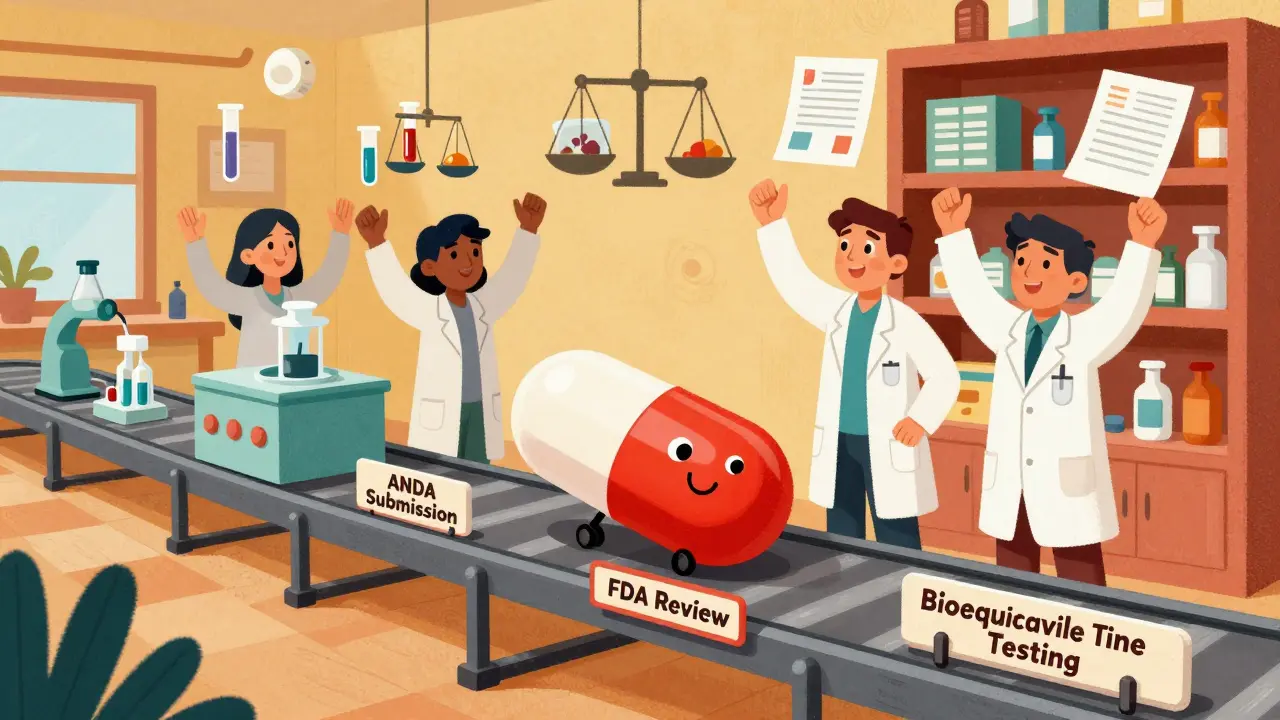
When you pick up a generic pill at your local pharmacy, it looks identical to the brand-name version. But how did it get there? The journey from a drug company’s lab to your medicine cabinet isn’t just about making a copy-it’s a complex, tightly regulated process that can take years. This is the story of how generic drugs go from ANDA submission to the shelf.
What Exactly Is an ANDA?
ANDA stands for Abbreviated New Drug Application. It’s not a shortcut-it’s a carefully designed path created by Congress in 1984 under the Hatch-Waxman Act. The goal? Let generic manufacturers bring affordable versions of brand-name drugs to market without repeating expensive clinical trials. Instead of proving a drug works from scratch, generic makers must prove their version is bioequivalent-meaning it delivers the same amount of active ingredient into the bloodstream at the same rate as the original.
For this to happen, the generic drug must match the brand in every key way: same active ingredient, same strength, same dosage form (pill, injection, patch), same route of administration (oral, topical, etc.), and same performance. The label must be nearly identical too, with only minor exceptions allowed.
The FDA doesn’t just accept claims. Every ANDA must include detailed data on chemistry, manufacturing, and controls (CMC). That means showing exactly how the drug is made, what equipment is used, how batches are tested, and how quality is maintained. It’s not enough to say, "It’s the same." You have to prove it, in writing, with lab results, process maps, and validation reports.
The Approval Process: Waiting, Testing, and Revisions
Filing an ANDA doesn’t mean instant approval. The FDA reviews each submission through its Center for Drug Evaluation and Research (CDER). Applications are submitted electronically via the Electronic Submissions Gateway. For standard generics, the review clock starts ticking-and it ticks slowly. Under current guidelines (GDUFA II), the average review time is about 30 months.
But not all ANDAs are treated the same. The FDA prioritizes certain drugs:
- First generics (the very first version to hit the market after a brand’s patent expires)
- Drugs in short supply (like insulin or antibiotics)
- Products tied to public health programs like PEPFAR
These can move faster-sometimes in under 12 months. But even then, the odds aren’t great. About 40% of initial ANDA submissions get a "Complete Response Letter" from the FDA. That means something’s missing, wrong, or unclear. The average applicant needs 1.7 rounds of review before approval. Common issues? Incomplete bioequivalence studies, mismatched labeling, or poorly documented manufacturing processes.
Manufacturers that meet with the FDA before submitting an ANDA-called pre-ANDA meetings-have a 30% lower rate of major deficiencies. These meetings aren’t mandatory, but smart companies use them. They ask questions, get feedback, and avoid costly delays.
Patents, Exclusivity, and the Race to Be First
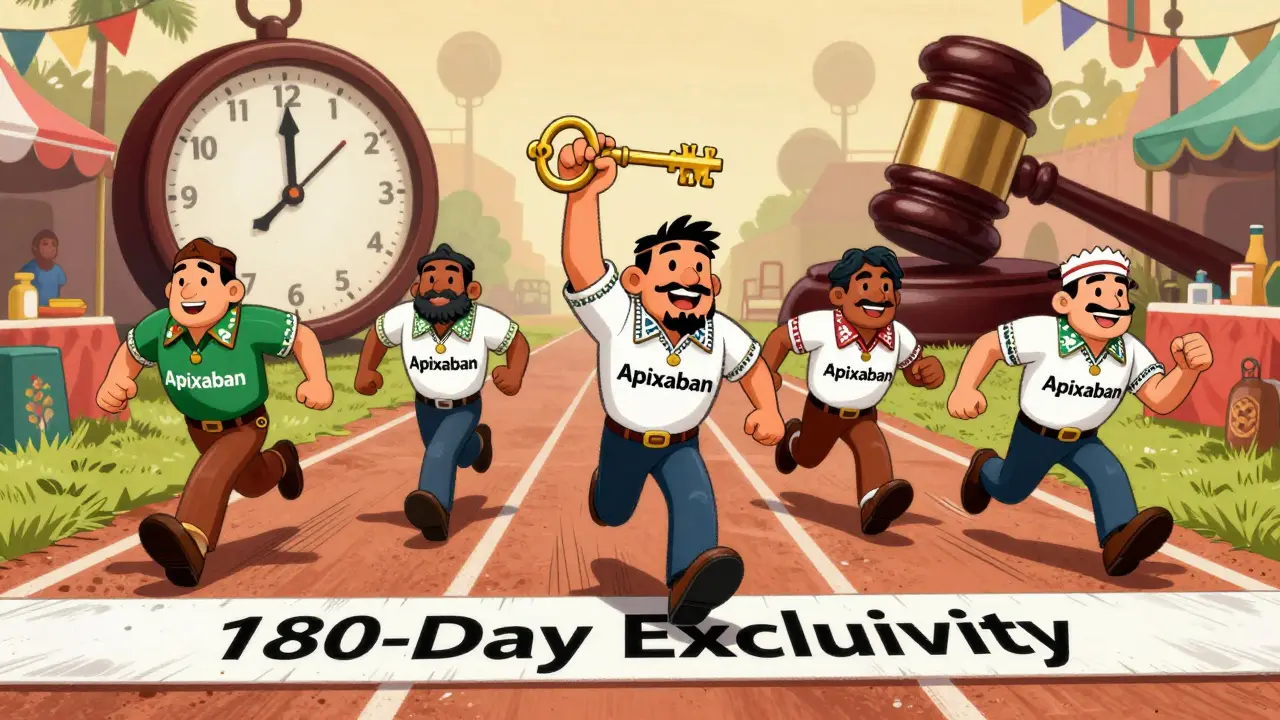
The race to market isn’t just about speed-it’s about money. When a brand-name drug’s patent expires, the first generic company to file a substantially complete ANDA with a "Paragraph IV certification" (which challenges the patent) gets 180 days of exclusive marketing rights. That’s a huge advantage. During that window, no other generics can enter the market.
This has created a high-stakes game. In 2022, six different manufacturers filed ANDAs for apixaban (the generic version of Eliquis) the day after the patent expired. Whoever got approved first would dominate sales. The winner? The one with the cleanest application and the fastest review.
But it’s not just about filing early. Patent lawsuits can delay approval. A brand-name company can sue, triggering a 30-month stay on approval. That’s why some generics sit on the shelf for years after approval-waiting for legal battles to end.
Approval Doesn’t Mean Availability
Getting FDA approval is only half the battle. A drug can be approved on paper but still not be on pharmacy shelves. Why? Because the real challenge is getting it into the hands of patients.
After approval, manufacturers must scale up production. Moving from small test batches to full commercial volume takes 60 to 120 days. Facilities must prove they can consistently produce thousands of pills per hour without contamination, variation, or quality issues. This isn’t easy. One small mistake in mixing or packaging can lead to recalls.
Next comes the payer system. Generic drugs don’t sell directly to pharmacies. They go through Pharmacy Benefit Managers (PBMs)-companies like Express Scripts, OptumRx, and CVS Health. These PBMs negotiate prices and decide which drugs go on which "tier" in formularies.
Here’s how it works: Tier 1 = preferred generic. Lower copay. High volume. Tier 2 = non-preferred. Higher copay. Lower sales. A 2023 IQVIA analysis found that generics on Tier 1 achieve 75% market share within six months. Tier 2? Just 35%. So even if a drug is approved, if the manufacturer doesn’t offer a deep enough discount to the PBM, it won’t be stocked.
Some manufacturers offer discounts of 20-30% beyond their initial pricing just to get on the preferred list. One sourcing manager on Reddit said, "If you don’t cut your price, you’re not even in the game."
From Wholesaler to Pharmacy Shelf
Once the PBM signs off, the drug moves into distribution. Most generics are shipped through one of three major wholesalers: AmerisourceBergen, McKesson, or Cardinal Health. These companies handle inventory, logistics, and delivery to pharmacies across the country.
Adding a new drug to their systems takes 15 to 30 days. The wholesaler must update their inventory codes, pricing, and ordering systems. Then, the drug goes to individual pharmacies.
At the pharmacy level, staff must be trained. Pharmacists need to know how to dispense it. The pharmacy’s computer system must recognize the new generic code. The label must print correctly. All of this usually takes 7 to 14 days.
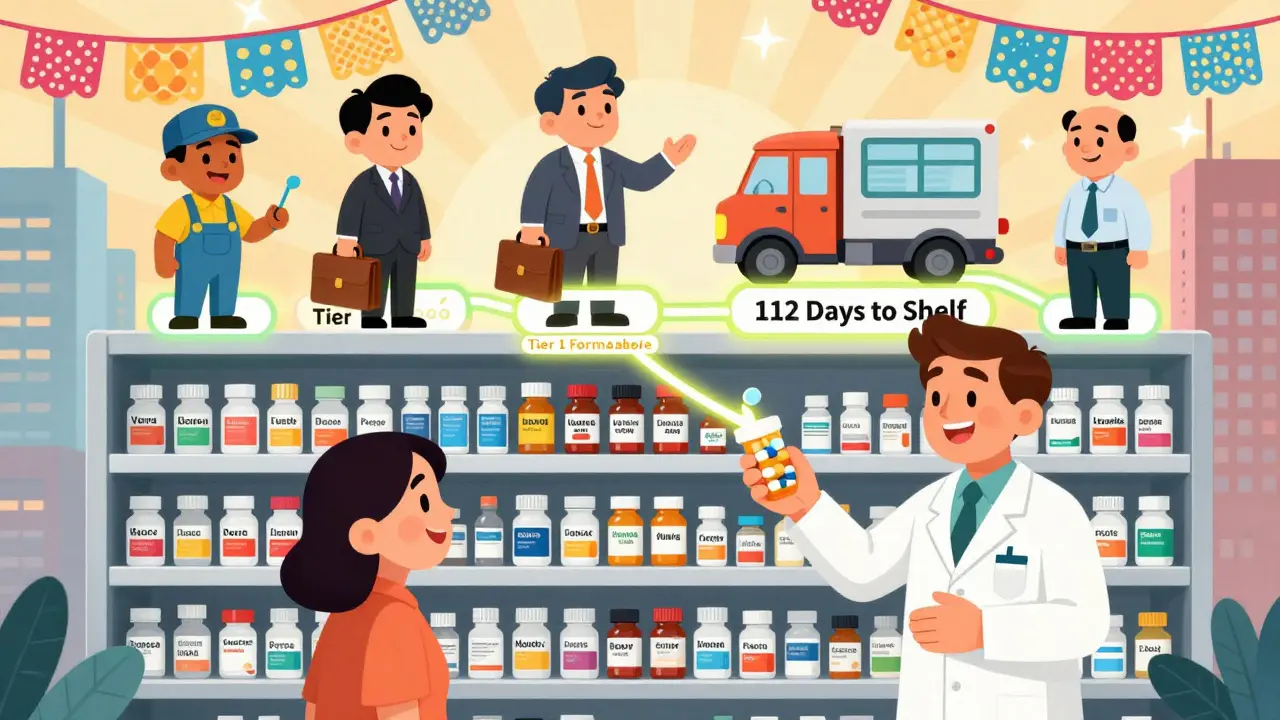
The average time from FDA approval to first dispensing at a retail pharmacy? 112 days. But it varies. Cardiovascular generics-like atorvastatin or metformin-often hit shelves in 87 days. Complex drugs, like inhalers or injectables, can take 145 days or more.
Why This Matters
Generic drugs are not just cheaper-they’re essential. In 2023, 90% of all prescriptions filled in the U.S. were for generics. They saved Americans $313 billion that year alone. Without the ANDA system, most people couldn’t afford their medications.
But the system is under pressure. Generic prices have dropped 4.7% per year since 2015. Some manufacturers are leaving the market because profit margins are too thin. The FDA is responding by prioritizing complex generics-drugs like topical creams, nasal sprays, and transdermal patches-that are harder to copy and often have fewer competitors.
Looking ahead, the FDA is pushing for faster reviews through GDUFA III (2023-2027). Artificial intelligence might soon help model bioequivalence or detect manufacturing flaws before a submission is even sent. But for now, the process remains human, slow, and meticulous.
Next time you fill a prescription and see "generic" on the label, remember: someone spent years proving it was safe. Someone else fought through legal battles. Someone negotiated with PBMs. And someone else made sure it got to your pharmacy on time. It’s not magic. It’s medicine.
How long does it take to get a generic drug from ANDA approval to the pharmacy shelf?
On average, it takes about 112 days from FDA approval to first dispensing at a retail pharmacy. This includes scaling up production (60-120 days), negotiating with pharmacy benefit managers (30-90 days), integrating into wholesaler systems (15-30 days), and updating pharmacy software (7-14 days). Complex drugs like inhalers or injectables can take over 145 days.
Why do some generic drugs cost more than others?
Cost differences come down to competition and market access. If a drug has only one or two generic manufacturers, prices stay higher. But when five or more companies make the same generic, prices drop sharply. Also, drugs on Tier 1 formularies (preferred by PBMs) often have lower copays because the manufacturer agreed to deeper discounts. A generic with no competition or poor formulary placement can cost significantly more.
What’s the difference between an ANDA and an NDA?
An NDA (New Drug Application) is for brand-name drugs and requires full clinical trials-animal studies, Phase I, II, and III human trials-to prove safety and effectiveness. An ANDA skips all that. It only needs to prove bioequivalence and provide detailed manufacturing data. NDAs cost about $2.6 billion and take 10-15 years. ANDAs cost $2-5 million and take 3-5 years.
Can a generic drug be different from the brand name?
Legally, it must be identical in active ingredient, strength, dosage form, and performance. But inactive ingredients-like fillers, dyes, or preservatives-can differ. That’s why some people report side effects with one generic but not another. If you notice a change, talk to your pharmacist. They can check if it’s a different manufacturer or batch.
Why do some generics take longer to reach the market after patent expiry?
Patent litigation is the biggest reason. If a brand-name company sues a generic manufacturer for infringement, it triggers a 30-month legal stay that blocks approval. Also, complex drugs-like inhalers or injectables-take longer to develop and approve. And if no manufacturer files an ANDA right away (often because of low profit potential), the drug stays brand-only longer.
Comments (8)
Katie Putbrese
These generic drug companies are ripping off American taxpayers. They get FDA approval, then charge the same prices as brand-name drugs because PBMs control everything. It's not competition-it's collusion. I've seen my insulin go from $45 to $120 just because the manufacturer didn't 'play nice' with Express Scripts. This system is rigged, and the FDA is complicit.
Why don't we just nationalize drug manufacturing? We build bombs and fighter jets-why can't we make pills without letting corporate middlemen squeeze families dry? I'm tired of pretending this is 'free market' when it's just a monopoly with extra steps.
And don't even get me started on how they use 'inactive ingredients' as an excuse to change the formula. My cousin had a seizure switching generics. No one investigates that. No one cares. But hey, at least it's 'bioequivalent' on paper, right?
Jacob Hessler
so like... the fda takes 30 months to approve a pill? that's insane. we can launch a rocket to mars in less time. why does it take longer to approve a generic than to build a new subway line?
and then they say 'oh but we need to check the chemistry'-like bro, it's the same damn molecule. why are we paying people to read spreadsheets for 2 years? this is why we can't have nice things.
Amber Gray
omg i just realized we’re paying for this whole system??? like the fda reviewers, the whosaleys, the pbms?? why not just make it gov run?? 🤯
also why do some generics taste weird?? i swear the blue one makes my tongue numb but the white one is fine. is that illegal??
Danielle Arnold
112 days? lol. that’s fast. last time i waited for a generic to hit shelves, i had time to learn spanish, break up with my boyfriend, and adopt a cat. it was a whole chapter of my life.
Jesse Hall
This is actually one of the most important stories I've read in a long time. I work in a pharmacy and see how much this affects real people every day. That $313 billion saved? That's thousands of families keeping their homes, feeding their kids, not choosing between insulin and rent.
It’s not perfect, but the system works. People who say it’s broken don’t realize how much coordination it takes just to get one pill from a lab in India to a shelf in rural Ohio. Hats off to the scientists, regulators, and logistics teams who make this happen. We need more people like them, not less.
Donna Fogelsong
ANDA is a front. The real story? Big Pharma owns the FDA. The 'bioequivalence' tests? They're designed to fail. The 180-day exclusivity? A backdoor patent extension. They want you to think this is about safety-it's about control. The FDA only approves generics that are made by companies that will later pay for 'consulting fees.'
Ever notice how the same 3 companies always get first approval? Coincidence? Or are they the same ones who donated to the senators who wrote GDUFA? I've seen the documents. I'm not crazy. The system is a shell game.
And don't tell me about 'quality control.' My sister's blood pressure spiked after switching to a 'generic' made in China. The label said 'Made in USA.' It wasn't. The FDA knew. They just didn't care.
Sean Bechtelheimer
you ever wonder why all the cheap generics come from india? 🤔
they're not 'bioequivalent'-they're just cheaper. the fda doesn't even inspect half the factories. i saw a video of a lab where they just pour the powder into pills with a shovel. no gloves. no masks. just a guy named Raj and a fan.
and the pbms? they pick the cheapest one. even if it's made in a basement. we're not saving money-we're poisoning people. and no one talks about it because 'it's legal.'
Seth Eugenne
Thank you for writing this. I’ve been a pharmacist for 18 years, and I’ve seen how hard people work behind the scenes to get these drugs to us. The chemists, the inspectors, the warehouse workers-they’re not celebrities, but they’re heroes.
One thing I wish more people knew: when a generic isn’t on the shelf, it’s rarely because of the FDA. It’s because the manufacturer couldn’t get the PBM deal. That’s the real bottleneck. If we could make formulary placement more transparent, we’d see way more generics available.
And yes, sometimes the fillers change. If a patient says, 'This one doesn’t work like the last one,' listen. It’s not all in their head. Talk to your pharmacist. We can switch it. We’re here to help.