
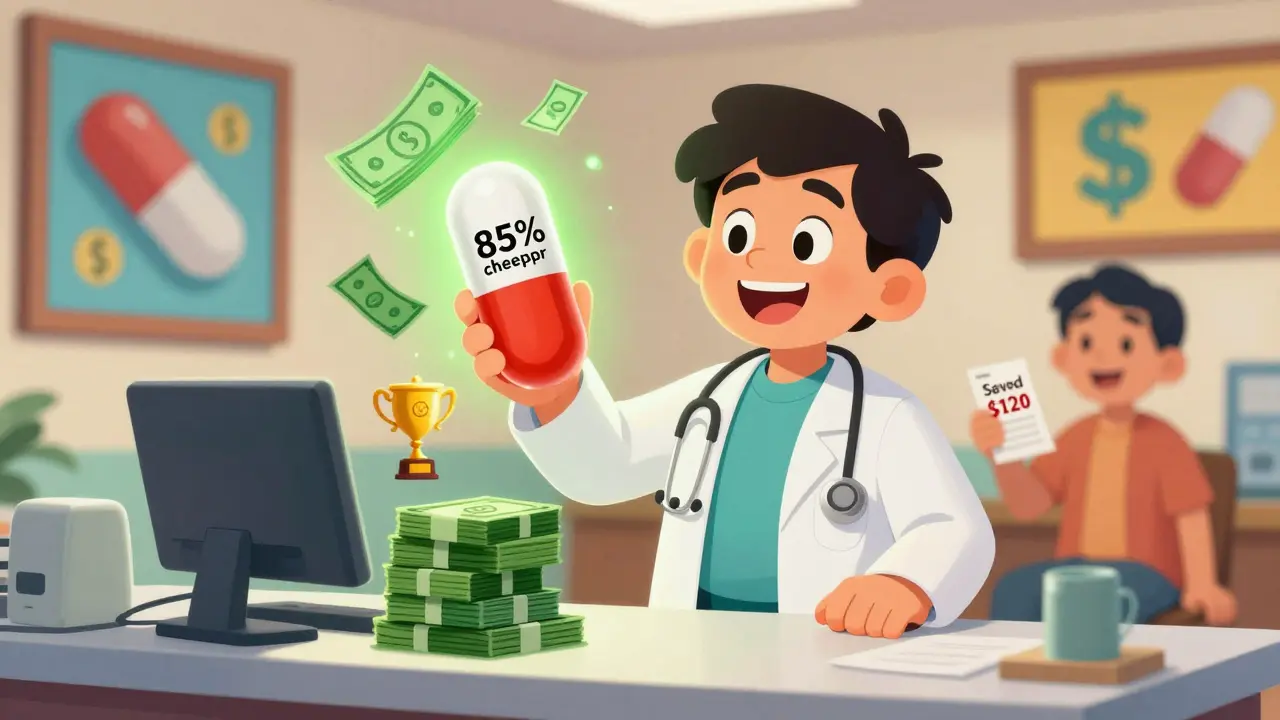
Have you ever wondered why your doctor reaches for a generic pill instead of the name-brand one? It’s not just because it’s cheaper-it’s often because they’re being rewarded for it. Across the U.S., healthcare providers are increasingly caught in a system where prescribing generic medications isn’t just encouraged-it’s financially incentivized. And that’s changing how medicine is delivered, one prescription at a time.
Why Generic Prescribing Matters
Generic drugs aren’t just knockoffs. They’re exact copies of brand-name drugs in active ingredients, dosage, and effectiveness. The FDA requires them to meet the same standards. But here’s the kicker: generics cost 80-85% less. In 2022, 90.5% of all prescriptions filled in the U.S. were for generics, yet they accounted for only 23% of total drug spending. That’s a $1.7 trillion savings over the last decade, according to the Congressional Budget Office. So when a doctor chooses a generic, they’re not just saving the patient money-they’re saving the whole system.
But here’s the twist: doctors don’t always choose generics, even when they’re clinically identical. Why? Because the system hasn’t always aligned their incentives with cost-saving goals. That’s where incentive programs come in.
How Incentives Work
Generic prescribing incentives come in two flavors: financial and non-financial. Financial ones are straightforward-cash bonuses. Blue Cross Blue Shield plans, for example, pay providers $5 to $15 per generic prescription in certain drug classes. Some physicians report annual bonuses of up to $5,000. UnitedHealthcare’s Value-Based Prescribing Program added $2,800 per year to one California doctor’s income, with no extra paperwork.
Non-financial incentives are quieter but just as powerful. Imagine getting your prior authorizations approved in minutes instead of days. Or being first on the schedule for urgent appointments. Some health plans now give priority access to providers who consistently choose generics. It’s not money, but it saves time-and time is money in a busy clinic.
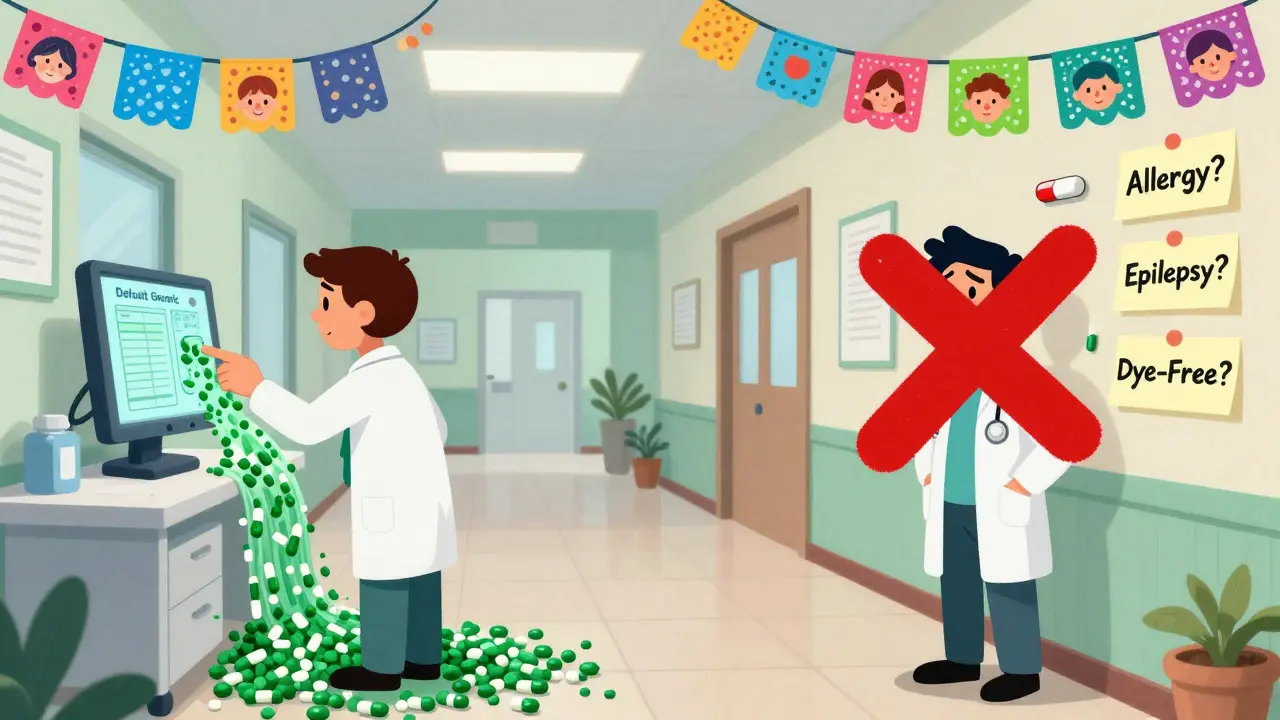
Then there’s the tech side. Electronic prescribing systems now default to generics. A 2020 study showed this simple change increased generic prescribing by over 22 percentage points. No persuasion needed. Just a setting tweak in the EHR.
What’s Working-and What’s Not
Not all programs are created equal. Formulary tiering-putting generics in the lowest-cost tier-only nudges prescribing up by 8-12%. But direct provider incentives? They’ve boosted generic use by nearly 25% in primary care settings. The difference? Direct rewards target the doctor’s behavior, not just the patient’s out-of-pocket cost.
But here’s where it gets messy. A 2023 JAMA Health Forum study found that doctors who participate in the 340B Drug Pricing Program-designed to help safety-net hospitals-actually prescribe fewer generics. Why? Because 340B lets them buy brand-name drugs at deep discounts. So they’re financially better off prescribing the more expensive option. It’s a perverse incentive: a program meant to help the poor ends up encouraging higher-cost prescribing.
And it’s not just about money. A 2022 study in the International Journal of Health Policy and Management found that 40-50% of physicians consider branded items-like pens, notepads, or free meals-as acceptable incentives. That’s not a bonus. That’s a relationship. And those relationships can quietly shift prescribing habits.
Provider Voices: The Real Story
Doctors aren’t robots. They’re caught between systems, patients, and budgets.
On Sermo, a physician network, Dr. Michael Chen in California says the incentive program was a welcome boost. “It didn’t change how I practice,” he said. “It just made the right choice easier.”
But Dr. Sarah Williams in Texas had a different take. “Some programs feel like they’re telling me how to treat my patients,” she told Medscape. “What if my patient needs the brand because of an allergy? What if the generic gives them nausea?”
Reddit threads echo this. User “MedDoc2020” wrote: “Generic incentives work great for high blood pressure or diabetes. But when you’ve got a 72-year-old with five chronic conditions and a history of adverse reactions, you can’t just pick the cheapest.”
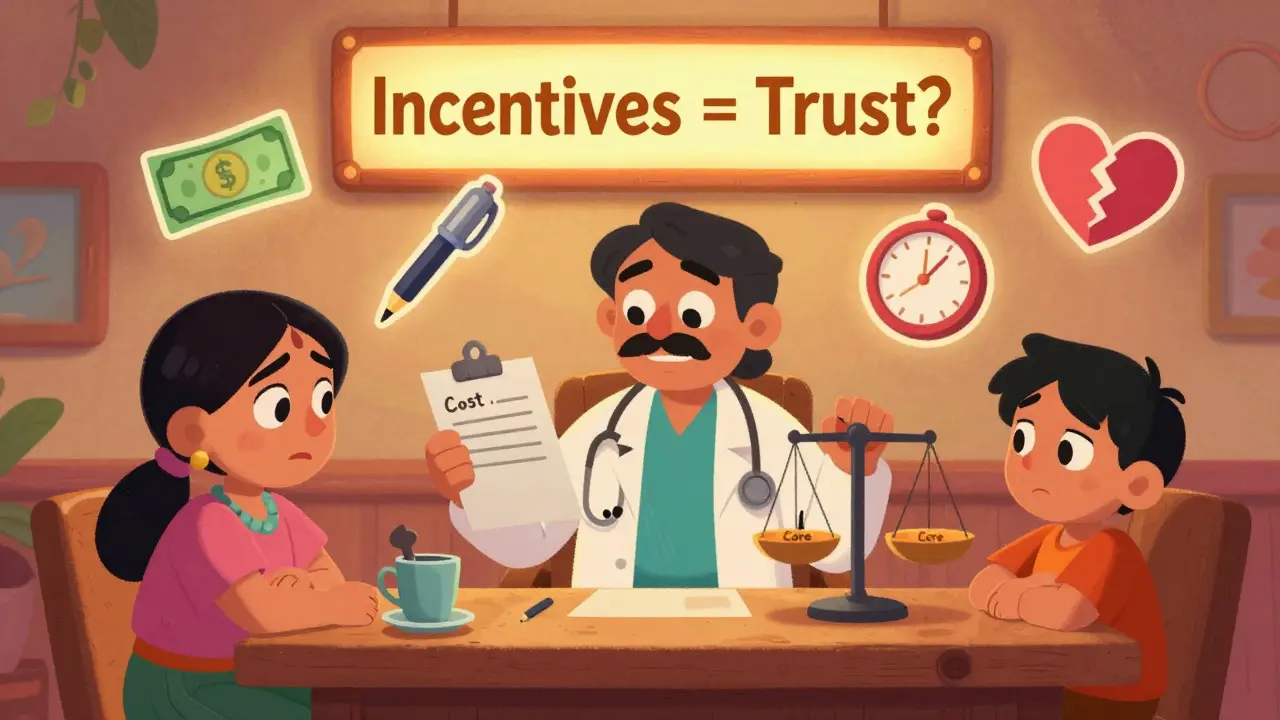
A 2021 MGMA survey of 1,200 providers found that 63% liked the incentives-as long as they were voluntary. But 78% worried that if patients found out doctors were getting paid to prescribe generics, trust would erode. That’s a real risk. Patients don’t want to feel like a cost-cutting line item.
The Bigger Picture: Global Lessons
The U.S. isn’t alone. Germany uses a system called “reference pricing”-if a brand-name drug costs more than the cheapest generic in its class, the patient pays the difference. Result? 93% of off-patent drugs are prescribed as generics. Compare that to the U.S. average of 85%.
England’s NHS studied prescribing behavior from 2011 to 2018 and found that when doctors can dispense drugs directly from their office, they prescribe 3.1% more expensive medications. Why? Because they profit from the markup. That’s not theory-it’s data.
These examples show: incentives work best when they’re transparent, tied to clinical outcomes, and designed to support-not override-clinical judgment.
What’s Next?
CMS is expanding its “$2 Drug List” model to more Medicare Advantage plans. Preliminary results show a 22.7% improvement in adherence for chronic conditions like asthma and hypertension. That’s huge. Better adherence means fewer hospital visits, fewer complications, lower long-term costs.
UnitedHealthcare is rolling out “value-based prescribing contracts” in 2024. These tie payments not just to cost, but to outcomes. Did the patient’s blood pressure drop? Did their HbA1c improve? If yes, bonus. If not, no money. It’s a step toward aligning incentives with real health-not just cheap prescriptions.
Experts predict generic use will hit 94% by 2028. But the real question isn’t how many prescriptions are generic-it’s whether they’re the right generics. And that’s where the next challenge lies.
The Fine Line Between Savings and Compromise
The biggest risk? One-size-fits-all prescribing. A 2022 ASPE survey found that 42% of providers who resisted incentive programs said the main reason was “they don’t account for clinical nuance.” A patient with epilepsy might need a specific brand because the generic alters absorption. A child with a rare allergy might need a dye-free version only available as a brand.
That’s why the American College of Physicians says incentives must exclude medications where brand is medically necessary. And they must be paired with education-not enforcement.
Training matters. Practices that added just 8-12 hours of education on formularies and therapeutic alternatives saw an 18.5 percentage point increase in generic use. That’s more than any bonus.
Bottom line: incentives aren’t evil. They’re tools. And like any tool, they can build or break trust.
What Providers Need to Know
If you’re a provider:
- Understand your plan’s incentive structure-know the dollar amounts, thresholds, and exclusions.
- Use your EHR’s clinical decision support. Don’t ignore alerts-but don’t blindly follow them either.
- When a patient asks why you chose a generic, explain it. Transparency builds trust.
- Speak up if the system doesn’t allow for exceptions. Your voice shapes policy.
If you’re a patient:
- Ask if a generic is available. Most of the time, it’s just as good.
- Don’t assume a brand is better. Ask your pharmacist or doctor why they chose what they did.
- Know your rights. If a generic causes a reaction, you’re entitled to the brand.
Do generic drugs work as well as brand-name drugs?
Yes. The FDA requires generic drugs to have the same active ingredients, strength, dosage form, and route of administration as the brand-name version. They must also meet the same strict standards for quality, purity, and performance. Studies consistently show no meaningful difference in effectiveness between generics and brands. The only differences are in inactive ingredients-like fillers or dyes-which rarely affect how the drug works.
Are provider incentives for generics ethical?
It depends on how they’re designed. Incentives that reward cost savings while allowing clinical flexibility are ethical. But when bonuses are tied to volume alone, or when they override clinical judgment, they become problematic. The real issue isn’t the money-it’s whether the system pressures doctors to choose based on profit rather than patient need. Transparency, exclusions for high-risk cases, and patient consent are key safeguards.
Can I ask my doctor to prescribe a brand-name drug instead?
Absolutely. You have the right to request a brand-name drug if you believe it’s better for you-especially if you’ve had a bad reaction to a generic, or if your condition requires a specific formulation. Your doctor may need to submit a prior authorization or explain why the brand is necessary. In many cases, insurance will still cover it if clinical justification is provided.
Why do some doctors resist generic prescribing incentives?
Many worry about losing clinical autonomy. Incentives that are rigid, don’t account for complex cases, or are tied to punitive metrics can feel coercive. Some also fear patients will distrust them if they learn their choices are influenced by financial rewards. Others point to real clinical differences-like inconsistent absorption in certain generics for epilepsy or thyroid conditions-where brand matters.
Do generic prescribing incentives lower the quality of care?
Not when designed well. Multiple studies, including those from the ACP and CMS, show that when incentives are paired with clinical decision support and exclusions for high-risk patients, quality either stays the same or improves-because patients are more likely to fill and take their prescriptions when they’re affordable. Poorly designed programs that ignore clinical nuance can lead to errors, but those are exceptions, not the rule.
Comments (13)
Ethan Zeeb
Generic incentives aren't the problem-it's the lack of exceptions. I've had patients with epilepsy crash because a generic switched absorption rates. No bonus is worth that. Doctors aren't greedy, they're just stuck between a system that says 'choose cheap' and a patient who needs the brand.
And yeah, I got paid $3k last year for generics. But I also fought insurance 12 times to get my patient their brand. So don't act like we're just cashing checks.
Darren Torpey
Bro, this whole system is like a video game where you unlock ‘Trust’ by doing the right thing-but the game’s coded to make you feel guilty for it. Generics? Yeah, 90% of the time they’re perfect.
But when you’ve got a grandma on levothyroxine who’s been stable for 15 years, and you switch her to a generic and she starts feeling like she’s underwater? That’s not savings-that’s a tragedy wrapped in a spreadsheet.
Let’s reward smart prescribing, not just cheap prescribing. 🙌
Lebogang kekana
Man, I’m from South Africa and we don’t even have this mess. Here, generics are the norm-no incentives needed. Why? Because the system assumes doctors are professionals, not cash-grabbing robots.
When you treat people like adults, they act like adults. Incentives? That’s a sign the system doesn’t trust its own doctors. And that’s the real disease here. 💪
Jessica Chaloux
I just cried reading this. My mom’s on a generic for blood pressure and she got dizzy for 3 weeks. We had to go back to brand. My doctor said he got a $10 bonus for the generic. I felt like a number. 😭
Jane Ryan Ryder
Oh look, another corporate scheme to make doctors into pharmacy sales reps while pretending it’s about ‘patient savings.’
Next they’ll pay us to prescribe more insulin so we can all get a bonus when diabetics end up in the ER. Classic. 🤡
Callum Duffy
The notion that financial incentives inherently corrupt clinical judgment is overly simplistic. The data suggests otherwise: when incentives are transparent, clinically nuanced, and tied to outcomes rather than volume, they improve adherence and reduce disparities.
What we must guard against is not the incentive itself, but the absence of clinical autonomy. A well-designed system doesn’t replace judgment-it enables it.
Chris Beckman
generic drugs are just as good like 95% of the time but sometimes they dont work and then you get stuck with a 200 dollar bill for the brand and your doc gets a 5 dollar bonus for the generic that made you puke. why is this even a thing. also i think doctors shouldnt get paid for anything. like ever. just let them be heroes. 🤷♂️
Dean Jones
Let’s not conflate financial incentive with moral failure. The entire healthcare system is built on incentives-insurance reimbursement, hospital funding, CMS metrics, EHR nudges, even continuing education credits. This is just one more variable in a long chain.
The real issue is that we’ve outsourced ethical decision-making to algorithms and spreadsheets. A doctor who prescribes a generic because they’re paid $15 isn’t morally compromised-they’re responding to a system that has failed to create a better default.
The solution isn’t to ban incentives. It’s to redesign the system so that the right choice is also the easiest, most supported, and most respected one. That’s not corporate-it’s clinical wisdom.
Jeff Card
I’ve been a nurse for 18 years. I’ve seen patients skip doses because the brand cost $80. I’ve seen them take half a pill because they couldn’t afford the rest. I’ve seen them die because they stopped taking their meds.
Generics save lives. Not because they’re cheaper, but because people can actually afford to take them.
Yes, there are exceptions. But those exceptions don’t invalidate the rule. We need better tools to identify them-not to scrap the whole system.
Matt Alexander
Generics work. FDA says so. Studies say so. Your pharmacist says so.
Unless you have a known allergy or a condition like epilepsy where absorption matters, stick with the generic.
It’s not a downgrade. It’s a smart choice. Save money. Save time. Save the system.
Gretchen Rivas
My grandmother took the same generic for 12 years. Never had an issue. She’s 89 and still walks 2 miles a day. Don’t romanticize the brand. Most of the time, it’s just packaging and ads.
Ask your doctor. If they say ‘it’s the same,’ believe them.
Stephen Vassilev
Let me be clear: this is not about savings. This is about the pharmaceutical-industrial complex using middlemen-insurance companies and EHR vendors-to quietly restructure physician behavior under the guise of ‘efficiency.’
Do you know what happens when you incentivize generic prescribing? You create a black market for brand-name drugs on the dark web. You create patients who lie about allergies. You create doctors who refuse to document reasons for brand use.
This is not healthcare. This is behavioral manipulation. And the FDA? They’re complicit. They allow generics with 15% bioequivalence variance. That’s not science. That’s gambling.
Mike Dubes
Look, I’m not some corporate shill. I’m a family doc in rural Ohio. I use incentives. I get the $5 per generic. And I love it.
But here’s the thing-I also have a list of 12 meds where I NEVER switch to generic. Epilepsy. Thyroid. Bipolar. I know my patients. I know their bodies.
And I tell them: ‘I get paid for this, but I only do it because it’s right for you.’
Transparency wins. Trust wins. And yeah, a little bonus helps keep my lights on.