
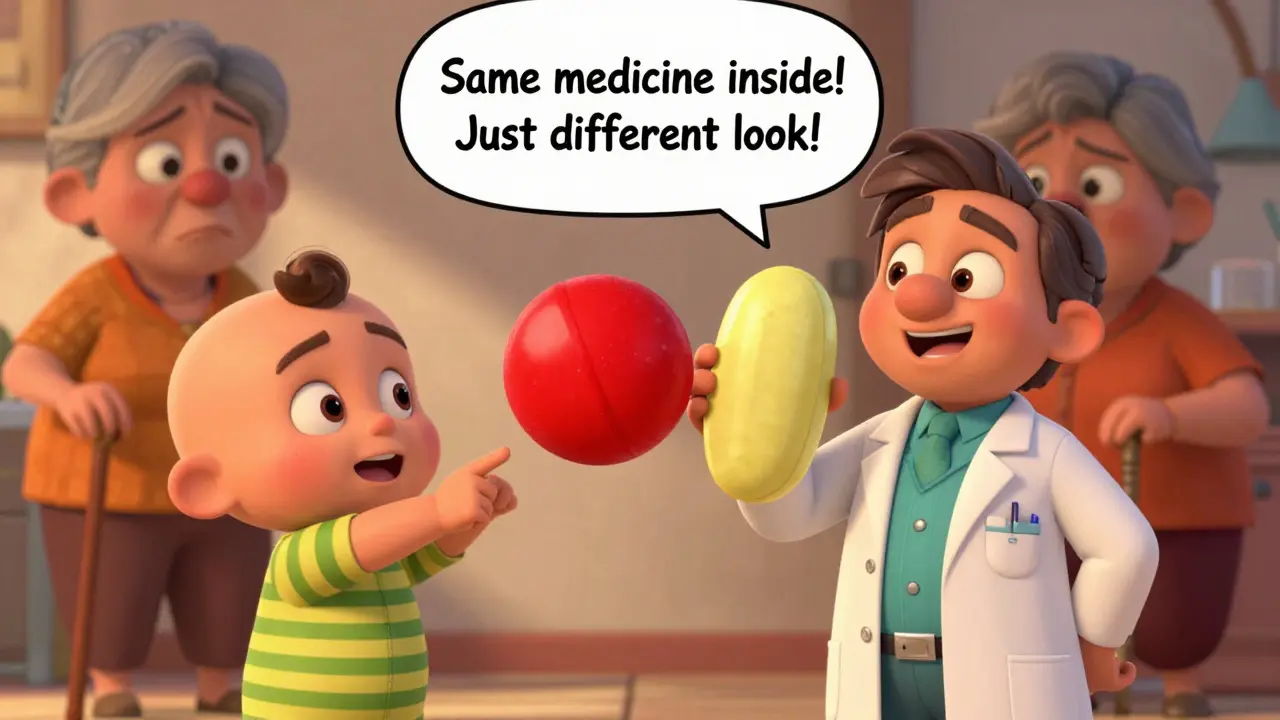
When a pharmacist hands you a pill that looks different from what you’ve been taking for years, it’s natural to wonder: Is this the same thing? This question becomes even more urgent when it involves generic substitution for children or older adults. While generics are scientifically proven to work the same way as brand-name drugs, the real issue isn’t science-it’s trust, perception, and understanding. For pediatric and senior patients, even small changes in pill shape, color, or taste can lead to confusion, refusal, or dangerous mistakes. The key isn’t just telling them it’s safe-it’s helping them feel safe.
Why Generic Substitution Feels Risky for Kids and Seniors
Generics aren’t knockoffs. They’re required by the FDA to have the same active ingredient, strength, and route of delivery as the brand-name drug. But here’s the catch: they don’t have to look the same. For a toddler on liquid amoxicillin, a bitter-tasting generic might mean the child refuses to take it at all. A 2022 parent survey on Reddit found that 64% of families reported their child refused a generic antibiotic because of taste, even though the brand version worked fine. That’s not a placebo effect-it’s a real barrier to treatment.
For seniors, the problem is layered. Many take four or more medications daily. When a blood pressure pill changes color, shape, or size every few months-because different generic manufacturers supply it-patients start to think they’re getting a different drug. One 78-year-old in a 2023 AARP survey said she stopped taking her medication because she thought the new pill was a different one. She wasn’t confused by science; she was confused by appearance.
Even worse, seniors often have memory issues or trouble reading small print. A 2021 study in Frontiers in Pharmacology found that 58% of older adults reported new side effects after switching to a generic-even when no biological change occurred. This is the nocebo effect: expecting something to be worse makes you feel worse. It’s psychological, but the consequences are physical.
The Hidden Gaps in Pediatric Generics
Most brand-name pediatric medications are made with kids in mind: sweet-tasting liquids, chewable tablets, easy-to-swallow capsules. But when the patent expires, manufacturers don’t always make the same kid-friendly versions. The FDA found that only 32% of generic versions of pediatric drugs come in liquid or chewable forms, compared to 68% of brand-name versions. That’s a huge gap.
Take lansoprazole (Prevacid) for acid reflux in infants. The brand came as a sprinkle capsule that could be mixed into applesauce. The generic? Only available as a capsule adults can swallow. For a three-month-old? Not usable. And because the FDA doesn’t require new pediatric studies for generics, many drugs never get tested for safety or effectiveness in children after they go generic. That means doctors are often guessing whether a generic will work the same way for a baby or toddler.
Parents don’t need a lecture on bioequivalence. They need to know: Is this safe for my child? Will they take it? Will it work? The American Academy of Pediatrics recommends that providers ask: “Is this the right formulation for your child?” before approving a switch. If the generic doesn’t come in a form your child can take, don’t force it. Ask for the brand-or another generic that does.
What Seniors Really Need to Know
Seniors aren’t resistant to saving money. In fact, 45% say cost is why they’re open to generics. But 68% believe generics are “less effective,” according to a 2021 CMS survey. That’s not ignorance-it’s experience. Many have been switched multiple times, with different pills every few months. One senior described it as “playing drug roulette.”
Effective communication starts before the switch. Don’t wait until the pharmacy calls. Talk to the patient and their caregiver during a regular visit. Use simple language: “This pill has the same medicine inside, but it’s made by a different company. That’s why it looks different.” Show them the old and new pill side by side. Use large-print handouts. Include a picture of the pill if possible.
Use the teach-back method. Ask them: “Can you tell me in your own words why this pill is okay to take?” If they say, “It’s cheaper, so it’s weaker,” you know there’s a misunderstanding. Correct it right then. Studies show this cuts medication errors by 29%.
Also, involve family. Many seniors live alone. A daughter or grandson who helps manage medications can be a bridge. Give them a printed note: “This is the same medicine as before. It just looks different. Please keep giving it to Mom/Dad.”
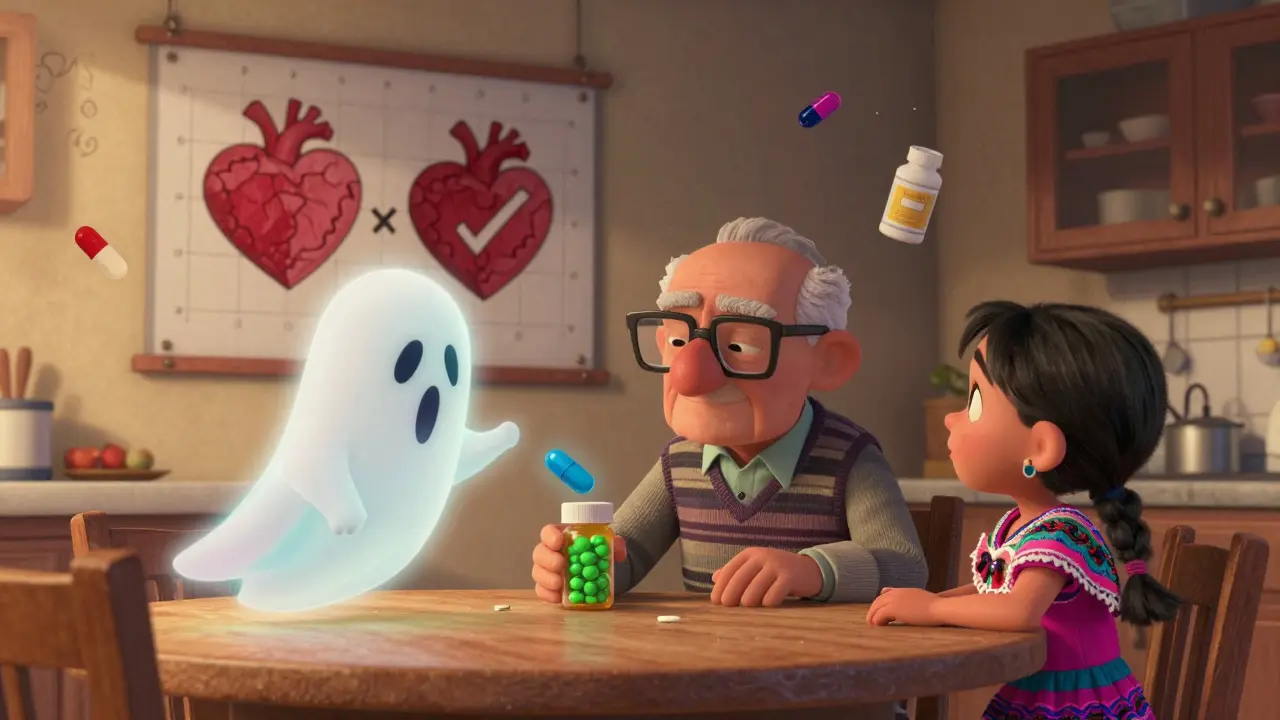
How to Talk About It-Without Scaring People
Don’t say: “It’s the same thing.” That’s too vague. People hear “same” and think “identical.” But generics aren’t identical. They’re equivalent. That means the medicine works the same way, even if the pill looks different.
Instead, say: “This medicine has the same active ingredient as your old one. It’s been tested to make sure it works just as well. The only difference is who made it and what it looks like.”
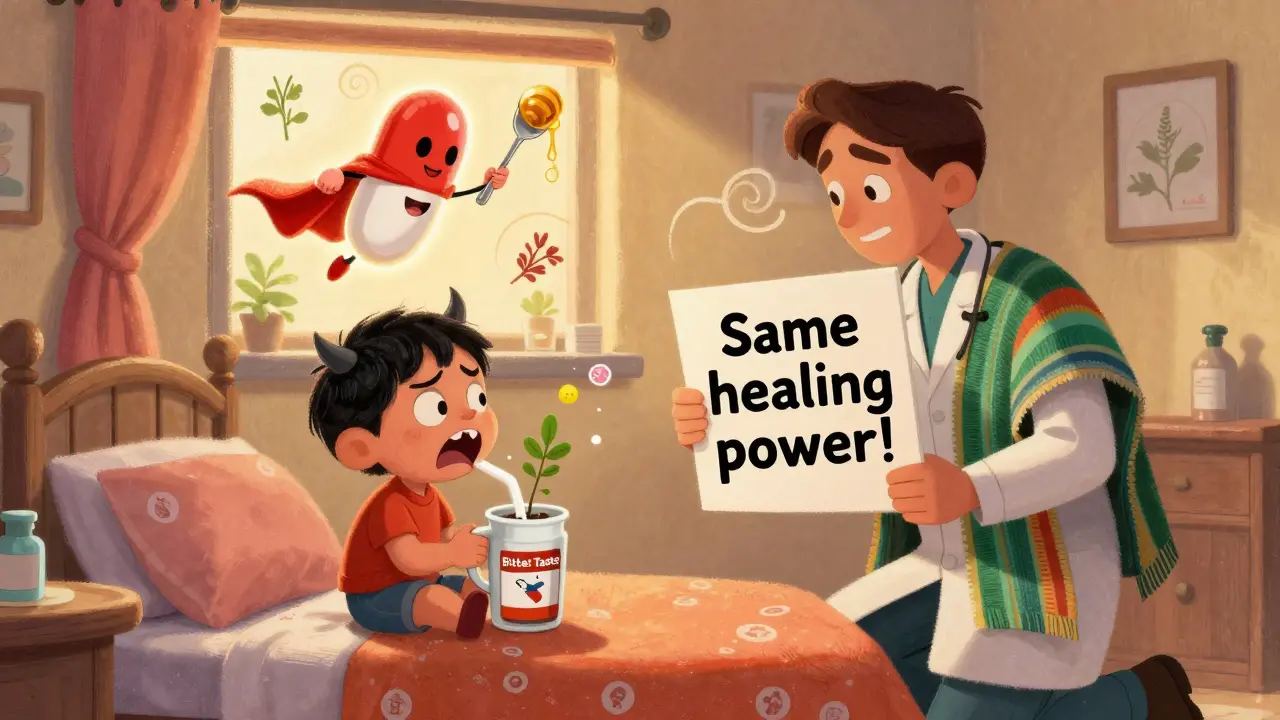
For kids: “The new medicine has the same healing power as the old one, but it might taste a little different. If it’s too bitter, let’s talk about other options.”
For seniors: “I know you’ve seen this pill before. It’s the same medicine, just made by a different company. It’s safe. But if you ever feel strange after switching, call us right away.”
Use visual aids. A simple chart showing the old pill and the new pill with a big checkmark next to “Same Medicine Inside” helps more than a paragraph of text.
What to Do When the Pill Changes Again
One of the biggest problems? Multiple switches. A senior might get one generic this month, another next month, and a third in three months. Each time, the pill changes. That’s confusing. It’s also risky.
Pharmacists should notify patients before a change. In 19 states, they’re required to get your consent. In 31 others, they must at least tell you. But many don’t. That’s why 52% of seniors in a 2023 AARP survey said they got confused by frequent changes.
Ask your pharmacist: “Will this be the same pill next time?” If the answer is no, ask if you can stick with one brand or one generic manufacturer. Some pharmacies can order a consistent version. It might cost a little more, but for seniors with memory issues, consistency is worth it.
For kids, if a generic causes refusal or vomiting, switch back. Don’t wait. The cost difference is real-but so is the risk of missed doses. A 2018 study found that when parents were told “it’s the same,” 37% stopped giving the medication entirely. When they got clear, calm explanations, that number dropped to 12%.
What’s Changing in 2026
The FDA launched its Generic Drug Communications Initiative in 2023, requiring manufacturers to include clear explanations in patient materials about formulation differences. Starting in 2024, new generic labels must say: “This medicine works the same as [brand name], but may look different.”
Some states are moving further. As of early 2024, 28 states are considering laws to block automatic substitution for drugs with narrow therapeutic windows-like epilepsy or heart medications-especially for kids and seniors. These are drugs where even a small change in absorption can cause serious problems.
Tools are helping too. Apps that let seniors scan their pill and see a photo and name are now used by 67% of seniors who report improved confidence in their meds. If your parent or child uses a smartphone, download one. It’s not magic-but it helps.
When to Say No to Generic Substitution
Not every drug should be switched. For children, avoid generics if:
- The brand comes in a liquid or chewable form and the generic doesn’t
- The child has refused the generic due to taste or texture
- The drug is for a condition like epilepsy or ADHD, where consistency matters
For seniors, avoid substitution if:
- The pill changes shape or color more than twice a year
- The patient has memory problems or confusion
- The drug has a narrow therapeutic index (like warfarin, digoxin, or levothyroxine)
In these cases, ask for the brand. Or ask for a specific generic manufacturer that you know works. Most pharmacies can special-order it.
Final Thought: It’s Not About the Pill. It’s About Trust.
Generics save the U.S. healthcare system over $370 billion a year. That’s huge. But for a child who won’t take their antibiotic or a senior who stopped their blood pressure pill because it looked different, the cost isn’t just financial-it’s health. The goal isn’t to push generics. It’s to make sure they work-really work-for the people who need them most.
Listen. Explain. Show. Ask them to repeat it back. Then, give them the power to speak up if something feels off. That’s how you turn a pharmacy transaction into real care.
Are generic drugs really the same as brand-name drugs?
Yes, in terms of active ingredient, strength, and how the body absorbs it. The FDA requires generics to be bioequivalent-meaning they deliver the same amount of medicine into the bloodstream within 80-125% of the brand-name version. But they can differ in color, shape, taste, or inactive ingredients. That’s why a child might refuse a generic liquid or a senior might think it’s a different pill.
Why do generics look different from brand-name drugs?
By law, generic manufacturers can’t copy the exact appearance of brand-name pills because trademarks are protected. So they change the color, shape, or logo. This isn’t a trick-it’s legal. But for people who rely on visual cues, especially seniors with memory issues, this causes confusion and fear.
Can a generic drug cause side effects the brand didn’t?
Not because of the active ingredient-those are identical. But sometimes, the inactive ingredients (like dyes or fillers) can cause reactions. For example, a child with a dye allergy might get a rash from a generic version that uses a different coloring. Or a senior with sensitive digestion might react to a new filler. Always report new symptoms to your doctor.
Should I always choose the brand-name drug for my child or elderly parent?
Not necessarily. Generics are safe and effective for most people. But if your child refuses to take it, or your parent gets confused by changing pills, it’s okay to ask for the brand-or a consistent generic version. Your health is more important than saving a few dollars if it means your loved one isn’t taking their medicine.
What should I do if my pharmacy switches my parent’s medication without telling me?
Call the pharmacy immediately. Ask if they notified the patient or caregiver. If not, request the original version. In 7 states and Washington, DC, pharmacists are required to get consent before switching. In others, they must at least notify you. You have the right to know-and to refuse-if the change affects safety or adherence.
Next time you’re picking up a prescription for a child or older adult, pause. Don’t just grab the pills. Ask one question: “Has this changed?” Then listen. You might just prevent a missed dose-or worse.
Comments (8)
Neeti Rustagi
While the article presents a compelling case for patient-centered communication regarding generic substitution, it is imperative to recognize that systemic inequities in pharmaceutical access persist across low-resource settings. In India, for instance, the majority of pediatric and geriatric populations rely entirely on generics due to economic constraints, yet there is virtually no standardized counseling protocol in community pharmacies. The absence of visual aids, multilingual labeling, or caregiver education exacerbates non-adherence. What is needed is not merely better communication, but institutional mandates for pharmacist-led patient education sessions - especially for high-risk populations. Without structural reform, even the most empathetic dialogue remains a Band-Aid on a hemorrhaging wound.
Furthermore, the FDA’s 2024 labeling requirement, while commendable, is insufficient. It does not address the reality that many seniors cannot read English, let alone comprehend pharmaceutical jargon. We must advocate for pictographic labeling systems, audio QR codes, and community health worker integration - not just better wording on a pill bottle.
Dan Mayer
lol at all this handholding. people are just being lazy. if you can't tell the difference between two pills that do the same thing, maybe you shouldn't be managing your own meds. my grandpa took 12 pills a day and never once confused them - he had a little pillbox with labels and a sharpie. problem solved. also, generics are 80% cheaper - if your kid refuses a pill because it 'tastes different,' that's a parenting issue, not a pharma one. stop coddling people. the system works fine if you're not an idiot.
also, 'nocebo effect'? sounds like pseudoscience. if they feel worse, they're probably just imagining it. or worse - they're lying to get the brand name so they can resell it on ebay.
Janelle Pearl
I’ve seen this firsthand with my mom. She’s 74, takes six meds, and every time the pill changes color, she panics. Last month, she stopped her blood pressure med for two weeks because the new one was oval instead of round. She thought she was getting a ‘weaker’ version. I sat with her, showed her the FDA sticker on the bottle, and even took a picture of the old and new pill side by side. She cried. Not because she was scared - but because no one had ever taken the time to show her it was the same.
It’s not about science. It’s about dignity. We treat seniors like they’re broken, not like they’re people who’ve spent decades managing their health. A simple ‘this looks different but does the same thing’ with a smile? That’s all it takes. And yes - I’m crying typing this. But I’m not alone.
Pharmacists - please, just talk. Look them in the eye. Don’t hand them a leaflet and walk away.
Ray Foret Jr.
Y'all are overthinking this 😅
I'm a pharmacy tech and I can tell you - the biggest issue isn't the pill color. It's the *lack of follow-up*. People get their script, leave, and never hear from anyone again. If you just called them a week later and asked, 'Hey, how's the new pill working?' - 90% of confusion would vanish.
Also, for kids - if the generic tastes like burnt plastic, no wonder they spit it out. The brand version has flavor masking. The generic? Sometimes it's just 'sugar + chalk'.
PS: I love that app idea! My aunt uses PillPack and says it's a game-changer. 🙌
Let's make this easier, not harder. Small steps > perfect plans.
Samantha Fierro
This is one of the most important public health discussions we are not having. The assumption that ‘bioequivalence equals clinical equivalence’ is dangerously reductive. For children with seizure disorders or seniors on anticoagulants, even minor variations in absorption can be catastrophic. And yet, we treat this like a cost-saving convenience rather than a clinical decision.
I urge all prescribers to adopt a three-step protocol: 1) Screen for risk factors (memory issues, polypharmacy, prior non-adherence); 2) Verify formulation compatibility (liquid/chewable availability); 3) Document patient/caregiver consent - not just a checkbox, but a verbal confirmation recorded in the chart.
This isn’t bureaucracy. It’s ethics. And if a pharmacy refuses to honor a request for consistent manufacturer? They should be required to escalate it to a clinical pharmacist. Because someone’s life is not a line item on an insurance spreadsheet.
Robert Bliss
My grandma used to say, 'If it looks different, it must be different.' I didn't get it until I started helping her with her meds.
One day, I found her staring at her pills like they were aliens. She'd been taking the same thing for 10 years, then one day it went from white oval to blue rectangle. She thought she was getting a new drug for her heart. She didn't say anything because she didn't want to be 'a bother.'
So I made her a little notebook. Every time the pill changed, I drew it, wrote the name, and stuck a sticker on it. She loved it. Said it made her feel smart again.
It cost me $2 and 15 minutes. But it saved her from stopping her meds for two weeks. Sometimes, the solution isn't high-tech. It's human.
Peter Kovac
The entire premise of this article is fundamentally flawed. It assumes that patient perception is a legitimate clinical variable - when in fact, it is an artifact of poor health literacy and societal over-medicalization. The FDA’s bioequivalence standards are robust, peer-reviewed, and validated across thousands of clinical trials. To suggest that visual differences or taste variations justify withholding generics is to elevate anecdote over evidence.
Furthermore, the suggestion that manufacturers should be required to produce pediatric formulations for generics is economically nonsensical. The market for pediatric generics is too small to justify R&D investment. If parents cannot administer a capsule by opening it and mixing the contents into food, then they require behavioral intervention - not regulatory overhaul.
The real issue is not pharmaceutical policy. It is the erosion of parental and caregiver responsibility. This article indulges fearmongering under the guise of compassion. That is not care. That is enabling.
rafeq khlo
What a disgraceful piece of emotional manipulation disguised as medical advice. You want us to believe that a child refusing a pill because it 'tastes bitter' is a crisis? Or that a senior confusing pill shapes is somehow a failure of the system? This is not healthcare - this is performance art for the woke left.
Generics save lives. Generics save money. Generics save the system. And yet you want to coddle people into believing they are fragile. You want to make pharmacists into therapists. You want to force manufacturers to cater to every whim of every confused elderly person. This is not progress. This is regression wrapped in a bow.
The solution? Teach people to read. Teach caregivers to manage. Teach patients to trust science - not their fear. Stop treating adults like children. And stop pretending that a 78-year-old who can't tell a blue pill from a white one is a systemic failure - it's a personal one.