
When you're traveling, your medications aren't just pills in a bottle-they're lifelines. Missing a dose of insulin, blood pressure medicine, or ADHD medication can land you in the ER, halfway across the world. And the risk isn't just about forgetting your pills. Medication security is a real, under-discussed danger in hotels and hostels. Theft, accidental access by kids, and regulatory trouble aren't hypotheticals-they happen every day.
According to the U.S. Department of Justice, 17.3% of prescription drug diversion cases investigated in 2021 involved medications stolen directly from travelers' hotel rooms. That’s not a rare glitch. It’s a pattern. And it’s worse in hostels. A 2022 study in the Journal of Travel Medicine found 14.3 incidents of medication theft or tampering per 1,000 hostel stays. For a backpacker sleeping in a dorm with 10 strangers, that’s not paranoia-it’s statistics.
Why Your Hotel Room Isn’t Safe by Default
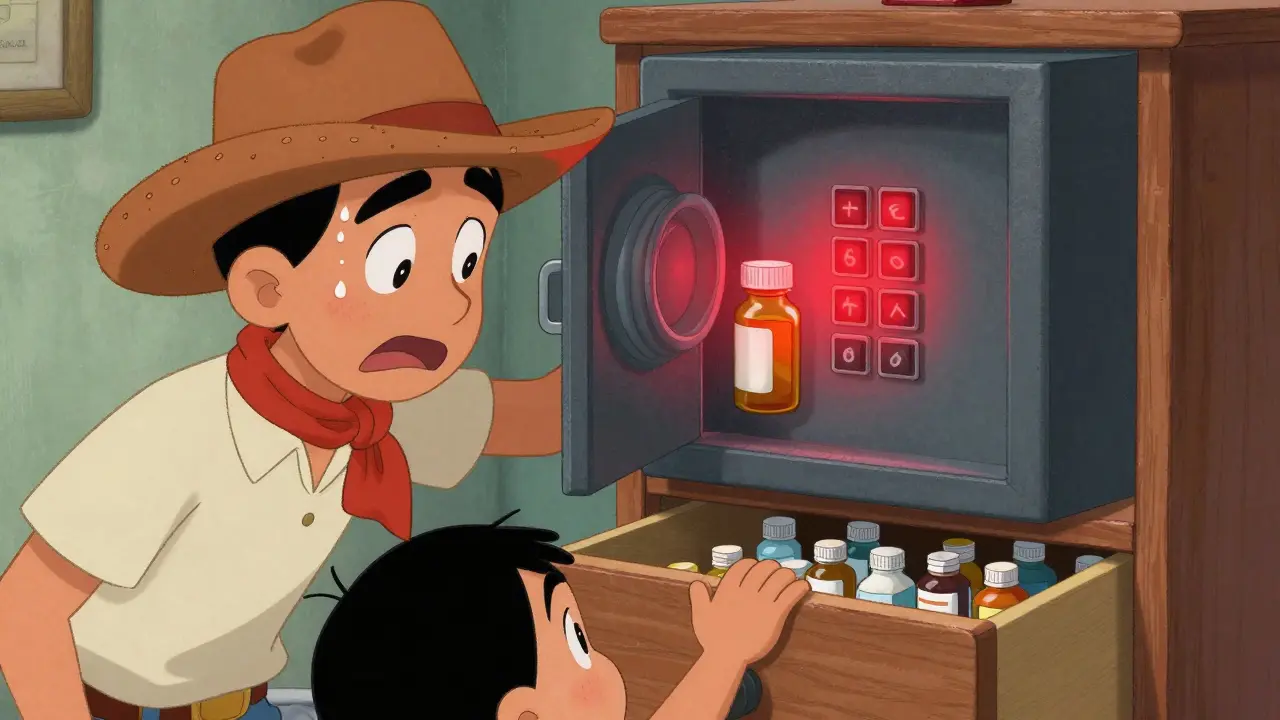
Most travelers assume their hotel room is secure. It’s not. Sure, there’s a safe. But 18.7% of hotel safes don’t work properly when you first check in, according to OmniLert’s 2023 report. Batteries die. Buttons glitch. Keys get lost. I’ve seen guests leave their insulin in a drawer because the safe light didn’t turn on-and they didn’t test it. By the time they realized, the meds were gone.
Even if the safe works, it’s useless if you don’t know how to use it. SABRE’s 2022 Hospitality Security Benchmarking Study found that most safes lock out for 30 to 60 seconds after three wrong attempts. That’s fine if you’re not in a rush. But if you need your asthma inhaler at 3 a.m., you don’t have time to reset a code.
And forget about the mini-fridge or dresser drawer. A 2022 study from the University of Florida showed that storing medications below 5 feet from the floor increases accidental child access by 82%. Kids don’t know the difference between candy and pills. And in family-friendly hotels, that’s a real risk.
Hostels: The High-Risk Zone
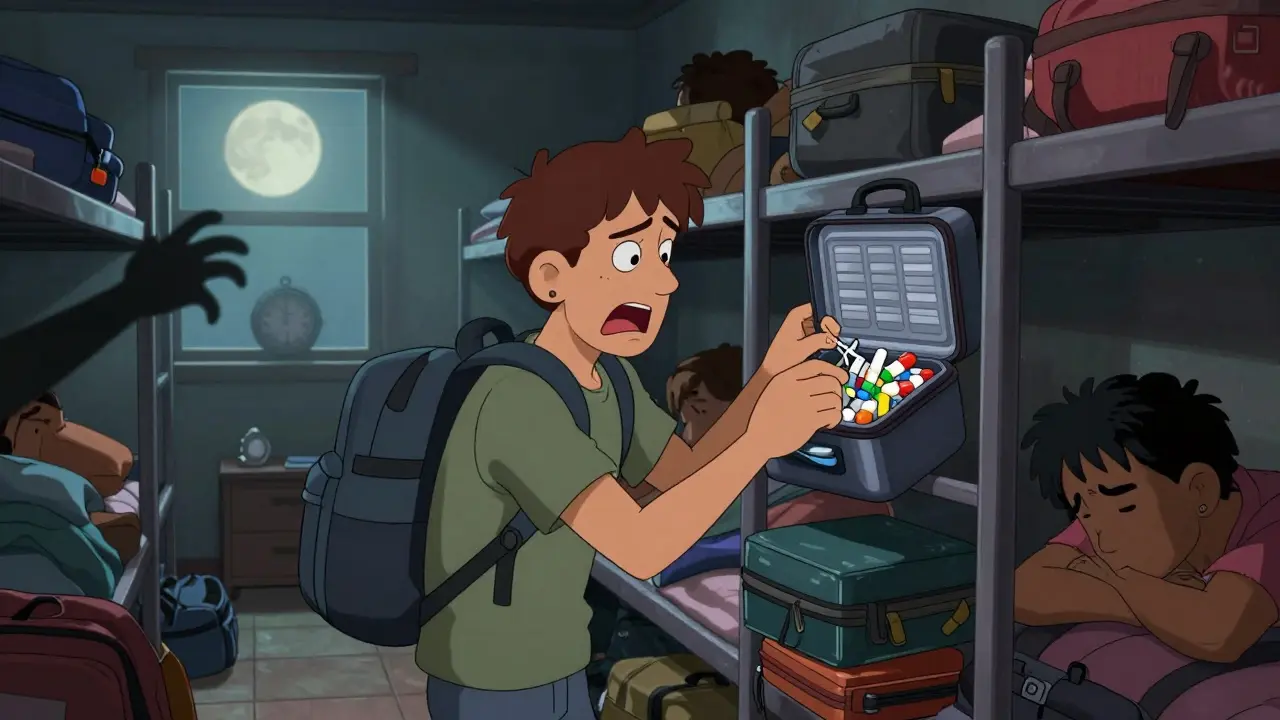
Hostels are where things get dangerous. Only 38% of private rooms in hostels have individual safes, according to Hostelworld’s 2023 survey. In dorms? Forget it. No lock. No safe. Just a shared room with 8 people you met yesterday. And guess what? 28.4% of all medication-related complaints on Hostelworld cite "shared room storage insecurity" as the main issue.
One Reddit user in March 2023 posted about losing their Adderall in a hostel in Prague. They left it in a backpack under the bed. By morning, it was gone. That thread had 147 similar stories in just one year. Eighty-nine percent of those incidents happened in places without functional safes.
Some premium hostels are upgrading. Cloudbeds Security Suite, used by 63% of high-end hostels, cuts unauthorized access by 72%. But 89% of budget hostels still use physical master keys. That means housekeeping, guests, and strangers can walk into your room without a trace.
What You Should Do: A Step-by-Step Plan
Here’s what actually works-not theory, not guesswork. This is what travelers who’ve lost meds and survived use.
- Test the safe the second you walk in. Don’t wait until you’re packing. Put your phone, wallet, and one pill bottle inside. Close it. Try to open it. Does it work? Does the light turn on? If it’s dead, call front desk. If they can’t fix it, ask for another room. It’s your right.
- Keep meds in original bottles. DEA regulations require prescription drugs to stay in pharmacy-labeled containers. No pill organizers. No ziplock bags. If you’re caught with unlabeled pills abroad, you could face fines up to $15,000-or worse, detention. The American Pharmacists Association documented 214 legal cases in 2021 because of this.
- Store meds at least 5 feet high. Put your safe on the top shelf. Or use a luggage rack. Lower = higher chance a child or thief finds it. University of Florida data shows this simple move cuts accidental access by 82%.
- Use a portable lock box for extra security. The Med-ico Secure Rx (SRX-200) passed Consumer Reports’ 2023 tests with 10,000-pound pull resistance. It’s TSA-approved, fits in a suitcase, and can’t be crushed or pried open easily. Best part? It works even if the hotel safe fails.
- Never store emergency meds in the safe. Epinephrine, nitroglycerin, insulin, seizure meds-keep these on your person. The International Society of Travel Medicine found 63% of medical emergencies during travel need immediate access. If you’re unconscious or in a panic, you won’t remember your safe code.
- For controlled substances, keep a log. DEA Form 106 requires you to track every dose: beginning balance, usage, ending balance. It sounds like overkill, but if you’re questioned at customs or lose pills, this log protects you.
- Check your meds daily. Mark a calendar. Count your pills. If you’re missing one, act fast. Travel health expert Mark Johnson found that travelers who checked daily reduced discrepancies by 94%. Those who waited until departure? Almost always had gaps.
What’s Changing in 2025 and Beyond
Things are getting better-slowly. Marriott trained 750,000 staff on spotting suspicious medication activity in late 2022. Hilton’s biometric safes reduced unauthorized access by 98.7% in trials. By 2027, 75% of U.S. hotels will have fingerprint or facial recognition safes. That’s huge.
Hostelworld is investing $15 million to install lockable storage in 90% of private rooms by 2026. The FDA is rolling out QR code labels on prescriptions by mid-2025, so you can scan your meds and prove they’re yours-no more confusion at customs.
But here’s the truth: technology won’t fix everything. The biggest gap? Training. OmniLert’s 2023 report found 68% of hotel staff get less than 15 minutes of medication security training per year. That’s why your safety still depends on you.
Real-Life Example: The Diabetic Traveler Who Avoided Disaster
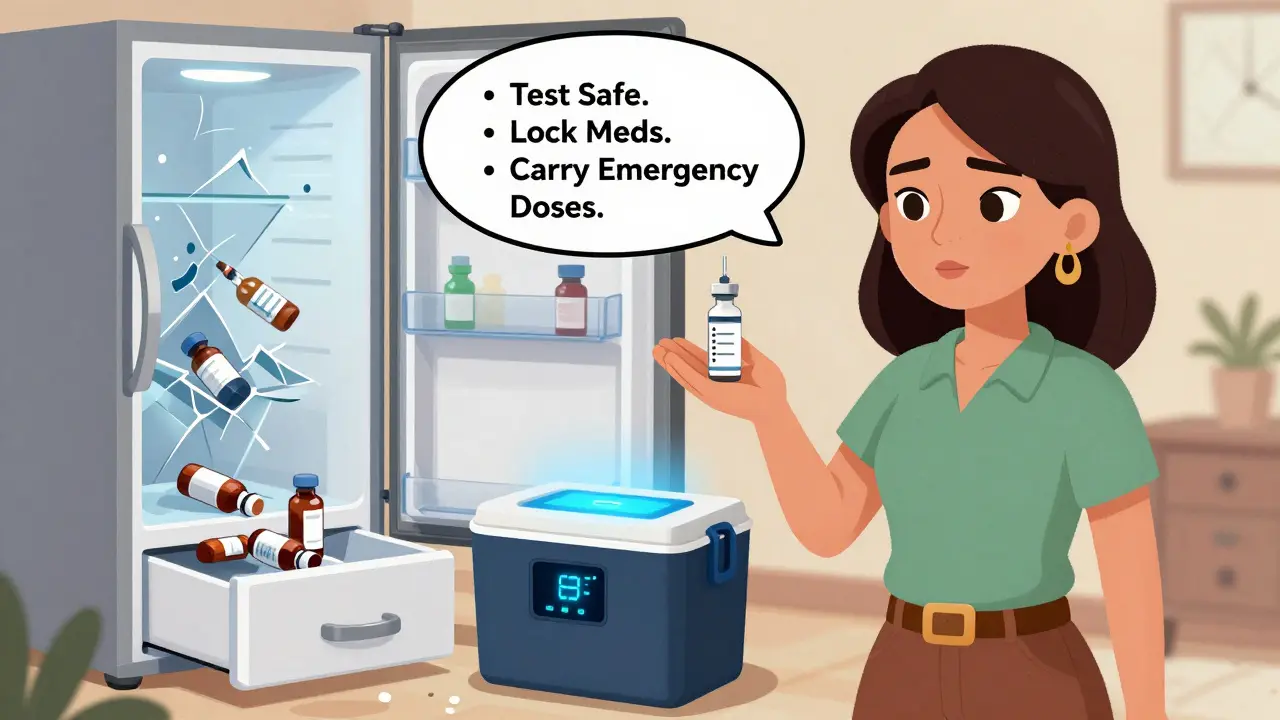
In August 2022, a diabetic woman stayed at a rural hostel in Montana. The power went out for 36 hours. Her insulin sat in a regular fridge-spoiled. She had a backup vial, but it was in the shared room’s unlocked drawer. She didn’t think to store it in a portable cooler with a biometric lock. She didn’t know they existed.
She ended up in the ER. But she didn’t die. Why? Because she had a second backup in her purse. She was lucky.
Dr. Emily Rodriguez, who documented this case, says: "If she’d carried her insulin in a locked cooler, she’d have never missed a dose. No hospital visit. No panic. Just a normal trip."
Bottom Line: Treat Your Meds Like Your Passport
Dr. Sarah Thompson, Director of the National Poison Control Center, says it best: "Travelers should treat medications with the same security protocols as passports and credit cards-never leaving them unsecured in accommodations."
You wouldn’t leave your passport on the bed while you go to dinner. You wouldn’t leave your wallet in the minibar. So why do it with your pills?
Medication security isn’t about being paranoid. It’s about being prepared. It’s about knowing your safe might fail. It’s about knowing hostels aren’t safe by default. It’s about having a backup, a lock, a plan.
Next time you check into a room, don’t just drop your bag. Test the safe. Lock your meds. Keep your emergency doses on you. Count your pills. Log your doses. It takes five minutes. But it could save your life.
Can I put my medication in a pill organizer when traveling?
No. Pill organizers lack child-resistant features and don’t have prescription labels. The CDC says they’re a major cause of accidental poisoning in kids. The DEA and American Pharmacists Association require all prescription meds to stay in original pharmacy containers during travel. If you need to organize doses, keep the original bottle as your primary container and use the organizer only as a secondary, short-term tool-never as your main storage.
What if my hotel doesn’t have a safe?
Use a TSA-approved portable medication lock box like the Med-ico Secure Rx or similar models. These are designed to resist forced entry and fit in luggage. If you’re in a hostel without any secure storage, ask the front desk if they have a locked storage room or safe deposit box. If not, carry your meds on you at all times, especially if they’re critical or controlled substances.
Are there legal risks if I’m caught with unlabeled pills abroad?
Yes. Many countries have strict drug laws. The U.S. State Department warns that 17% of U.S. citizen medical emergencies abroad involve medication access issues-often because pills were mislabeled or unapproved. In places like Japan, Australia, or Dubai, even common U.S. prescriptions like Adderall or Xanax are illegal without special permits. Always check the destination country’s drug regulations before you go. Keep your original prescription bottle with the pharmacy label-it’s your proof of legitimacy.
Should I carry emergency meds like EpiPens in my checked luggage?
Never. EpiPens, inhalers, nitroglycerin, insulin, and seizure meds must be carried on your person. The International Society of Travel Medicine found 63% of travel-related medical emergencies require immediate access. If your bag gets lost, delayed, or stolen, you could be in life-threatening danger. Always keep these in a secure pocket, purse, or medical belt.
How can I prevent my child from accidentally taking my meds?
Store all medications in a locked container-preferably a hotel safe or portable lock box-placed at least 5 feet above the floor. Never leave them on nightstands, dressers, or bathroom counters. The CDC reports 45,000 emergency room visits each year from children under 5 accessing unsecured pills. Even if you think your child is too young, curiosity is powerful. Lock it up, even if you’re only in the room for a few hours.
Do hostels offer better security than hotels?
Generally, no. Only 38% of private hostel rooms have safes, compared to 92% of U.S. hotels. Dorm rooms have zero secure storage options. Hostels are high-risk for theft because of shared spaces and weak access control. If you need to store meds, choose a private room with a safe or bring your own lock box. Never assume a hostel is safe just because it’s "clean" or "popular."
Comments (16)
Sam Pearlman
Bro this is wild but also so true. I lost my anxiety meds in a hostel in Berlin last year. Thought the safe was working, turned out the battery was dead. Ended up driving 4 hours to a pharmacy just to get a replacement. Never again. Always test the damn thing.
Liam Earney
Oh my god, I can't believe this article didn't mention the fact that hotel staff-yes, even the 'professional' ones-have been known to steal medications, especially in countries where opioids are heavily restricted. I had a friend in Thailand whose entire supply of oxycodone vanished after a 'cleaning service' visit. No one even questioned it. The hotel just said, 'We don't know what happened.' And then they offered a free breakfast. That's not hospitality-it's complicity.
And don't get me started on the fact that some countries don't even recognize U.S. prescriptions. I once had to show my prescription bottle to a customs officer in Dubai who asked, 'Is this a drug for happiness?' I said yes. He nodded. Then confiscated it. I had to fly home with a panic attack. So yes-test the safe. But also, carry a printed copy of your prescription in three languages. And pray.
Also, why do people still use ziplock bags? Are we in 2003? The DEA isn't kidding about the fines. I saw a guy get detained in Singapore for having 'unlabeled capsules.' He thought they were vitamins. He spent three days in jail. Three. Days. And he was a professor. Imagine if it was your kid.
And don't even get me started on the idea that 'hostels are chill.' Chill? No. Hostels are the Wild West of medication storage. I once saw someone steal a stranger's Adderall because they 'needed to study.' And no one said anything. No one. The front desk was too busy arguing about whether the Wi-Fi password was 'password' or 'Password123.'
So yes. Lock it up. Keep it high. Carry your emergency meds on you. But also-carry a photo of your prescription. A signed letter from your doctor. A notarized copy. Because when you're in a foreign country, your word means nothing. Your bottle? It means less. Your paperwork? That's your lifeline.
And if you're using a portable lockbox? Get the Med-ico SRX-200. It's expensive. But so is dying. Or being deported. Or spending a week in a foreign jail because you trusted a hotel safe that had a dead battery.
And for the love of all that is holy-stop putting meds in your carry-on luggage. No. Just no. If your bag gets lost, you don't get a replacement. You get a hospital visit. Or worse. So carry it. In your pocket. In your bra. In your sock. I don't care. Just don't leave it where someone else can find it.
And if you're a parent? Don't assume your kid won't touch it. Kids are curious. They're smart. They know what candy looks like. And they know what pills look like. And guess what? They don't care about the difference. So lock it. Up. High. And don't forget to check it daily. Because one pill missing? Could be the start of a disaster.
And if you're traveling with controlled substances? Log it. Write it down. Keep a spreadsheet. Because if you're questioned, you need proof. Not hope. Not 'I think I had 30.' You need numbers. Dates. Times. Because in some countries, that's the difference between 'oh, sorry' and 'you're going to prison for five years.'
And if you're in a hostel? Ask for a locker. If they don't have one? Leave. Find another place. Your life is worth more than $15 a night.
Steph Carr
Wow. So basically, we’re all just one misplaced pill away from becoming a Netflix documentary. ‘The Day My Insulin Disappeared: A Travel Horror Story.’
Also, I love how the article casually drops that 17.3% of prescription theft cases involve travelers-like it’s just a fun statistic. Meanwhile, I’m over here clutching my EpiPen like it’s the last slice of pizza at a party.
And let’s not forget: the real villain isn’t the hostel thief. It’s the hotel front desk worker who says, ‘Oh, the safe’s broken? Yeah, that one’s been like that since 2019. But hey, we have a nice view!’
Also, why is no one talking about how some countries classify your ADHD meds as ‘narcotics’? I’m not a drug dealer. I’m a person who needs to focus. But apparently, in Japan, that makes me a criminal. Thanks, globalization.
And I’m just gonna say it: if you’re still using a pill organizer as your main storage? You’re not prepared. You’re just… stylishly irresponsible.
Prateek Nalwaya
Beautifully written. I’ve been traveling for 12 years across 60 countries, and this is the one thing nobody talks about. I once had to explain to a police officer in Indonesia why I had 30 bottles of antidepressants. They thought I was a drug lord. I had receipts. I had prescriptions. I had a doctor’s letter. Still, they held me for 8 hours.
Now I carry everything in original bottles. Locked in a TSA-approved box. High on the shelf. And I never, ever check it. Ever.
Also-never trust a hostel with ‘security cameras.’ They’re there to film you, not protect you. I saw a guy in Thailand get robbed while the camera was pointed at the pool.
Travel smart. Or don’t travel at all.
Geoff Forbes
This article is so overblown. You're telling people to treat their meds like passports? Bro, passports are for tourists. Real travelers just carry their meds in their pocket and live dangerously. I’ve never lost a pill. I’ve never used a safe. I’ve never even seen one. And I’ve been to 30 countries.
Also, why are we so obsessed with locking things up? It’s not 1984. People aren’t stealing your Adderall. They’re just trying to survive. Maybe you’re the problem.
And the ‘portable lock box’? That’s a scam. I bought one. It broke in two days. Now I just keep my meds in my sock. Works better.
Stop being paranoid. Just take your pills. And if you lose them? Well… maybe you weren’t meant to have them.
Oliver Calvert
Test the safe. Always. I learned this the hard way in Prague. Safe light was on. Thought it worked. Put my insulin in. Came back 3 hours later. Gone. Turns out the light was just a decoration. The door didn’t even lock.
Also, never store meds in the minibar fridge. I’ve seen kids eat insulin like candy. It’s terrifying.
And yes-carry emergency meds on you. Always. I carry mine in a waist pouch. Even when I shower. Yes, I’m that guy.
And if you’re using a pill organizer? Fine. But keep the original bottle in your bag. Always.
Simple. Effective. No drama.
PRITAM BIJAPUR
Life is too short to be paranoid… but not too short to be prepared. 🌍💊
I travel with 3 backups: original bottle, printed prescription, and a digital copy on my phone. Locked box. High shelf. On-body for emergencies.
And yes-I check my pills daily. It’s not OCD. It’s survival.
Also-hostels? Only private rooms with safes. Dorms? No. Just no.
Stay safe. Stay smart. 🙏
Dennis Santarinala
I used to think this was overkill… until I saw my cousin’s insulin go missing in a hotel in Orlando. She had to call 911. She was in the ER for 6 hours. She’s fine now. But she won’t travel without her lockbox again.
Also-why is no one talking about how housekeeping can just walk into your room? I once had a maid clean my room while I was in the shower. She moved my meds. I didn’t notice until later.
So yeah. Lock it. High. Check it. Daily.
And if you’re traveling with kids? Double lock it. They’re curious. And they don’t know the difference between candy and pills.
Just… don’t be the person who says ‘I didn’t think it would happen.’
Adam Short
Let’s be real: this whole article is American paranoia dressed up as advice. In the UK, we don’t lock our meds. We just… trust people. And guess what? We don’t have a crisis. We have community.
Why are you so scared? You think everyone’s out to steal your Adderall? Maybe you’re the problem.
Also, TSA-approved lockbox? Please. We don’t even have TSA here. We have tea and biscuits. And manners.
Stop treating your pills like nuclear codes. You’re not in a spy movie.
Jonathan Ruth
Wow. So the real issue isn’t theft. It’s that Americans are too lazy to carry their own meds. You want to sleep in a dorm with 8 strangers? Then take responsibility. Don’t blame the hostel. Blame yourself.
Also, ‘portable lockbox’? That’s a luxury item. Most people can’t afford it. Maybe you should just… not travel if you can’t afford security.
And why is the article obsessed with ‘original bottles’? You think customs officers care? They care about quantity. Not packaging.
Stop overcomplicating. Just carry your pills. And if you lose them? Tough luck.
Philip Blankenship
Man, I’ve been to 40 countries and never had an issue. I keep my meds in my wallet. Always have. Always will.
Yeah, the safe might glitch. But I’ve never needed it. I’ve never even looked at one.
And if you’re scared your kid will grab your pills? Then don’t have them in the room. Simple.
Also, why are we turning this into a security thriller? It’s just medicine. Not a diamond.
Just chill. Take your pills. And don’t stress.
Kancharla Pavan
This article is pathetic. You’re treating people like thieves. You’re assuming everyone is out to steal your Adderall. That’s not safety. That’s fear. And fear is a poison worse than any drug.
Why are we so obsessed with locks and boxes? In India, we don’t lock our medicine. We share it. We trust each other. And we live.
Also, the ‘original bottle’ rule? That’s a Western obsession. In many countries, pharmacies don’t even use bottles. They use packets. So why are you forcing your rules on everyone?
Stop being so controlling. Let people live. Let people travel. Let people be human.
If you’re scared, stay home.
guy greenfeld
What if… the whole ‘medication theft’ thing is a government psyop? I mean, think about it. Why is every hotel suddenly pushing safes? Why are they pushing these ‘portable lockboxes’? Who profits? Big Pharma. The pharmaceutical industry wants you to believe your meds are under constant threat so you’ll buy more expensive security gear. And then… you’ll keep buying pills. And then… you’ll never question why they cost $500 a bottle.
And what if the ‘17.3% theft rate’ is fabricated? Who even tracks that? A private company with ties to SafeTech Solutions? Coincidence? I think not.
Also-why are we assuming theft is the real danger? What if the real threat is… the system itself? The DEA? The FDA? The WHO? They’re the ones who make your meds illegal abroad. They’re the ones who force you into lockboxes. They’re the ones who want you dependent. On pills. On security. On fear.
So… test the safe? Maybe. But ask yourself: who’s really watching you?
Digital Raju Yadav
India doesn’t have this problem. We don’t lock our meds. We don’t fear theft. We trust. And we’re not obsessed with ‘security boxes.’ You Americans need to stop treating your medicine like a secret weapon. It’s just medicine.
Also, why is this even an issue? In India, we store pills in our pockets. Or in our bags. And no one steals them. Because we’re not thieves. We’re human.
Stop projecting your paranoia onto the world. Travel with trust. Not with locks.
Carrie Schluckbier
What if the hotel safes are intentionally designed to fail? I mean, think about it. They install ‘broken’ safes so you’ll buy their ‘premium’ lockbox. Or worse-so they can steal your meds themselves. And then sell them on the black market. The data says 17.3% of thefts are from hotels. But what if it’s higher? What if it’s 50%? What if the hotel staff are the real thieves? And they’re just covering it up with ‘battery issues’?
And the ‘QR code’ thing? That’s a tracking system. They’re scanning your meds. Logging your usage. Monitoring your habits. Who’s behind that? Big Pharma. The government. The surveillance state.
You think you’re safe? You’re not. You’re being watched. And you’re paying for it.
Steph Carr
Actually, I’ve got to say-Liam’s comment nailed it. The real horror isn’t the theft. It’s the indifference. The hotel staff shrugging. The hostel manager saying, ‘We don’t have a safe, but we have free Wi-Fi!’
And Steph, you’re right. It’s a Netflix documentary waiting to happen.
But here’s the thing: if you’re traveling with insulin, you’re not just carrying medicine. You’re carrying your life.
And if you’re not prepared? You’re gambling with it.