
When you need a generic medication like lisinopril or metformin, buying it from an online pharmacy might seem like a smart way to save money. But if you’re relying on insurance to cover it, things get complicated fast. Not every online pharmacy works with your insurance. Some do. Some don’t. And even when they do, the cost can vary wildly depending on whether you’re using a mail-order service tied to your plan or a random website you found on Google.
How Insurance Actually Covers Generic Drugs
Your health plan doesn’t pay for drugs directly. Instead, it uses a Pharmacy Benefit Manager (PBM) - companies like CVS Caremark, Express Scripts, or Optum Rx - to manage your drug benefits. These PBMs create a list called a formulary, which ranks medications into tiers. Generics almost always sit in Tier 1, the cheapest level. For a 30-day supply of a generic drug at a retail pharmacy, your copay might be $5. For a 90-day supply through your plan’s mail-order pharmacy, it could be $10. That’s not a mistake - it’s designed to encourage you to buy in bulk. You pay less per pill, and the insurer saves on administrative costs. But here’s the catch: this only works if you use pharmacies in your plan’s network. If you order from an independent online pharmacy that isn’t contracted with your PBM, your insurance won’t pay a cent. You’ll pay full price and then try to get reimbursed - if your plan even allows it.Mail-Order vs. Independent Online Pharmacies
There’s a big difference between a mail-order pharmacy run by your insurance company and a random online store selling pills. Mail-order services are part of your insurance network. You get your prescriptions filled through your PBM, and they ship directly to your door. Most require a 90-day prescription from your doctor, and delivery takes about a week. It’s great for maintenance meds like blood pressure or diabetes drugs, but useless if you need antibiotics right now. Independent online pharmacies? They’re like Amazon or Walmart’s website - just for pills. Some accept insurance. Most don’t. A few, like Amazon Pharmacy, offer their own subscription model: RxPass. For $5 a month, Prime members can get over 100 common generics without any copay or deductible. But here’s the twist: RxPass doesn’t use your insurance. It replaces it. That means if you’re on a high-deductible plan, RxPass might save you more than your insurance ever could.Why Your Insurance Might Switch Your Medication
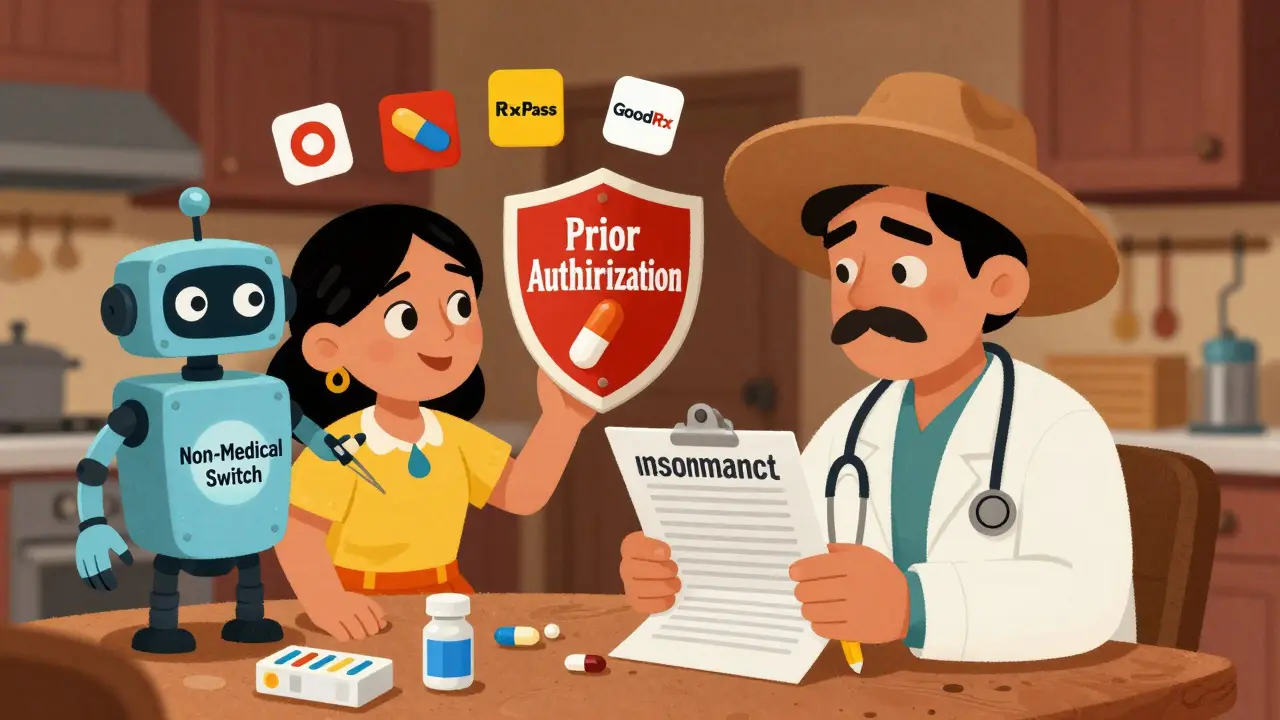
You might wake up one day and find your brand-name drug replaced with a generic - even if your doctor didn’t recommend it. This is called non-medical switching, and it’s becoming standard practice. Insurers do it because generics cost 80-90% less. If your plan’s formulary no longer includes your brand-name drug, or if the copay for it jumps to $150, you’re effectively forced to switch. Some patients report side effects after switching. One person on PatientAdvocate.org described severe reactions after their insurance switched them from Copaxone to a generic multiple sclerosis drug without warning. That’s not rare. In fact, 27% of insurance-related calls to MHBP’s support line in 2023 were from people confused or upset about unexpected generic substitutions. If you need the brand drug for medical reasons - say, because the generic doesn’t work for you - you can request a formulary exception. Your doctor files a prior authorization, explaining why the generic won’t work. It’s not guaranteed, but it’s your right. Don’t assume the pharmacist will fight for you. You need to speak up.
What You Can Do to Save Money
Before you click "Buy Now" on any online pharmacy, check these three things:- Is the pharmacy in your plan’s network? Log into your insurer’s website or call the number on your card. Ask: "Is [pharmacy name] in-network for mail-order or retail?" If they say no, don’t order.
- Compare prices with and without insurance. Use tools like GoodRx or SingleCare. Sometimes, Walmart’s $10 90-day generic program beats your $15 copay - especially if you haven’t met your deductible yet.
- Check if RxPass or similar programs work for your meds. Amazon RxPass covers 100+ generics, including common ones like atorvastatin, metformin, and levothyroxine. If your drug’s on the list and you’re a Prime member, you’ll pay $5/month, no insurance needed.
What to Do If Your Insurance Denies Coverage
If your plan denies coverage for a generic you were told was covered, or if you get hit with an unexpected charge, you have options:- Call your insurer’s pharmacy help line. MHBP’s 24/7 nurse line (1-800-556-1555) helps members understand formularies and copays. You don’t need to be an expert - just ask: "Why is this not covered?"
- Ask your doctor to file a prior authorization for the brand drug if the generic caused problems.
- File an appeal. Most insurers have a formal process. Don’t give up after one no.
- Use a cash-price tool like GoodRx. Even without insurance, you can often find generics for less than your copay.
The Bigger Picture: Why This System Exists
The reason this system is so complex? Money. PBMs control 92% of U.S. prescription drug plans. Their job is to reduce costs for employers and insurers. That’s why they push generics, mandate mail-order, and exclude brand-name drugs. In 2023, 68% of large employers required generic substitution when available. That saved employers an average of $1,200 per employee per year. But patients pay the price in confusion and sometimes, health risks. The system works great if you’re healthy, on stable meds, and understand your formulary. It falls apart if you’re juggling multiple conditions, have bad reactions to generics, or don’t know how to navigate the rules.What’s Changing in 2025
By 2025, nearly half of all generic maintenance drugs will be delivered by mail or home delivery, up from 32% in 2022. That’s because insurers are pushing harder for long-term prescriptions. At the same time, direct-to-consumer models like RxPass are growing - though they still cover less than 1.2% of the market. Meanwhile, 28 states now have laws limiting how much you can pay out-of-pocket for generics. In some places, the cap is $10 for a 30-day supply. The Inflation Reduction Act also capped insulin at $35/month for Medicare users - a policy that’s starting to influence commercial plans. Expect more caps on other high-cost drugs soon.Final Advice: Don’t Guess. Verify.
The biggest mistake people make is assuming their insurance works the same everywhere. It doesn’t. A pharmacy that accepts your insurance in California might not in Texas. A drug covered by your plan last month might be excluded this month. Formularies change constantly. Always check:- Is the online pharmacy in-network?
- What’s my exact copay for this drug?
- Is there a cash price lower than my copay?
- Does RxPass or another subscription service cover this drug?
Comments (15)
Frank Drewery
Just wanted to say this post saved me a ton of stress last month. I was about to order metformin from some sketchy site until I checked my insurer’s network. Turned out my mail-order was cheaper than the ‘discount’ site. Seriously, always verify first. You’d be shocked how many people lose money thinking they’re saving.
Also, RxPass is a game changer if you’re on Prime. I’ve been using it for my lisinopril and it’s just $5 a month. No copay, no deductible, no headache. Wish I’d known sooner.
mary lizardo
The structural inefficiencies inherent in the current pharmaceutical benefit management paradigm are not only economically regressive but also ethically indefensible. The commodification of essential therapeutics under the guise of cost containment represents a profound failure of public policy. One cannot help but observe the alarming proliferation of predatory pricing mechanisms masquerading as consumer empowerment.
Moreover, the normalization of non-medical switching without clinical justification constitutes a violation of the Hippocratic Oath’s foundational tenets, albeit indirectly enforced by corporate entities devoid of medical licensure. The regulatory vacuum permitting such practices demands immediate legislative intervention.
jessica .
you think this is bad? wait till you find out the gov is secretly working with big pharma to make you take generics so they can track you through your meds. i read it on a forum. they put microchips in the pills. thats why the mail order ones are cheaper - they’re scanning you every time you get a refill.
also, amazon is a spy tool. why do you think they’re pushing rxpass? they want your health data. they already know when you’re sick. they sell it to the feds. dont trust anything.
and why do all the ‘experts’ say ‘call your insurer’? because they work for the pmb’s. they’re paid to tell you to keep quiet.
Sajith Shams
Everyone in the US is clueless about how drug pricing works. In India, generics are sold at 1/10th the price without insurance because there’s no middleman. No PBMs. No formularies. Just manufacturers selling directly to pharmacies. The entire US system is a scam built on layers of corporate greed.
And you people think RxPass is a solution? It’s just Amazon replacing one monopoly with another. You’re still paying for the same drugs, just through a different gatekeeper. Real savings come from importing from Canada or India - if you’re brave enough to risk it.
Also, why are you all surprised that PBMs push generics? They’re not healthcare companies. They’re financial firms that trade in drug rebates. Their job isn’t to help you. It’s to maximize profit for their clients - the insurance companies. You’re the product, not the customer.
Erica Vest
Just a quick note for anyone reading this - if you’re on a high-deductible plan and haven’t met your deductible yet, always check the cash price before using insurance. I’ve had cases where Walmart’s $10 90-day generic was cheaper than my $15 copay even after insurance applied. GoodRx and SingleCare are your best friends.
Also, don’t assume your formulary is static. I’ve seen drugs get removed from Tier 1 with zero notice. Always double-check before refilling. And if you’re switching meds and feel off - speak up. Your doctor can’t fight for you if you don’t tell them something’s wrong.
Chris Davidson
Insurance is a scam
Pharmacies are in bed with PBMs
Generics are fine unless you’re one of the 5% who gets messed up
Just pay cash if you can
And stop complaining
Everyone else does
Glen Arreglo
As someone who’s lived in three countries and now in the U.S., I can say this: the American healthcare system is the only one where you need a PhD just to buy aspirin. In Germany, you walk in, show your card, and walk out with your meds. No formularies. No prior auth. No mystery pricing.
I get that PBMs exist to cut costs, but the cost isn’t just financial - it’s emotional. People are scared to switch meds because they’ve heard horror stories. And rightly so.
Maybe the real solution isn’t more tools or apps - it’s simpler: regulate PBMs like utilities. They’re not optional. They control access to life-saving drugs. They should be held to public standards.
Jedidiah Massey
Let’s be real - the entire PBM ecosystem is a Ponzi scheme dressed in white coats. These entities are essentially arbitrageurs who extract value from the supply chain without adding any clinical utility. The formulary is a weaponized instrument of price discrimination, and the ‘mail-order’ mandate is just a thinly veiled attempt to lock patients into long-term, low-margin revenue streams.
RxPass? A corporate Trojan horse. Amazon doesn’t care about your health - they care about your data, your loyalty, and your recurring revenue stream. You think you’re saving? You’re just being monetized differently.
And don’t get me started on the ‘$10 generics’ - those are loss leaders. They’re bait. Once you’re hooked on the convenience, they upsell you on Prime, supplements, and wearable tech. It’s all connected.
TL;DR: You’re not a customer. You’re a data point with a prescription.
Janelle Moore
wait so if i take my blood pressure med from amazon rxpass does that mean my insurance doesnt cover it anymore? like what if i need to go to the er and they ask for proof i have insurance for meds? do i just show them my amazon receipt?
also my mom got switched to a generic and her brain started fogging up. they said it was 'just adjustment' but she cried for a week. i think they're poisoning us. why do they even make different generics if they're all the same? something's fishy.
and why do they always send it in those plastic bottles? why not like, paper? is it to track us? i'm not paranoid i just read the news.
Matt Davies
Brilliant breakdown - this is the kind of stuff that should be taught in high school. I’ve been using GoodRx for years and honestly, I’ve saved more than my insurance ever did. One time I found a 90-day supply of metformin for $8 cash at Costco - my copay was $22. Mind blown.
And RxPass? Absolute genius if you’re on a stable regimen. I’ve got my thyroid med, statin, and metformin all on it. $5/month feels like stealing. No paperwork. No waiting. No ‘we’re sorry but your formulary changed.’
Biggest takeaway? Stop trusting the system. Trust your wallet. Trust your pharmacist. And always, always check the price before you click buy.
mark shortus
I JUST GOT SWAPPED TO A GENERIC AND I THOUGHT I WAS DYING. MY HANDS WERE SHAKING. I HAD TO CALL MY DOCTOR AT 2AM. THEY SAID IT WAS 'NORMAL.' IT WASN'T NORMAL. I FELT LIKE I WAS BEING POISONED.
AND NOW MY INSURANCE WON'T COVER THE BRAND NAME BECAUSE 'THERE'S A GENERIC.'
WHAT KIND OF MADNESS IS THIS? I'M NOT A LAB RAT. I'M A PERSON. I HAVE A LIFE. I HAVE A FAMILY.
AND NOW I'M SCARED TO EVEN REFILL MY MEDS BECAUSE I DON'T KNOW WHAT I'M GETTING.
WHY IS THIS ALLOWED?
WHY IS NO ONE DOING ANYTHING?
MY DOCTOR ISN'T HELPING. MY PHARMACIST JUST SMILES AND HANDS ME THE BOTTLE.
I'M SO ANGRY.
Vicki Belcher
Thank you for this!! 🙏 I was so confused about RxPass until I read this. I just signed up and got my levothyroxine for $5/month. No insurance needed. I’m crying happy tears 😭
Also, I used GoodRx and found my metformin at Walmart for $4. I thought I was dreaming. My copay was $18. I’m never using insurance for generics again unless I have to.
PS: Your pharmacist is your secret weapon. Talk to them. They know way more than you think 💪
Mark Able
Wait so if I buy from Amazon RxPass, does that mean I can’t use my HSA? Because I’ve been saving up for my meds. What if I need to pay for something else? Is this going to mess with my taxes? I don’t want to get audited because I bought pills online.
Also, can I use RxPass for my cat’s meds? My vet said his thyroid med is the same as the human one. Can I just order it and give him half? 😅
Dorine Anthony
I’ve been on the same generic for 5 years. Never had an issue. But I know people who had bad reactions. I get why the system is confusing. Honestly? Just call your insurer. It takes 5 minutes. Most of the time they’ll straight up tell you the answer.
And if you’re on a budget? GoodRx is your BFF. I’ve saved hundreds this way. No drama. No stress. Just cheaper pills.
Also - thank you for mentioning RxPass. I didn’t even know it existed. Just signed up. 🙌
Frank Drewery
Just saw your comment about the HSA - you can absolutely use it for RxPass. It’s a qualified medical expense. I use mine for it all the time.
And no, don’t give your cat your meds. They metabolize things differently. I learned that the hard way when my dog ate my blood pressure pill. (He’s fine. Don’t worry. But don’t do it.)