
Performance-Enhancing Drug Risk Calculator
Assess Your Risk
This tool estimates potential health risks based on your usage patterns. Results are estimates based on scientific data and should not replace professional medical advice.
Health Risk Assessment
Key Health Impacts
What You Should Do
1. Stop use immediately - Stopping is the first step toward recovery.
2. Consult a medical professional - Discuss your usage history with a doctor who understands PEDs.
3. Get comprehensive medical testing - Blood tests can reveal hormone imbalances and organ strain.
4. Begin structured recovery - Recovery may take 6-12 months or longer without medical supervision.
5. Seek psychological support - Many users experience depression and mood swings during recovery.
When you see an athlete lift heavier, run faster, or recover quicker than ever before, it’s easy to assume they’re just working harder. But behind many of those gains are drugs-medications that aren’t prescribed to treat illness, but to push the body beyond its natural limits. This isn’t just about Olympic champions anymore. It’s about gym-goers, weekend warriors, and young athletes who think they’re getting ahead-when they’re actually risking their long-term health.
What Are Performance-Affecting Medications?
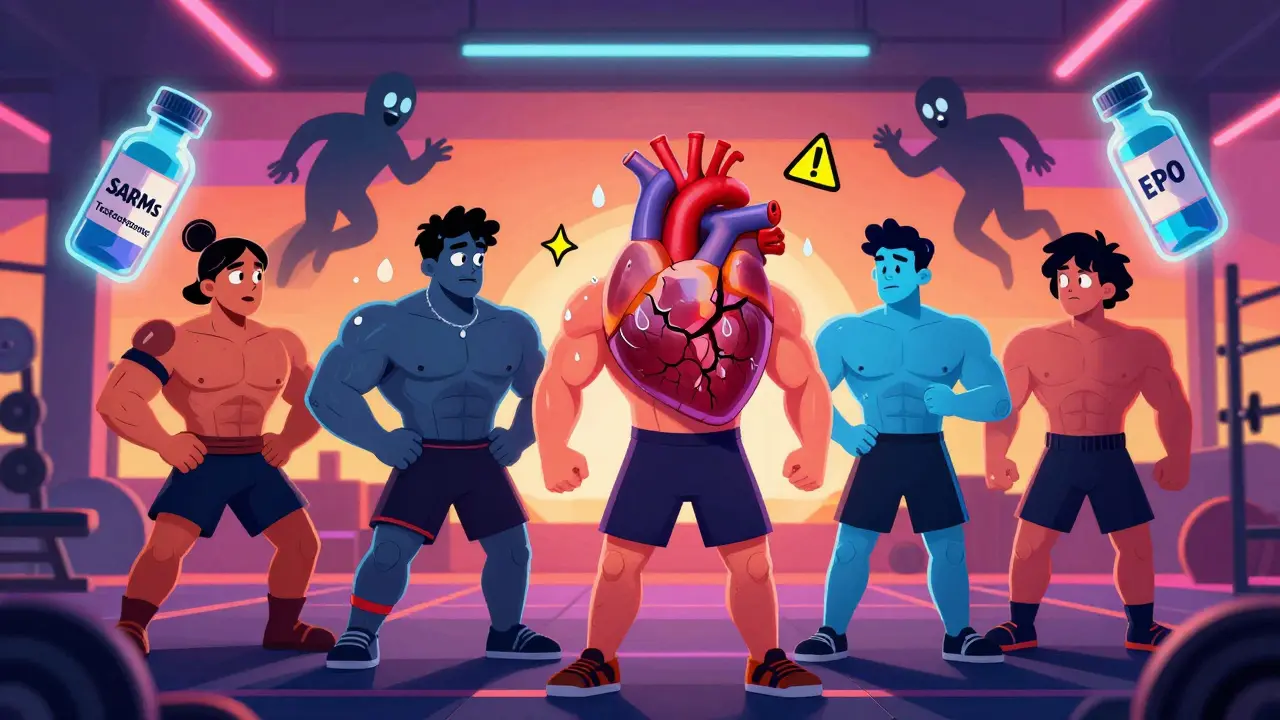
Performance-affecting medications aren’t just illegal steroids. They include stimulants, hormone boosters, blood boosters, and newer compounds like SARMs. These aren’t mystery substances; they’re well-studied drugs with known effects. Anabolic steroids like testosterone and nandrolone increase muscle mass by 10-20% in just 6-12 weeks. Stimulants like caffeine (at 3-6 mg per kg of body weight) sharpen reaction time by 8-12% within half an hour. Blood doping-either through transfusions or EPO injections-can boost VO2 max by 5-15%, giving endurance athletes a clear edge.
But here’s the catch: these drugs don’t just enhance performance. They change your body in ways that stick around long after the drug is gone. The body doesn’t distinguish between a ‘performance’ dose and a ‘medical’ dose. Your heart, liver, hormones, and mind all react the same way-whether you’re an elite athlete or someone lifting weights at a local gym.
The Hidden Costs: More Than Just Doping
Most people think of doping as something that happens in professional sports. But data from the University of Colorado Anschutz Medical Campus (2023) shows that 60-80% of anabolic steroid users today are recreational athletes-not pros. These are people who don’t compete, but still want to look bigger, recover faster, or feel stronger. They don’t think they’re breaking rules. They think they’re just using supplements.
That’s the problem. Many of these substances are sold as ‘research chemicals’ or ‘not for human consumption’-a legal loophole that lets them slip through the cracks. The FDA found that 89% of SARMs products tested contained ingredients not listed on the label. One product might promise LGD-4033 but actually contain a completely different steroid. Users have no idea what they’re taking. And doctors? They often don’t know either.
Take heart health. A study published in PMC Article 4026349 found that long-term steroid users had 27-45% greater cardiac mass than non-users-even after adjusting for body size and age. That’s not just bigger muscles. That’s thickened heart walls, reduced pumping efficiency, and higher risk of sudden cardiac events. The American Heart Association confirmed in June 2022 that steroid use raises the risk of major heart problems by 36%. And this isn’t just in older users. There are documented cases of 28-year-olds with kidney failure and 26-year-olds suffering heart attacks.
How Your Body Breaks Down
Your hormones are tightly balanced. When you flood your system with synthetic testosterone, your body doesn’t just adapt-it shuts down. After just 8 weeks of use, 90% of male users stop producing their own testosterone. Levels drop below 300 ng/dL, which is the clinical threshold for hypogonadism. Testicles shrink. Sperm counts fall below 1 million per mL (normal is over 15 million). Recovery can take 6-12 months-and for some, it never fully comes back.
Women face different but equally serious risks. In 35% of female users, voice deepening becomes permanent. Clitoral enlargement over 2.5 cm has been documented in clinical cases. These changes aren’t reversible. And the psychological toll? A 2022 survey in the Journal of Strength and Conditioning Research found that 83% of users experienced severe mood swings, and 67% had clinically significant depression during off-cycles. One Reddit user wrote: ‘I gained 25 lbs of muscle in 10 weeks. Lost it all in 8 weeks off. Then I couldn’t get out of bed for months.’
Then there’s the body’s connective tissue. Tendons and ligaments don’t grow as fast as muscle. When steroids give you explosive strength but don’t strengthen your tendons, you’re one wrong lift away from a rupture. The American Academy of Orthopaedic Surgeons (AAOS) has documented cases where athletes tore tendons at just 70% of the load their muscles could handle. That’s not an accident. It’s physics.
Why ‘Safer’ Alternatives Aren’t Safer
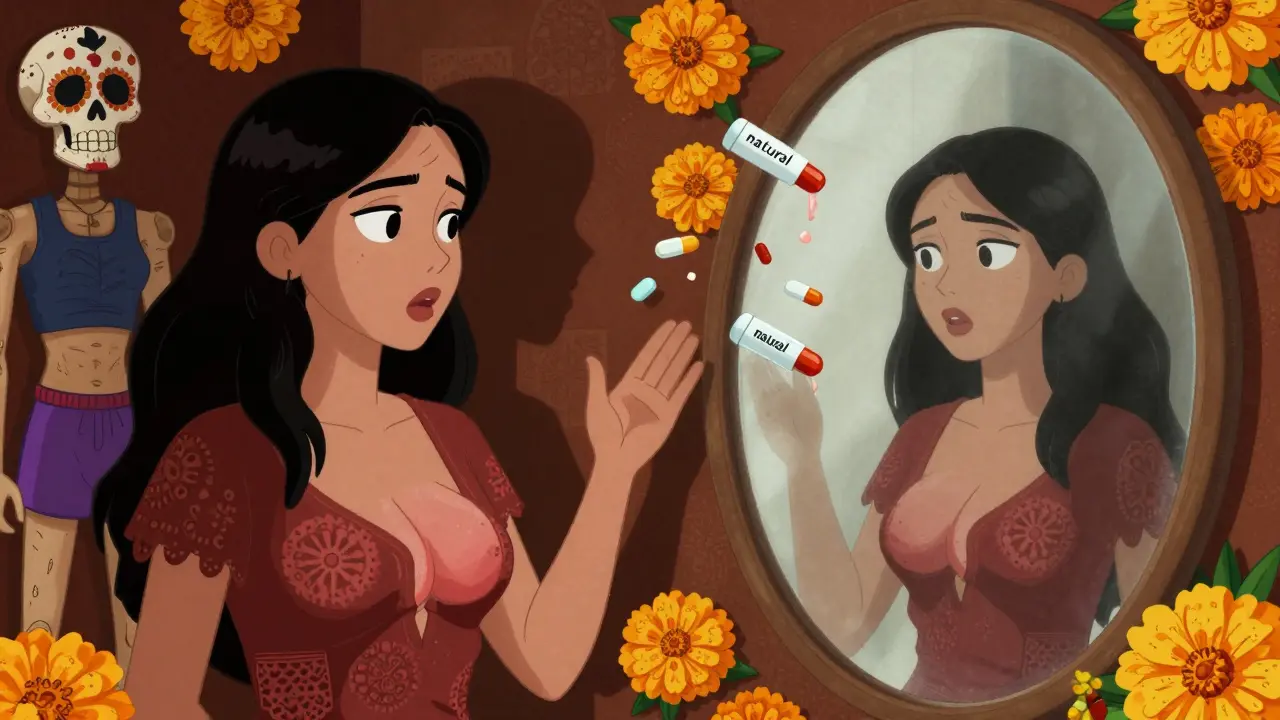
SARMs-selective androgen receptor modulators-are marketed as the ‘clean’ way to build muscle. No liver damage. No estrogen conversion. No side effects. Except that’s not true.
The FDA tested hundreds of SARMs products and found 78% contained completely different substances than what was listed. Some had undisclosed steroids. Others had unapproved compounds with no safety data. There’s no long-term research on SARMs. No clinical trials. Just anecdotal reports from online forums. And yet, they’re the fastest-growing segment in the PED market, with a 35% annual increase in use.
WADA added three new SARMs to its monitoring list in 2023. That’s not because they’re new. It’s because they’re everywhere. And they’re not regulated. You can buy them online, in capsule form, with no prescription. No warning labels. No medical oversight. Just a promise-and a risk.
The Medical Blind Spot
Here’s the quiet crisis: doctors don’t ask. Patients don’t tell.
A 2021 report from the American Academy of Family Physicians (AAFP) found that 42% of recreational athletes admitted to using performance-enhancing drugs-but only 12% had ever mentioned it to their doctor. Why? Shame. Fear. Or just thinking it’s ‘not a big deal.’
But here’s what happens when it goes unreported. A patient comes in with fatigue, low libido, and mood swings. The doctor runs tests. Finds low testosterone. Prescribes hormone replacement. Doesn’t know the patient has been using steroids for two years. The treatment makes things worse. The body’s natural system is already suppressed. Adding more hormones doesn’t fix it-it deepens the problem.
Dr. Michael Lombardo of AAFP says it plainly: ‘7 of 10 family physicians fail to recognize PED use in recreational athletes.’ Why? Because the symptoms look like depression, aging, or stress. Not drug use. And without asking, they’ll never know.
What About Therapeutic Use Exemptions?
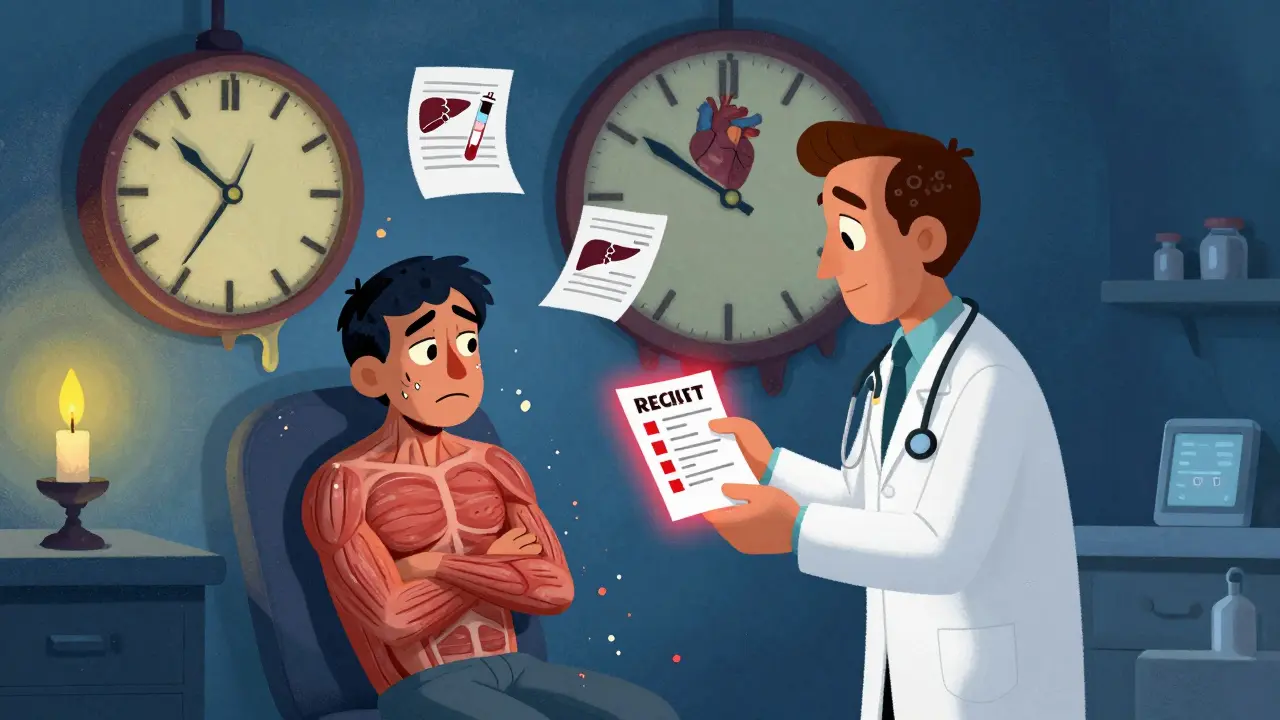
WADA does allow some medications for athletes with legitimate medical conditions. These are called Therapeutic Use Exemptions (TUEs). But they’re not a loophole. To get one, you need to prove you have a diagnosed condition-like hypothyroidism or asthma-and that the medication is necessary. You can’t get a TUE for ‘low energy’ or ‘wanting to recover faster.’
Even then, monitoring is strict. Quarterly blood tests. Hormone levels. Liver panels. All tracked. Recreational users? They rarely get any medical oversight at all. They buy pills online, take them for 6 weeks, then stop. No labs. No follow-ups. No one checking if their kidneys are failing or their liver is inflamed.
It’s Not Just About Winning
Some people say, ‘If it’s not banned, why not use it?’ But the real question isn’t whether it’s allowed. It’s whether it’s worth it.
You might gain 10 pounds of muscle in 10 weeks. But what’s the cost? A heart that’s aging 10-15 years faster. A liver under constant strain. Hormones out of balance for years. A mind that crashes after the high fades. And for what? A few extra reps. A slightly tighter shirt. A moment of confidence that fades when the drug wears off.
And here’s the brutal truth: the gains don’t last. Muscle built on steroids melts away fast once you stop. The body doesn’t keep what it was tricked into building. And without the drug, many users feel worse than before they started.
The strongest athletes aren’t the ones with the most drugs. They’re the ones who train smart, recover well, and respect their body’s limits. That’s not sexy. It doesn’t sell supplements. But it’s the only way to stay healthy for life.
Can over-the-counter supplements contain banned substances?
Yes. Many supplements sold as ‘natural’ or ‘legal’ contain undisclosed steroids, stimulants, or SARMs. The FDA has found that up to 89% of products labeled as SARMs contain different, unapproved compounds. There’s no guarantee of safety or legality-even if it’s on a store shelf.
Do performance-enhancing drugs affect women differently?
Yes. Women are more vulnerable to irreversible changes. Voice deepening occurs in 35% of female users and is permanent. Clitoral enlargement beyond 2.5 cm has been documented. Hormonal disruption can lead to infertility, irregular periods, and long-term testosterone suppression. These effects often don’t reverse even after stopping use.
How long does it take to recover from steroid use?
Recovery varies. Natural testosterone production can take 6-12 months to return after stopping. Some users never fully recover and need lifelong hormone therapy. Mental health symptoms like depression can last for months. Heart and liver damage may be partially reversible, but fibrosis and tissue stiffening often remain permanent.
Are SARMs safer than traditional steroids?
No. SARMs are marketed as safer, but they’re unregulated and poorly studied. Most products contain undisclosed ingredients. Long-term effects on the heart, liver, and hormones are unknown. There’s no evidence they’re safer than steroids-and plenty of evidence they’re just as dangerous.
Can doctors detect if someone is using performance-enhancing drugs?
Yes, but only if they ask. Blood tests can reveal abnormal hormone levels, liver enzyme spikes, or high hematocrit. But most doctors don’t screen for PED use unless the patient brings it up. Without direct questioning, many users go undetected-even when their health is clearly declining.
What Should You Do?
If you’re using these substances, stop. Talk to a doctor. Not a coach. Not a friend. Not an online forum. A licensed medical professional. There’s no shame in asking for help. What you’re feeling-fatigue, mood swings, low libido-is real. And it’s treatable.
If you’re not using them but know someone who is, don’t judge. Ask. Listen. Offer support. The pressure to ‘look like a pro’ is real. But so is the cost.
There’s no shortcut to real strength. No pill that replaces sleep, nutrition, and consistent training. The body is built to adapt. It just needs time-and respect.
Comments (11)
Davis teo
I saw a guy at my gym take something called 'LGD-4033' for 8 weeks. He looked like a Transformer. Then he vanished. No one saw him again. I think they took him to a secret lab. Or worse-his heart just gave out. 🤯
Oana Iordachescu
The pharmaceutical-industrial complex has been quietly weaponizing fitness culture for decades. The FDA’s 89% contamination statistic is not an anomaly-it is a feature. Every supplement label is a lie. Every 'natural' claim is a marketing ploy. The system is designed to keep you addicted, dependent, and unaware.
Marie Crick
If you're using this stuff, you're already dead inside. Just admit it.
Chris Beeley
Let us not confuse the moral panic of the 20th century with the biochemical reality of the 21st. The body is not a temple; it is a bioelectrochemical system, and to deny optimization is to embrace biological stagnation. The elite do not train harder-they engineer themselves. The rest of us cling to 'natural' as a psychological crutch, when in fact, every human has always been a hybrid of biology and intervention-from fire to penicillin to CRISPR. To call steroids 'cheating' is to misunderstand evolution itself.
Arshdeep Singh
Bro, you think you’re smart because you read a study? Nah. Real strength is waking up at 5 a.m., eating clean, sleeping 8 hours, and not needing a pill to feel like a man. The ones on steroids? They’re just scared of being average. And that’s the real tragedy.
Ellen Spiers
The epidemiological data presented in this article is methodologically robust, particularly the cardiac hypertrophy metrics derived from MRI volumetric analysis. However, the conflation of recreational use with clinical pathology is problematic. The distinction between pharmacokinetic exposure and iatrogenic harm requires stratification by dosage duration, co-administration, and genetic polymorphisms-none of which are adequately addressed in the AAFP survey.
madison winter
I mean... if you're gonna do it, at least get a prescription. Or at least know what's in the powder you're snorting. I'm not judging. I'm just saying... your liver doesn't care about your intentions.
Robert Shiu
Hey, if you're reading this and you're using something, I get it. I've been there. You think it'll fix your confidence, your energy, your self-worth. But here's the truth: real strength isn't in the mirror. It's in showing up when you're tired. It's in healing, not hiding. You're not alone. Talk to someone. A doctor. A counselor. A friend. You don't need a pill to be enough.
Michaela Jorstad
I just want to say... thank you for writing this. I’ve seen so many people I care about go down this path. And no one talks about the emotional crash. The loneliness. The shame. You don’t need to be a hero to be worthy. You’re already enough. 💛
Courtney Hain
This is all a distraction. The real story? The government and Big Pharma are pushing this because they want you dependent. They want you buying supplements so they can patent the next 'miracle drug' that fixes the damage from the last one. They’re not stopping PEDs-they’re monetizing them. Look at the patents. Look at the clinical trials. Look who funds the 'anti-doping' agencies. It’s all connected. Wake up.
Liam Crean
I’ve been off steroids for three years. My testosterone never fully came back. I’m on TRT now. I don’t regret the gains. But I regret thinking I needed them to be worth anything. This article didn’t scare me. It reminded me. And that’s worth more than any pill.