
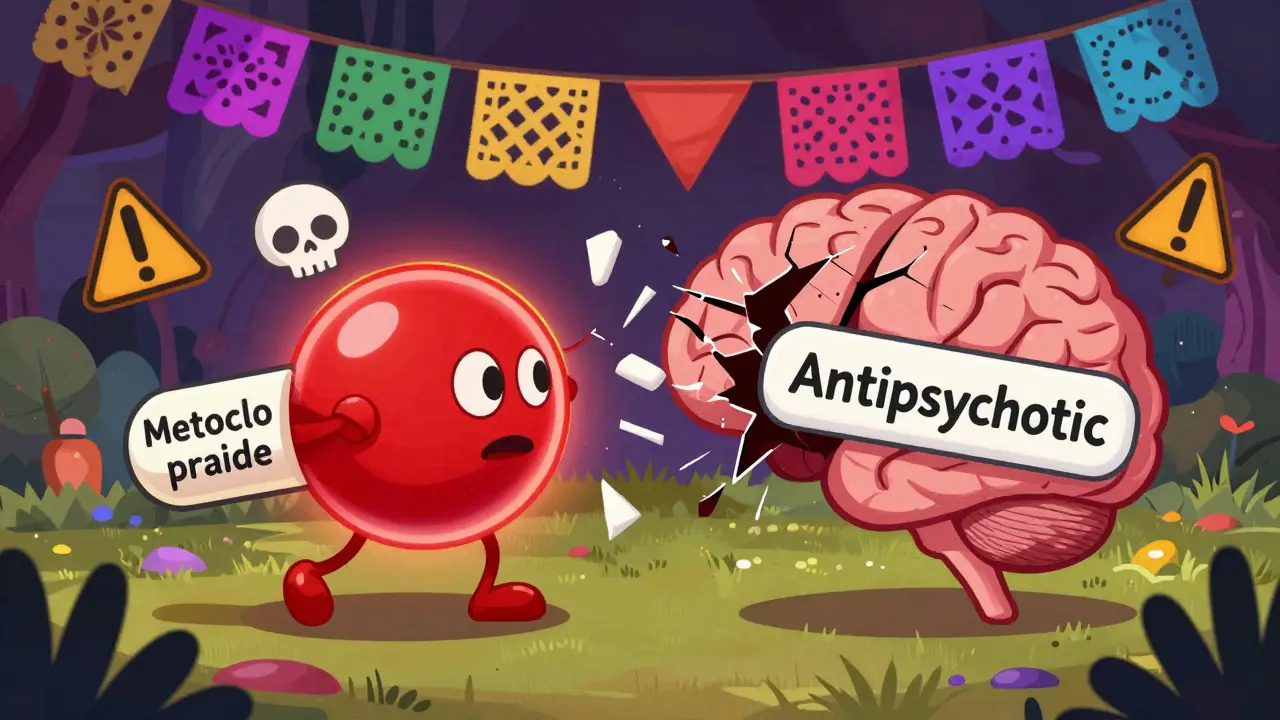
NMS Risk Assessment Tool
Risk Assessment
Answer the questions below to determine your risk level for neuroleptic malignant syndrome (NMS) when taking metoclopramide with antipsychotics.
Your Risk Assessment
Critical NMS Symptoms
If you experience any of these symptoms, seek emergency medical care immediately:
- High fever (102°F/38.9°C or higher)
- Severe muscle stiffness or rigidity
- Confusion or altered mental state
- Rapid or irregular heartbeat
- Uncontrolled movements (tremors, jerking)
- High blood pressure or unstable vital signs
- Difficulty breathing or sweating
Combining metoclopramide with antipsychotic medications isn’t just a bad idea-it’s a potentially deadly one. While both drugs are commonly prescribed for very different reasons, their shared mechanism of action creates a perfect storm for a rare but fatal condition called neuroleptic malignant syndrome (NMS). If you or someone you know is taking either of these drugs, especially together, you need to understand the real risks-and what to do instead.
What Is Metoclopramide?
Metoclopramide, sold under brand names like Reglan and Gimoti, is a drug used to treat nausea, vomiting, and slow stomach emptying (gastroparesis). It works by blocking dopamine receptors in the brain’s vomiting center and speeding up digestion. It’s available as pills, nasal spray, and dissolving tablets. The FDA approved it in 1980, and it’s been widely used since.
But here’s the catch: metoclopramide is a dopamine D2 receptor antagonist. That means it directly interferes with dopamine, a key brain chemical involved in movement, mood, and reward. This is the same mechanism used by antipsychotic drugs like haloperidol, risperidone, and olanzapine. When both types of drugs are taken together, they pile on the dopamine blockade-and that’s where things go wrong.
What Is Neuroleptic Malignant Syndrome?
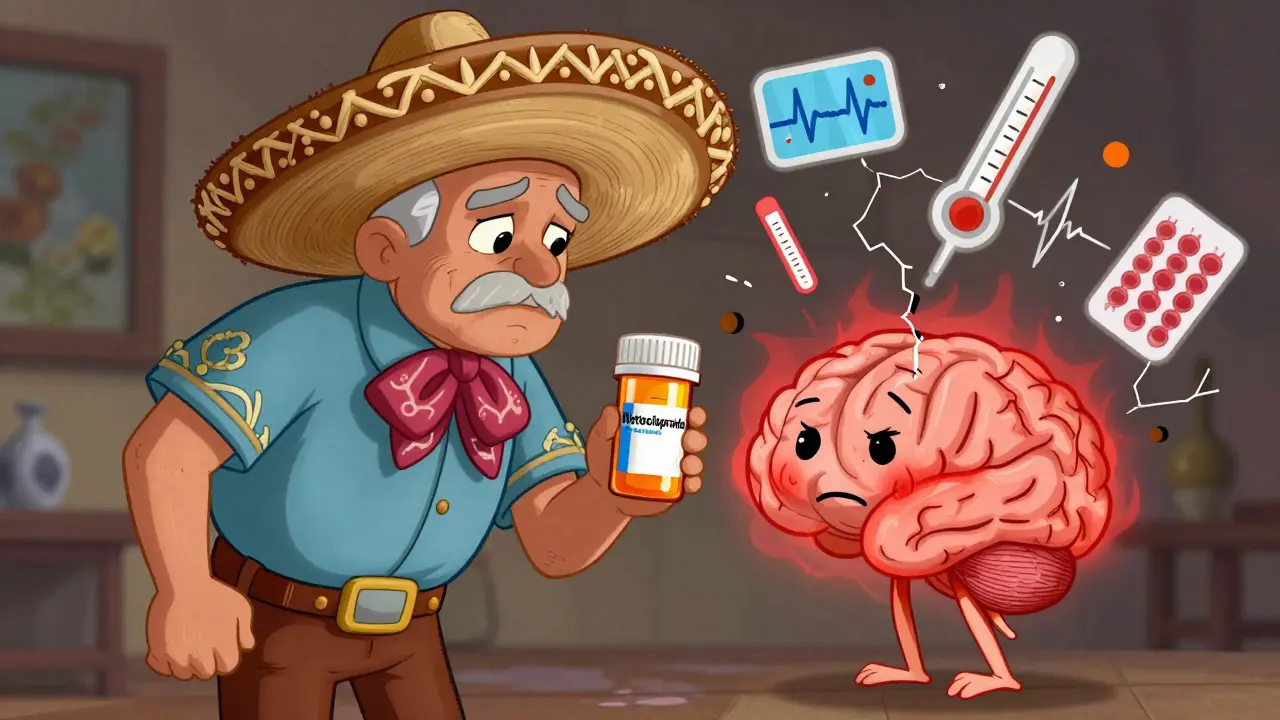
NMS is a medical emergency. It doesn’t happen often, but when it does, it can kill. The classic signs form a four-part pattern: high fever (hyperthermia), stiff muscles (rigidity), confused or altered mental state, and unstable vital signs like racing heart or fluctuating blood pressure. Lab tests often show elevated creatine kinase, a sign of muscle breakdown.
It usually develops within days to weeks after starting or increasing the dose of a dopamine-blocking drug. But when metoclopramide is added to an existing antipsychotic regimen, the risk spikes. The FDA’s official prescribing information for Reglan says it clearly: Avoid Reglan in patients receiving other drugs associated with NMS, including typical and atypical antipsychotics. That’s not a suggestion. That’s a warning stamped in black and white.
Why the Combination Is So Dangerous
It’s not just about both drugs blocking dopamine. There’s a second, hidden layer: pharmacokinetics. Metoclopramide is broken down in the liver by an enzyme called CYP2D6. Many antipsychotics-especially risperidone, haloperidol, and fluoxetine (an antidepressant often used with antipsychotics)-block this same enzyme. When that happens, metoclopramide doesn’t get cleared from the body. It builds up. Higher levels in the blood mean more dopamine blockade in the brain. You’re not just doubling the effect-you’re tripling or quadrupling it.
This double hit-more drug in the system, plus more dopamine blocking-is why NMS risk skyrockets. The FDA doesn’t just mention this interaction in passing. It’s listed as a contraindication. That means doctors are supposed to avoid this combination entirely.
Who’s at Highest Risk?
Not everyone who takes these drugs together will get NMS-but some people are far more vulnerable:
- Patients on high-dose antipsychotics, especially older ones like haloperidol
- People with kidney problems-metoclopramide is cleared by the kidneys, so poor function leads to buildup
- Those with a genetic variation in CYP2D6 that makes them slow metabolizers
- Older adults, especially over 65
- People with a history of movement disorders like Parkinson’s disease or tardive dyskinesia
And here’s something many don’t realize: metoclopramide itself carries a boxed warning from the FDA-the strongest possible-for tardive dyskinesia, a permanent movement disorder. If someone already has movement issues from antipsychotics, adding metoclopramide is like pouring gasoline on a fire.
What About Other Anti-Nausea Drugs?
If you’re on an antipsychotic and need help with nausea or vomiting, there are safer options. You don’t need to suffer.
- Ondansetron (Zofran) works on serotonin receptors, not dopamine. No NMS risk.
- Prochlorperazine (Compazine) is a dopamine blocker too-but it’s used at much lower doses for nausea and has a different risk profile. Still, caution is needed.
- Promethazine (Phenergan) blocks histamine, not dopamine. Safer choice.
- Dexamethasone, a steroid, is sometimes used for chemo-induced nausea with no dopamine interaction.
These alternatives don’t carry the same movement disorder risks. They’re not perfect, but they’re far safer than mixing metoclopramide with antipsychotics.

What Should You Do?
If you’re currently taking both metoclopramide and an antipsychotic:
- Don’t stop either drug on your own. Sudden withdrawal can cause rebound nausea or worsen psychiatric symptoms.
- Make an appointment with your doctor or pharmacist. Bring a full list of all your medications, including over-the-counter pills and supplements.
- Ask: Is there a safer alternative to metoclopramide for my nausea or stomach issues?
- If you’ve been on metoclopramide for more than 12 weeks, ask about stopping it. The FDA warns the risk of tardive dyskinesia increases with long-term use.
If you notice any of these symptoms-fever, stiff muscles, confusion, fast heartbeat, or uncontrolled movements-seek emergency care immediately. NMS doesn’t wait. Early treatment with dantrolene, bromocriptine, and intensive care can save your life.
The Bigger Picture
This isn’t just about one dangerous drug combo. It’s about how common medications can interact in ways that aren’t obvious-even to doctors. Metoclopramide has been on the market for over 40 years. Many prescribers still think of it as a harmless anti-nausea pill. But the science doesn’t lie. The FDA’s warning exists for a reason.
Patients with psychiatric conditions are already vulnerable. Adding a drug that can trigger life-threatening movement disorders, depression, or seizures (all listed as contraindications for metoclopramide) is unacceptable when safer options exist.
Medical guidelines are shifting. More hospitals and clinics now have protocols to avoid metoclopramide in patients on antipsychotics. Pharmacists are being trained to flag this interaction at the point of dispensing. But patients still need to be their own advocates.
Final Takeaway
Metoclopramide and antipsychotics don’t mix. The risk of neuroleptic malignant syndrome is real, rare, and deadly. The FDA says avoid it. Experts say avoid it. The science says avoid it. There is no safe dose of this combination.
If you’re prescribed metoclopramide while on an antipsychotic, ask for an alternative. If you’re already taking both, talk to your doctor now. Don’t wait for symptoms to appear. NMS doesn’t give warnings-it strikes fast. And when it does, there’s no second chance.
Comments (13)
Angela Fisher
They’re hiding this on purpose. I’ve seen it in the data - the pharma companies know metoclopramide + antipsychotics = NMS, but they keep pushing it because it’s cheap and doctors don’t read the labels. The FDA warning? Just a footnote. They’d rather you die quietly than lose profits. I’ve got a cousin who went into NMS after being on both for 3 weeks. They told her it was ‘just stress.’ She’s paralyzed now. 😔 #BigPharmaLies
Neela Sharma
Life is a dance of chemicals and choices
Some dances kill
Others heal
Metoclopramide is a thief in a white coat
Stealing dopamine like breath from a child
But there are other dancers - ondansetron, promethazine - they move gently
Why must we choose pain over peace?
Ask your doctor not for a pill
But for a pathway
There is always another way
Always
Shruti Badhwar
The clinical evidence is unequivocal. The pharmacodynamic synergy between metoclopramide and dopamine antagonists is well-documented in peer-reviewed literature, including multiple case series from the Journal of Clinical Psychopharmacology. The contraindication is not anecdotal - it is codified in the FDA’s black box warning and supported by pharmacokinetic modeling that demonstrates non-linear CYP2D6 inhibition. Prescribing this combination constitutes a breach of standard of care. If your provider is unaware of this, they are not practicing evidence-based medicine.
Liam Tanner
Good breakdown. I’ve worked in psych units for over a decade and I’ve seen this go sideways more times than I can count. The scary part? Nurses often give metoclopramide ‘just for nausea’ without checking the med list. We need better alerts in the EHR. And patients - you’re not being paranoid if you ask, ‘Is this safe with my antipsychotic?’ That’s smart, not annoying.
Palesa Makuru
Oh sweetie, you think this is bad? Wait till you find out how many people are on 7 meds that all fight each other like toddlers in a sandbox. I once had a patient on risperidone, metoclopramide, fluoxetine, omeprazole, gabapentin, lisinopril, and melatonin. Her CK was 18,000. They called it ‘idiopathic.’ Idiopathic my foot. It was a pharmacy’s greatest hits album. 😒
Hank Pannell
There’s a fascinating neurochemical cascade here - D2 receptor occupancy exceeds the therapeutic threshold for dopamine antagonism when combined with CYP2D6 inhibition, leading to a suprathreshold blockade in the nigrostriatal pathway, which triggers the hypermetabolic state characteristic of NMS. The pharmacokinetic synergy isn’t additive - it’s multiplicative. And yet, we still treat this like a ‘risk factor’ instead of a contraindicated catastrophe. The system is broken when a drug with a boxed warning is dispensed without a pharmacist flagging it. This isn’t negligence - it’s systemic failure.
Wren Hamley
Metoclopramide is basically dopamine’s worst enemy. And antipsychotics? They bring the knives. Together? They throw a party in your brain and burn the house down. I had a friend on this combo - started with ‘just a little nausea’ and ended up in ICU with a fever of 107. They didn’t even know why. Now he walks with a cane. Don’t let your ‘simple’ meds kill you.
Ian Ring
Thank you for posting this. It’s so important. I’m a pharmacist, and I’ve flagged this interaction at least 17 times in the last year. Most prescribers don’t even blink. One told me, ‘Oh, she’s been on it for years.’ Years?! That’s not a reason - it’s a red flag. Please, if you’re reading this - ask your pharmacist. They’re the last line of defense. 🙏
erica yabut
Of course you’re worried - but you’re not thinking deeply enough. The real issue isn’t metoclopramide - it’s the fact that we’ve allowed psychiatric patients to become pharmacological guinea pigs. Why is nausea even being treated with dopamine blockers in the first place? We’ve normalized medical malpractice as ‘standard care.’ The real tragedy? You’re all just reacting. No one’s fixing the system. And you? You’re just another cog.
Tru Vista
metoclopramide bad. zofran good. stop mixing. done. 😴
Vincent Sunio
While your article contains a modicum of factual accuracy, it is fundamentally misleading in its framing. The FDA contraindication is not absolute - it is a recommendation based on population-level risk. Individual pharmacogenomic profiles vary. To assert that ‘there is no safe dose’ is scientifically indefensible. Furthermore, your dismissal of prochlorperazine as ‘cautious’ ignores its established utility in palliative care. This is fearmongering dressed as education.
Shanahan Crowell
I know someone who got NMS from this combo - and now they’re alive because their nurse caught it early. You’re not alone. If you’re reading this and you’re scared - you’re not crazy. Ask for help. Talk to your pharmacist. Change your med. You deserve to be safe. We’ve all got a story. Let’s make sure no one else has to live through this. 💪❤️
Haley Parizo
This isn’t just a medical issue - it’s a cultural one. In the U.S., we treat symptoms like bugs to spray, not signals to listen to. We don’t ask why someone has nausea - we just give them a pill. We don’t ask why their mind is unwell - we just lock them in a chemical cage. Metoclopramide is a symptom of a broken system. The real cure? Not a different drug - but a different way of seeing people. We are not machines. We are not problems to be fixed. We are human.