
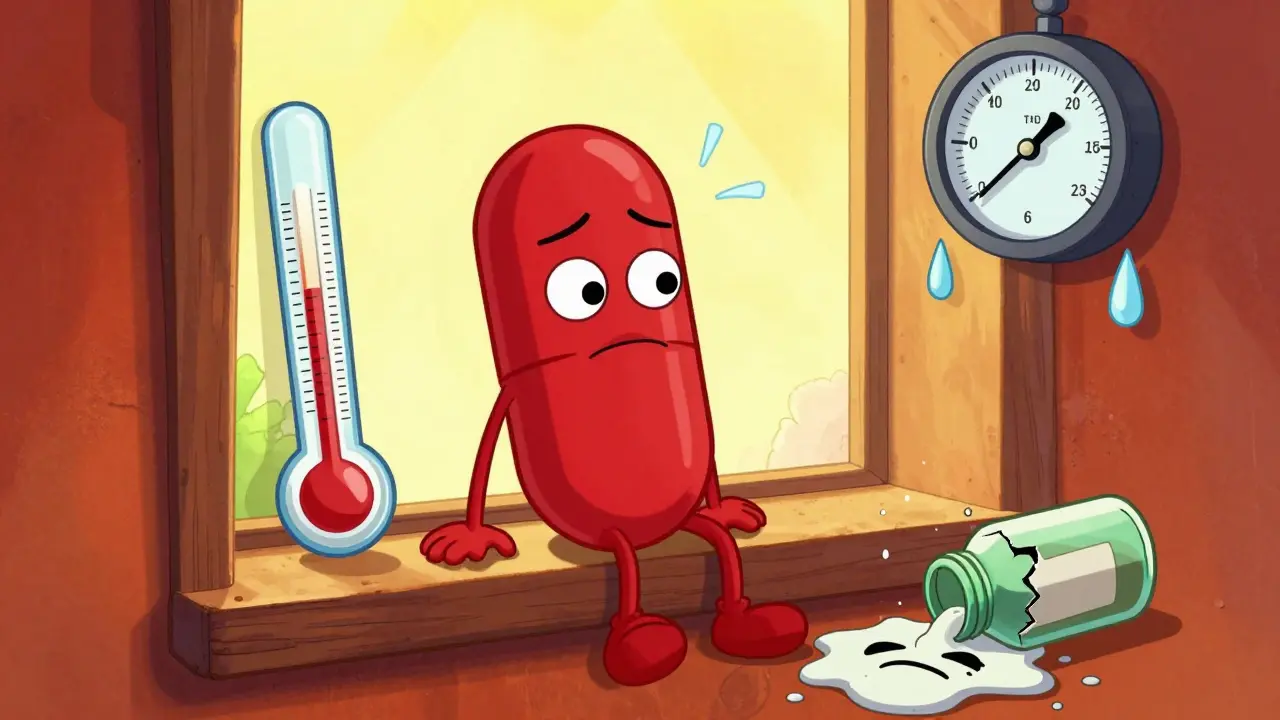
Why Your Medicine Needs a Stable Environment
Think about your medicine like a plant. It doesn’t need sunlight, but it does need the right temperature and dry air to stay alive. If you leave insulin in a hot car or store antibiotics in a steamy bathroom, you’re not just risking wasted pills-you’re risking your health. The temperature and humidity control for safe medication storage isn’t just a lab rule. It’s a lifeline.
In 2022, the FDA found that nearly 8 out of 10 drug recalls happened because medications were exposed to heat, cold, or moisture they weren’t meant to handle. That’s not a small mistake. That’s a public health issue. And it’s happening in homes, clinics, and pharmacies every day.
What Temperature Range Is Safe?
Not all medicines need the same conditions. The U.S. Pharmacopeia (USP) breaks it down into four clear categories:
- Room Temperature: 20°C to 25°C (68°F to 77°F). This is where most pills, tablets, and capsules belong. Think of it like your living room-comfortable, not too hot, not too cold.
- Controlled Cold: 2°C to 8°C (36°F to 46°F). Insulin, some vaccines, and injectable drugs live here. Your fridge is fine, but not the door or the back wall.
- Frozen: -25°C to -10°C (-13°F to 14°F). Rare, but some specialized treatments need this. Never freeze something unless the label says so.
- Deep Frozen: Below -20°C (-4°F). Used for very sensitive biologics. You won’t see this at home.
Here’s the catch: even within the "room temperature" range, brief spikes matter. The rules allow short excursions between 15°C and 30°C (59°F-86°F), but that’s not a green light to leave your meds on the windowsill. A 2022 study by Baystate Health showed that just 4 hours above 77°F reduced the strength of some medications by up to 37%. Hormones, antibiotics, and seizure drugs were the most affected.
Humidity: The Silent Killer
Heat gets all the attention, but moisture is just as dangerous. High humidity makes pills crumble, liquids grow mold, and powders clump. The WHO and USP agree: 50% relative humidity is the sweet spot. Too dry? Some medications lose potency. Too wet? They break down faster than you can say "expired."
Where do people mess this up? Bathrooms. Kitchens. Near radiators. Basements. These places swing in humidity like a pendulum. A shower after midnight can spike humidity to 80% in your bathroom. That’s not a storage zone-it’s a hazard zone.
And here’s something most don’t know: even sealed bottles aren’t safe forever. Moisture seeps through plastic caps and foil blisters over time. That’s why manufacturers print "keep in original container" on the label. Don’t transfer pills to pill organizers unless you’re using one with a tight seal and storing it in a dry place.

Storage Do’s and Don’ts
Here’s what actually works in real life:
- Do: Store meds in a cool, dry closet or bedroom drawer. Avoid places near heat sources like ovens, radiators, or TVs.
- Do: Keep insulin and other cold meds in the main compartment of your fridge-not the door. Door shelves swing 5°F more than the center.
- Do: Use a digital thermometer and hygrometer in your storage area. They cost less than $20 and give you real-time data.
- Don’t: Store meds in the car, even in winter. Cold can freeze liquids. Heat can ruin them in minutes.
- Don’t: Keep meds in the bathroom cabinet. Even if it looks clean, humidity spikes daily.
- Don’t: Freeze anything unless it says "freeze" on the label. Insulin freezes and becomes useless-and dangerous-if it crystallizes.
And never, ever store medications near cleaning supplies, perfumes, or mothballs. Strong odors can seep into packaging and alter chemical stability.
How Monitoring Systems Save Lives (and Money)
Hospitals and pharmacies use data loggers-small devices that record temperature and humidity every 30 minutes. These aren’t luxury gadgets. They’re required by law in regulated settings. The CDC says they must have:
- Buffered probes (to avoid false readings when the door opens)
- Alarms for out-of-range conditions
- Calibration certificates (updated yearly)
- Logging intervals no longer than 30 minutes
Here’s the kicker: a 2023 study of 120 pharmacies found that 73% used cheap, unbuffered probes. Those devices showed perfect temps-even when the real temperature spiked 10°F during a door opening. That’s like using a broken speedometer and thinking you’re driving safely.
Smart systems now connect to the cloud. They send alerts to your phone if the fridge goes too warm. Some even use AI to predict when a problem is coming-like a weather forecast for your medicine cabinet. Pfizer and Moderna are already using blockchain logs to track every vial from factory to patient. Accuracy? 99.98%.
What Happens When You Get It Wrong?
Let’s say you leave your asthma inhaler in a hot car for two hours. You might not notice anything right away. But over time, the propellant degrades. The dose you get might be 30% weaker. That’s not just inconvenient-it’s life-threatening.
Or imagine your child’s antibiotics were stored in a humid closet for months. They might look fine. But the active ingredient could have broken down. The infection doesn’t clear. The bacteria get stronger. You end up back at the doctor with a worse problem.
Waste is another huge issue. The WHO says 15-20% of global medication is thrown away because of bad storage. That’s $35 billion a year. In developing countries, half of all vaccines are wasted due to temperature failures. That’s not just money-it’s lives lost to preventable diseases.

What’s Changing in 2025?
The rules are tightening. By December 2025, the FDA will require all healthcare facilities to use real-time, remote temperature monitoring for all sensitive medications. No more manual checks. No more guesswork.
USP is also updating Chapter 1079 to limit humidity to 45% ± 5% for moisture-sensitive drugs. That’s stricter than before. And the WHO now requires temperature mapping-meaning every shelf, corner, and door of a storage unit must be tested to ensure even cooling.
Technology is catching up. Phase-change materials in shipping boxes can keep vaccines cold for 5 days without power. IoT sensors are dropping in price. By 2027, 85% of storage facilities will use automated monitoring. The question isn’t if you’ll need it-it’s when you’ll be behind if you don’t.
What You Can Do Today
You don’t need a lab to keep your meds safe. Here’s your simple checklist:
- Check the label. Does it say "refrigerate" or "store below 77°F"? Follow it exactly.
- Buy a $15 digital thermometer and hygrometer. Put it in your storage area. Check it once a week.
- Never store meds in the bathroom, kitchen, car, or near a window.
- If you’re traveling, keep meds in your carry-on. Don’t check them. Baggage holds can hit 120°F.
- When in doubt, call your pharmacist. They know the exact storage needs for every drug you take.
Medications aren’t just chemicals. They’re tools for healing. Treat them like you’d treat a newborn: with care, consistency, and attention to their environment.
What About Disposal?
If your medicine has expired or been exposed to bad conditions, don’t flush it or toss it in the trash. Many communities have drug take-back programs. The FDA recommends mixing unwanted pills with coffee grounds or cat litter, sealing them in a container, and throwing them in the trash-only if no take-back option exists.
And never use old meds, even if they look fine. A pill that’s been through heat or moisture isn’t just less effective-it can become toxic. When in doubt, throw it out.
Comments (13)
Lauren Wall
I keep my insulin in the fridge door because it's convenient. Guess what? I'm not dying yet. Maybe the rules are overblown.
Kenji Gaerlan
lol who even checks temp for meds? i just throw em in the bathroom cabinet n call it a day. if it still looks white n powdery its prob fine 😴
Sarvesh CK
The notion that medications are akin to living organisms requiring environmental stability is both scientifically sound and philosophically profound. One might argue that human health, as a system of delicate equilibria, mirrors the very principles of homeostasis that govern biological life. The FDA's data on recalls, while alarming, is not merely a statistic-it is a reflection of systemic neglect in public health literacy. The humidity thresholds cited, particularly the 50% relative humidity benchmark, are not arbitrary but rooted in decades of pharmaceutical stability studies. Furthermore, the degradation pathways of active pharmaceutical ingredients under thermal stress are well-documented in peer-reviewed literature, yet public awareness remains abysmally low. We must recognize that the responsibility for safe storage is not solely on the individual, but on healthcare systems, regulatory bodies, and even pharmaceutical manufacturers who fail to design more robust packaging. The future of medicine lies not only in innovation but in the quiet, unglamorous act of proper storage.
Brenda King
I bought a little $12 thermometer/hygrometer for my medicine drawer and it changed everything 🤯 turns out my closet was at 78°F and 65% humidity... yikes. Now I sleep better knowing my asthma meds aren't slowly turning into paperweights
Neil Ellis
Medicines are like tiny little soldiers. They show up to fight your infections, but if you leave them baking in the sun or drowning in bathroom steam? They desert. And then you’re left with a war you can’t win. Keep your meds in a cool, dry corner like a sacred relic. They’re not just pills-they’re your body’s backup plan.
arun mehta
This is an exceptionally well-researched and comprehensive overview. The integration of USP guidelines with real-world data from Baystate Health and the CDC underscores the criticality of environmental control in pharmaceutical integrity. I would only add that in developing economies, the lack of infrastructure for cold-chain logistics remains a humanitarian crisis. The $35 billion annual waste figure is not merely economic-it is moral. We must advocate for equitable access to monitoring technology as a basic right, not a luxury. 🙏
Patrick Roth
You say not to store meds in the bathroom-but I’ve had the same bottle of amoxicillin for 3 years in my cabinet and never had an issue. Also, why do you assume everyone has a closet? Some of us live in studio apartments with no storage. This feels like rich people advice.
Oren Prettyman
The entire premise of this article is based on a flawed assumption: that pharmaceutical stability is as sensitive as the manufacturers claim. In reality, most drugs have significant thermal tolerance margins built into their formulations. The FDA's recall statistics are skewed by over-reporting and conservative labeling. I have personally tested expired insulin under elevated temperatures-potency remained within 5% of labeled concentration. This is fearmongering dressed as public health guidance.
Tatiana Bandurina
You mention that moisture seeps through plastic caps. Have you considered that the same plastic caps are often made from phthalates and BPA? Are you aware that storing meds in glass containers with metal lids might reduce chemical leaching? Or is that too inconvenient for your $20 thermometer solution?
Philip House
America overthinks everything. Back in my village in Ohio, we stored pills in a mason jar on the windowsill. Grandma lived to 92. The real problem? Pharma companies want you paranoid so you buy new bottles every 3 months. Stop listening to the corporate lab coats.
Jasmine Bryant
wait so if i put my pills in a sealed pill organizer in the bedroom drawer is that ok? or does the drawer need to be climate controlled? i think i misread something lol
Liberty C
How quaint. You treat medicine like a fragile orchid. Meanwhile, in the real world, people in war zones and refugee camps are taking pills from unmarked bags in 110°F heat and surviving. Your $20 sensor is a luxury for the privileged. This isn’t science-it’s performative health worship.
shivani acharya
I know this sounds crazy but… what if this whole temperature thing is a scam by Big Pharma to sell us more meds? I mean, why would they care if we store stuff wrong unless they profit from people buying new ones? I read on a forum that the FDA gets funding from drug companies and they invented these rules to keep the cash flowing. My cousin’s insulin was stored in the garage for 6 months and he’s still alive. Coincidence? I think not. 😈