

Most people on multiple heart medications know the drill: morning pills, afternoon pills, night pills. A handful of tablets scattered across the kitchen counter. It’s not just inconvenient-it’s a major reason why so many stop taking their meds. That’s where cardiovascular combination generics come in. They’re not magic. But they’re one of the simplest, cheapest, and most proven ways to make sure your heart treatment actually sticks.
What Exactly Are Cardiovascular Combination Generics?
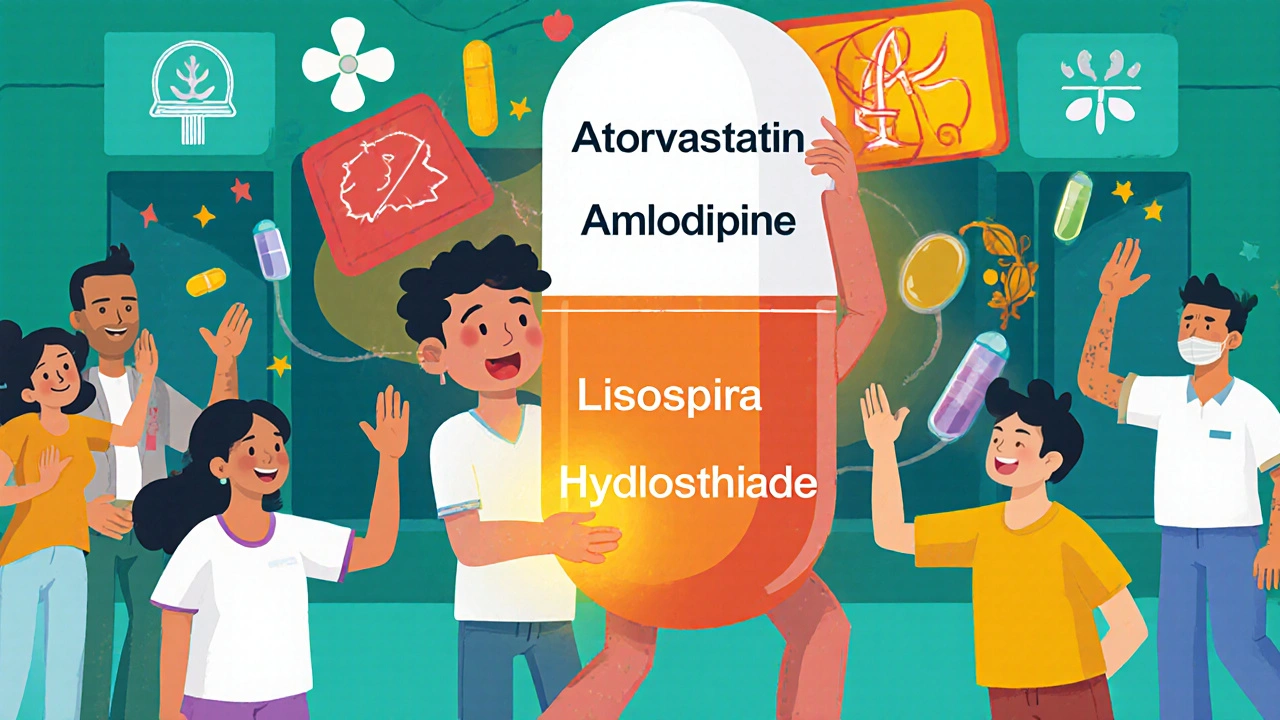
Imagine taking one pill instead of four. That’s the idea behind cardiovascular combination generics. These are single pills that combine two or more heart medications-like a blood pressure drug and a statin-into one tablet. They’re not new. The concept of a "polypill"-a single pill with aspirin, a statin, a blood pressure pill, and a beta-blocker-was floated over 20 years ago. But now, it’s becoming real.
These aren’t brand-name drugs. They’re generics. That means they contain the same active ingredients as the originals, but cost far less. The FDA requires them to deliver the same amount of medicine into your bloodstream as the brand version, within a tight range (80-125%). That’s not a guess. It’s science. And it’s backed by over 60 clinical trials reviewed in the European Heart Journal.
Common combinations you’ll see include:
- Atorvastatin + amlodipine (statin + blood pressure pill)
- Lisinopril + hydrochlorothiazide (ACE inhibitor + diuretic)
- Simvastatin + ezetimibe (two cholesterol-lowering drugs)
- Carvedilol + hydrochlorothiazide (beta-blocker + water pill)
Some of these combinations were once only available as expensive brand-name pills. Now, they’re generic. For example, the combo of ezetimibe and simvastatin (once sold as Vytorin) became generic in 2016. The heart failure drug sacubitril/valsartan (Entresto) got its first generic approval in 2022.
Why Do These Combinations Matter?
Let’s say you’re on four separate pills: one for blood pressure, one for cholesterol, one to thin your blood, and one to slow your heart. You’re supposed to take them all daily. But studies show that when patients have to take four or more pills a day, adherence drops to 25-30%. That’s not just bad luck-it’s dangerous. Missing doses increases your risk of heart attack, stroke, and death.
Now switch to one or two combination pills. Suddenly, you’re taking half as many pills. And guess what? Adherence jumps. Studies show it rises by 15-20% when you go from multiple pills to a single fixed-dose combo. That’s not a small improvement. That’s life-saving.
The American Heart Association gives these combinations a Class I recommendation-the highest level of evidence. That means they’re not just helpful. They’re standard care for patients needing multiple heart meds.
How Much Money Do You Save?
Cost is the biggest driver. In 2017, Medicare data showed brand-name cardiovascular pills cost an average of $85.43 per fill. Generic combinations? Around $15.67. That’s an 80% drop.
That’s not just pocket change. A 2020 Circulation study estimated that if every patient who could switch to a generic combo did, the U.S. healthcare system could save $1.3 billion a year. And that’s just from Medicare. Add private insurance and out-of-pocket costs, and the number climbs higher.
Take a common combo: atorvastatin 20 mg + amlodipine 5 mg. The brand version? Over $200 a month. The generic? $12. That’s not a typo. Twelve dollars. For two life-saving drugs.
Even when you’re not on insurance, pharmacies like Walmart, Costco, and Kroger offer many generic cardiovascular combos for under $10 for a 30-day supply. You don’t need fancy coverage. You just need to ask.
Are Generic Combos Really as Good as Brand-Name?
This is the question everyone asks. "Will it work the same?"
The answer is yes-for most people. The FDA’s bioequivalence rules aren’t a loophole. They’re strict. A generic must deliver the same amount of medicine, at the same rate, as the brand. Thousands of patients have been studied. The European Heart Journal review of 61 trials found no meaningful difference in safety or effectiveness between generics and brands for blood pressure, cholesterol, and antiplatelet drugs.
But here’s the nuance. Some patients notice differences. On Drugs.com, 78% of 1,245 users said generic heart meds worked just as well. But 12% reported side effects-mostly dizziness, fatigue, or muscle aches-when switching from brand to generic, especially with beta-blockers or calcium channel blockers.
Why? It’s not the active ingredient. It’s the fillers. The dyes. The coatings. These "inactive ingredients" can vary between manufacturers. For most people, it’s nothing. But if you’re sensitive, or on a drug with a narrow therapeutic window (like warfarin), even small changes can matter.
That’s why experts like Dr. Aaron Kesselheim warn: don’t switch blindly. If you’re stable on a brand, talk to your doctor before switching. If you’re starting fresh, generics are a great first choice.
What’s Missing? The Polypill Gap
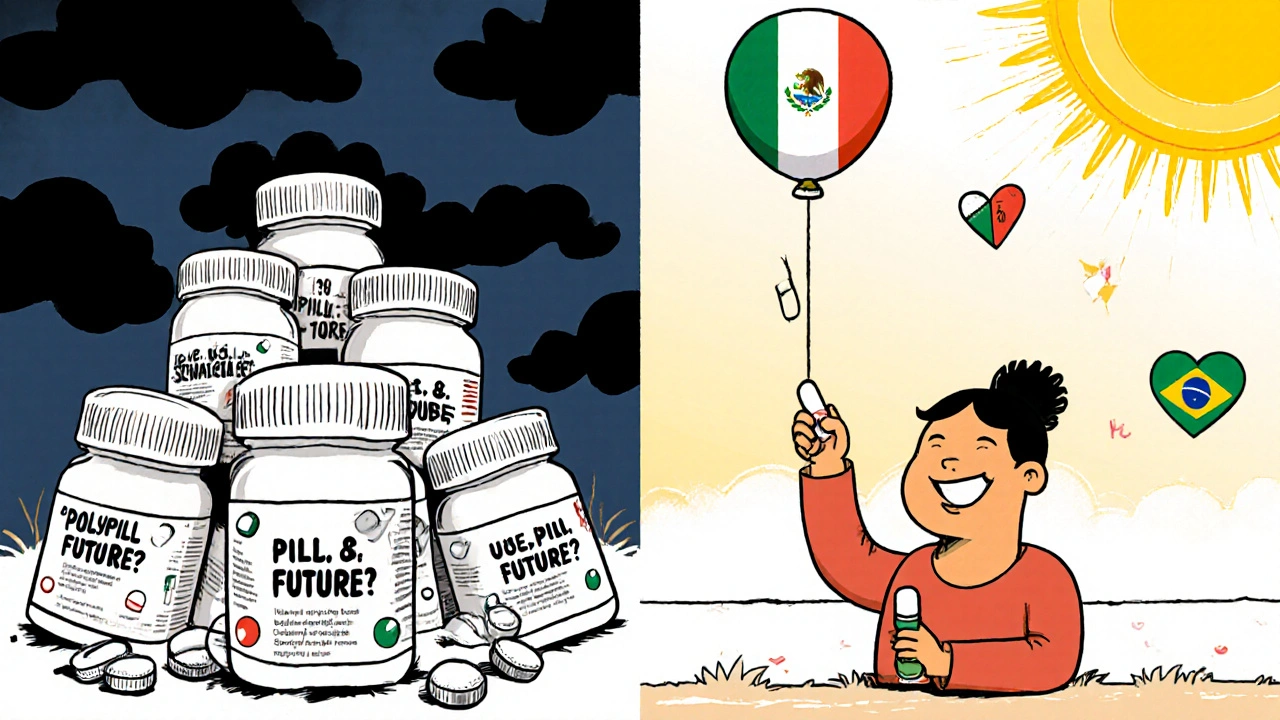
Here’s the frustrating part. We have all the pieces. Aspirin. A statin. An ACE inhibitor. A beta-blocker. All available as cheap generics. But we don’t have a single pill that combines all four.
In the U.S., no such combo is FDA-approved. It exists in India, Brazil, and parts of Europe. But here? You still have to take two or three pills. Why? Because drug companies don’t make money off a four-drug generic. The patent landscape is messy. Regulatory hurdles are high. And the market doesn’t push for it.
That’s a missed opportunity. Dr. Deepak Bhatt from Harvard called fixed-dose combinations "one of the most promising strategies" to prevent heart disease globally. The World Heart Federation estimates that if we rolled out polypills in low- and middle-income countries, we could prevent 15-20 million cardiovascular deaths in the next decade.
Here in the U.S., we’re not there yet. But we’re closer than ever. The FDA released draft guidance in 2021 to make it easier to develop these combos. It’s coming. Just not yet.
What Should You Do?
If you’re on multiple heart meds, here’s what to do next:
- Check your pill bottle. Are you taking more than two separate pills daily? If yes, ask your doctor: "Is there a combination generic I can switch to?"
- Ask your pharmacist for the generic versions. They know what’s available and what’s cheapest. Many pharmacies have $4 lists for heart meds.
- If you’ve switched and feel off-dizzy, tired, swollen-call your doctor. Don’t assume it’s "just the meds." It might be the filler.
- Don’t panic if your insurance says "no prior auth needed" for a generic combo. That’s a good sign. It means they know it’s safe and cost-effective.
- If you’re on warfarin or another narrow-therapeutic-index drug, ask your doctor if switching generics is safe for you. Monitor closely.
And if your doctor says, "There’s no combo for that," ask: "Are the individual components available as generics? Could I take two pills instead of four?" Sometimes, you can still cut your pill count in half without a fancy combo.
What Do Pharmacists See?
A 2019 survey by the American Pharmacists Association found that 65% of patients worried about generics. Their top fears? "Will it work?" and "Will I get side effects?"
But here’s the kicker: 89% of pharmacists say they routinely explain bioequivalence to patients. And 9 out of 10 patients who get that explanation stop worrying.
Pharmacists aren’t just handing out pills. They’re educators. Walk up to your pharmacist and ask: "What’s the cheapest way to take my heart meds?" You’d be surprised what they can do.
Bottom Line: Simpler, Cheaper, Just as Safe
Cardiovascular combination generics aren’t perfect. But they’re the closest thing we have to a no-brainer win in heart care. They cut costs. They cut pill burden. And they save lives by making it easier to take your meds.
You don’t need to wait for a polypill. You can start today. Ask your doctor. Ask your pharmacist. Switch one combo at a time. And if you’re already on generics? Good. Keep going.
The goal isn’t to take the fewest pills possible. It’s to take the right ones-every day. And combination generics make that possible.
Are cardiovascular combination generics safe?
Yes, for most people. The FDA requires generic combination drugs to deliver the same amount of active ingredient as the brand-name version, within strict limits (80-125% bioequivalence). Over 60 clinical trials show they’re just as effective and safe. But if you switch and feel worse-dizzy, fatigued, or swollen-tell your doctor. Rarely, differences in inactive ingredients can cause reactions, especially with drugs like beta-blockers or calcium channel blockers.
Can I switch from brand-name heart meds to generics?
You can, and you should-if your doctor agrees. Most brand-name cardiovascular drugs have generic equivalents. Switching can save you 80% or more. But don’t switch on your own. Talk to your doctor first, especially if you’re on warfarin, digoxin, or other drugs with a narrow therapeutic window. Your doctor can help you transition safely.
Why isn’t there a "polypill" with aspirin, statin, blood pressure, and beta-blocker in the U.S.?
There’s no single pill combining all four because drug companies haven’t pushed for it. The patents on the individual drugs have expired, so there’s little profit in making a combo. Also, regulatory approval for multi-drug combos is complex. While polypills are used in countries like India and Brazil, the U.S. hasn’t approved one yet. But the FDA has issued draft guidance to make it easier. It’s coming.
How much do cardiovascular combination generics cost?
They’re extremely cheap. In 2017, Medicare data showed generic cardiovascular combos cost about $15.67 per fill, compared to $85.43 for brand-name versions. Many pharmacies like Walmart and Costco sell common combinations like atorvastatin + amlodipine for under $10 for a 30-day supply. You don’t need insurance to get these prices.
Do combination generics improve adherence?
Yes, dramatically. When patients take four or more separate pills daily, adherence drops to 25-30%. With a single combination pill, adherence jumps to 75-85%. That’s because taking one pill is easier than remembering four. The American Heart Association calls fixed-dose combinations a Class I recommendation-the strongest level-for improving adherence in patients needing multiple heart meds.
What are the most common cardiovascular combination generics?
Common ones include: atorvastatin + amlodipine (cholesterol + blood pressure), lisinopril + hydrochlorothiazide (blood pressure combo), simvastatin + ezetimibe (two cholesterol drugs), and carvedilol + hydrochlorothiazide (beta-blocker + diuretic). These are widely available as generics and often cost less than $15 a month.
Should I avoid generics if I’ve been on brand-name meds for years?
Not necessarily. If you’re stable and doing well, there’s no urgent need to switch. But if you’re paying hundreds a month for brand-name meds, switching to generics could save you hundreds. Talk to your doctor about trying a generic combo. Many people switch without issue. If you notice side effects, your doctor can adjust the dose or switch manufacturers.
Comments (15)
gerardo beaudoin
Just switched my dad to the atorvastatin + amlodipine combo last month. He was taking four pills a day and kept forgetting half of them. Now it’s just one in the morning. He says he actually remembers to take it now. No side effects either. Simple win.
tushar makwana
in india we have polypill since 2010s. my uncle took it for bp and cholestrol. cost 15 rupees a month. no drama. no insurance. just medicine. why usa still make it hard? people die because of cost. not because of science.
Richard Thomas
While the empirical data presented in the article is statistically significant and aligns with the meta-analytic findings of the European Heart Journal, one must remain cognizant of the confounding variables inherent in adherence studies-particularly the Hawthorne effect, wherein patient behavior is altered due to observation. Furthermore, the assumption that bioequivalence equates to therapeutic equivalence neglects inter-individual pharmacokinetic variability, especially in geriatric populations with altered hepatic metabolism.
Sara Shumaker
I’ve been thinking a lot about how we treat health as something you have to ‘manage’ instead of something you’re supported in. We give people a list of pills and say ‘good luck’-but what if we gave them one pill and said ‘we believe you can do this’? That shift in messaging might be as powerful as the medicine itself. I’ve seen patients cry when they realize they don’t have to juggle six pills anymore. It’s not just about cost. It’s about dignity.
Scott Collard
Generic combos are fine until you need to switch manufacturers. Then you get weird side effects. I’ve seen it. Doctors don’t care. Pharmacies don’t care. Patients suffer silently.
Robert Bashaw
THIS IS A SCAM. Big Pharma doesn’t want you to know this. They’re sitting on polypill patents like they’re gold bars. They’d rather you take four pills and pay $300/month than give you one pill for $12. Wake up. This isn’t medicine-it’s corporate greed dressed in white coats.
Monica Lindsey
People who switch to generics are just gambling with their lives. If you’re not on the exact brand your doctor prescribed, you’re asking for trouble. And don’t even get me started on Walmart’s $4 list-those are barely regulated.
jamie sigler
Why are we even talking about this? It’s obvious no one cares. People stop taking meds because they’re lazy. Not because it’s expensive or complicated.
Bernie Terrien
Let’s be real: the only reason combos are cheaper is because they’re made in China or India with cheaper fillers. You think the FDA checks every batch? Nah. They rubber-stamp it. You’re trading safety for savings. And you call that progress?
Jennifer Wang
It is imperative to note that while fixed-dose combinations demonstrate statistically significant improvements in medication adherence, clinicians must conduct individualized pharmacokinetic assessments prior to substitution, particularly in patients with comorbid renal or hepatic impairment. The bioequivalence thresholds established by the FDA are appropriate for the general population but may not account for polypharmacy interactions in elderly patients.
stephen idiado
Western medicine is broken. You treat symptoms, not root causes. Polypills? Pathetic. Fix diet, stress, sleep. No pill replaces a human being who stops eating sugar and walks 10k steps. This is pharmaceutical colonialism.
Subhash Singh
While the cost-effectiveness of combination generics is well documented, I am curious whether any longitudinal studies have been conducted to assess the impact on cardiovascular event rates over a five-year period, particularly in low-resource settings where adherence patterns may differ significantly from U.S. populations.
Geoff Heredia
They’re putting tracking chips in these pills. I read it on a forum. The FDA is working with Big Pharma to monitor your heart rate via your medication. That’s why they’re pushing combos-they want data. Don’t take it. You’re being watched.
Tina Dinh
OMG YES!!! 🙌 I told my doc I was drowning in pills and she switched me to a combo. Now I actually feel like I’m winning at life 💖✨ #HeartHealthWin
Andrew Keh
It is encouraging to observe the growing adoption of fixed-dose combinations in clinical practice. However, the implementation of such regimens should be accompanied by structured patient education programs to ensure that individuals understand the rationale behind the change and recognize potential signs of adverse reactions. A collaborative approach between physician, pharmacist, and patient remains essential.