
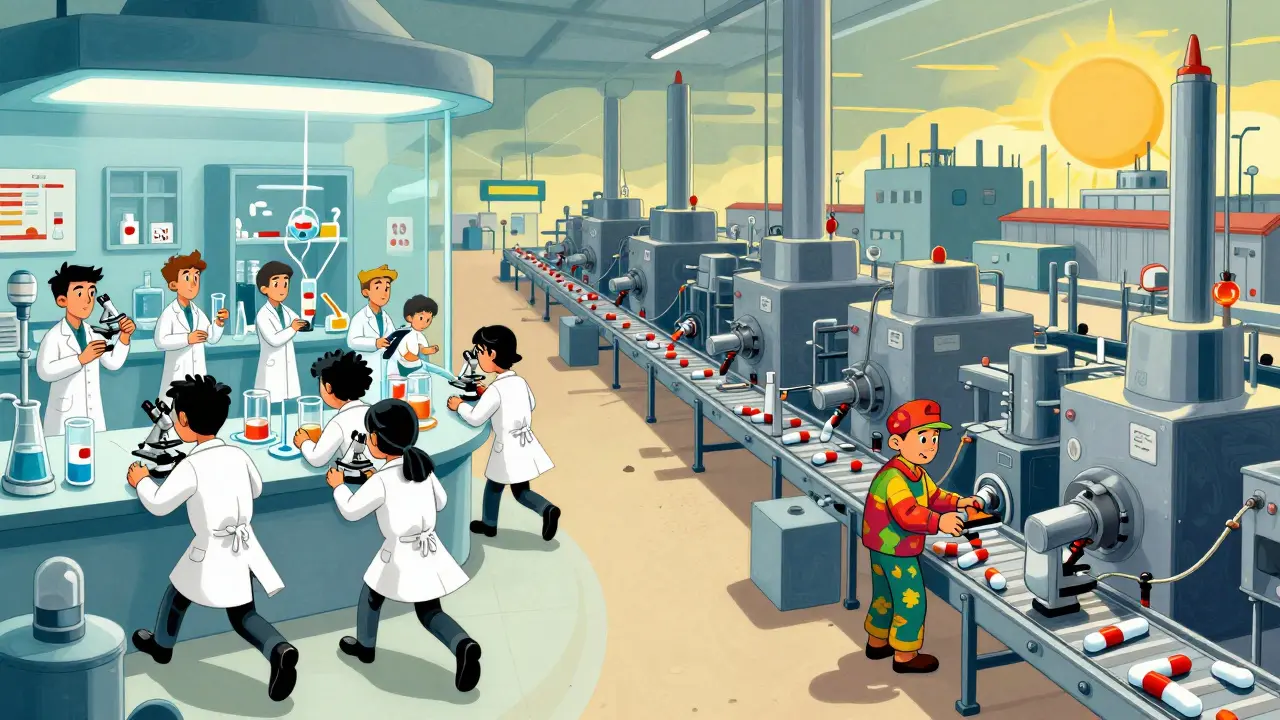
When you pick up a prescription at the pharmacy, you probably don’t think about who made it or how much it cost to produce. But behind every pill, there’s a story of labor, regulation, and economics. And that story looks completely different depending on whether the drug is a brand-name product or a generic version.
Generic drugs make up 90% of all prescriptions filled in the U.S. Yet, they account for less than 20% of total drug spending. How is that possible? The answer lies in labor costs - and how they’re structured differently between brand-name and generic manufacturers.
Why Generic Drugs Cost So Much Less
Generic drugs aren’t cheaper because they’re made from cheaper ingredients. The active pharmaceutical ingredient (API) in a generic drug is chemically identical to the brand-name version. The real savings come from how those drugs are made - especially in terms of labor.
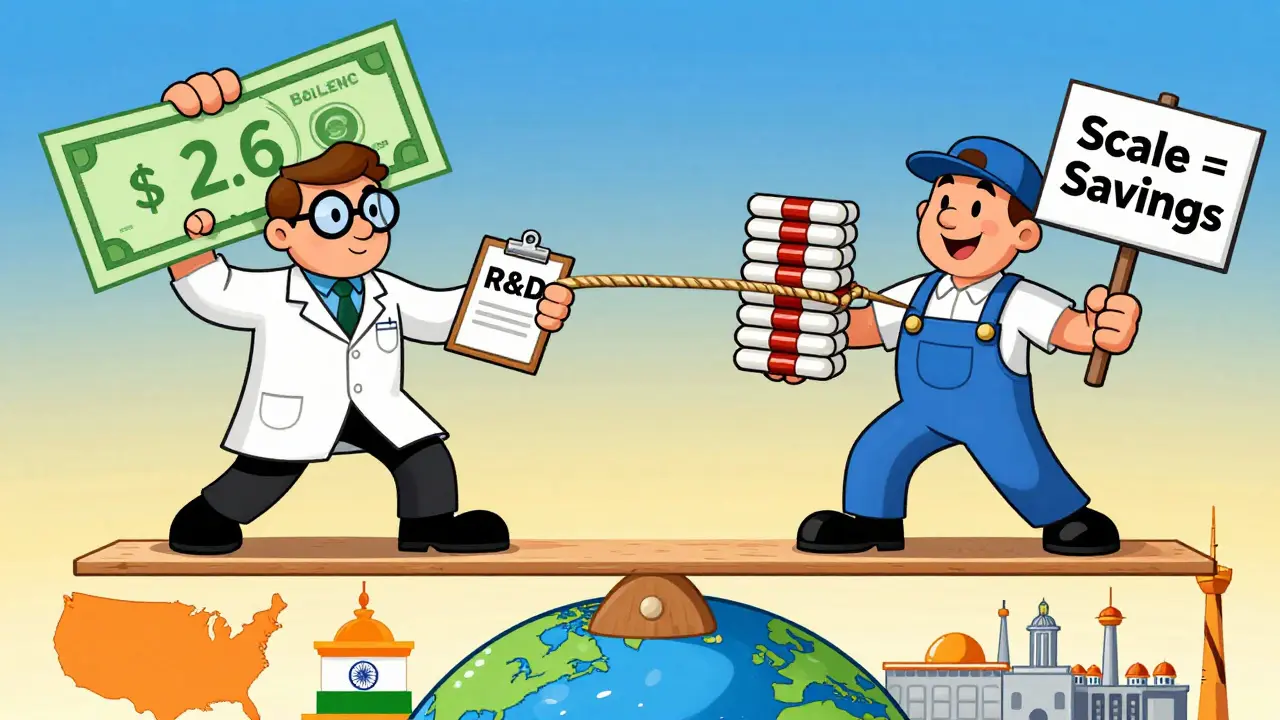
For brand-name drugs, labor is a major expense. Developing a new drug takes 10 to 15 years and costs about $2.6 billion on average. That money goes to scientists, clinical trials, regulatory filings, patent lawyers, and marketing teams. Even after approval, the labor burden doesn’t stop. Brand manufacturers maintain small, highly skilled teams to manage complex production processes, handle strict quality controls, and respond to regulatory audits.
Generic manufacturers don’t have to do any of that. They don’t need to prove safety or efficacy - the FDA already accepted those claims when the brand-name drug was approved. So their labor doesn’t go into research. It goes into making the same thing, over and over, as efficiently as possible.
Labor Cost Breakdown: Brand vs Generic
Here’s how labor stacks up:
- Brand-name drugs: Labor makes up 30% to 40% of total manufacturing costs during early production. This includes R&D staff, quality assurance specialists, regulatory compliance officers, and production supervisors.
- Generic drugs: Labor accounts for only 15% to 25% of costs. Why? Because they’re produced at massive scale, with streamlined processes and fewer regulatory hurdles.
One key difference is volume. A single generic drug factory might produce 100 million pills per month. That kind of scale means workers can focus on repetitive tasks - filling bottles, labeling, packaging - with minimal supervision. Machines do most of the heavy lifting. A single operator can manage multiple production lines. In contrast, brand-name production often runs smaller batches, with more manual checks and frequent equipment cleanings.
BCG’s 2019 study found that generic manufacturers cut unit costs by 27% every time production volume doubles. Brand manufacturers only saw a 17% drop. That’s because generics benefit from what economists call economies of scale. More output = less labor per unit.
Quality Control: The Hidden Labor Cost
Don’t be fooled - generic drugs aren’t made by untrained workers in garages. In fact, quality control (QC) is one of the biggest labor expenses in generic production.
Every batch of generic drugs must be tested for purity, potency, and stability. Raw materials are checked. In-process samples are analyzed. Final products are inspected under strict FDA guidelines. All of this requires trained technicians, lab analysts, and documentation specialists.
According to DrugPatentWatch, QC alone accounts for over 20% of total generic drug production costs. That includes:
- Testing raw materials (labor-intensive lab work)
- Running in-process checks during manufacturing
- Final product validation
- Batch record documentation (paperwork that can take hours per batch)
For a medium-sized generic company with 20 to 500 employees, just maintaining compliance systems costs about $184,000 per year. Add in FDA program fees and new drug applications, and you’re looking at over $2 million annually in labor-related compliance costs.
So while generics avoid R&D expenses, they still need skilled labor - just in different places.
Where the Drugs Are Made Matters
Most API - the active ingredient - for generic drugs is made overseas. About 80% of global API production happens in India and China. Why? Labor costs there are 42% lower than in the U.S., according to Prosperous America’s 2023 analysis.
But here’s the catch: those lower costs don’t mean those factories are more efficient. The HHS Office of the Assistant Secretary for Planning and Evaluation found that international production advantages come from:
- Lower wages
- Weaker environmental regulations
- Government subsidies
- Massive scale
That means when you buy a generic drug made in India, you’re not just getting a cheaper product - you’re benefiting from a global labor imbalance. A worker in a U.S. QC lab might earn $65,000 a year. In India, the same role pays $12,000.
This creates tension. As U.S. regulators push for more domestic production to reduce supply chain risks, companies face pressure to bring manufacturing home. But that could raise labor costs - and ultimately, drug prices.
Contract Manufacturing: The New Normal
Many generic manufacturers don’t own factories anymore. Instead, they outsource production to Contract Manufacturing Organizations (CMOs). In fact, biosimilar producers spend 42% of their cost of goods sold on CMOs - compared to just 28% for traditional generic makers.
This shift changes how labor costs work. Instead of paying fixed salaries to in-house staff, companies pay per batch. That gives them flexibility: when demand spikes, they can order more. When demand drops, they scale back. It’s like hiring freelancers instead of full-time employees.
But this also means less job security for workers. CMOs often operate on thin margins, which can lead to understaffing, rushed production, or skipped inspections - all of which risk quality.
Why Prices Keep Dropping - And Why That’s a Problem
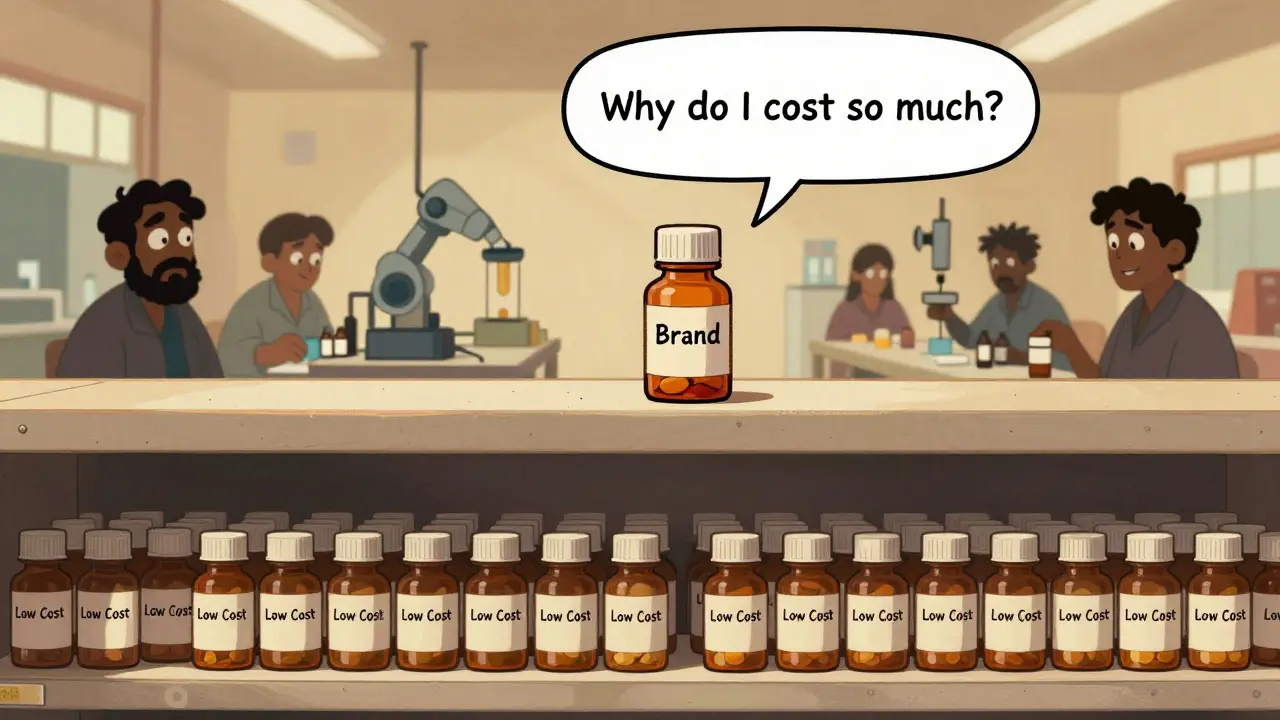
Every time a new generic enters the market, prices drop. The FDA found that when just three generics compete, prices fall below the brand-name price. With five or more, prices can plunge by 80% to 90%.
But here’s the hidden cost: that pressure forces manufacturers to cut labor wherever they can. That means:
- Reducing QC staff
- Slowing training programs
- Delaying equipment upgrades
- Increasing automation without skilled oversight
The FDA warned in 2023 that this race to the bottom could lead to drug shortages. If a factory cuts too many workers, a single equipment failure or contamination event can shut down production for months. And with generics making up 9 out of 10 prescriptions, that affects millions of patients.
Who Really Pays the Price?
Consumers pay less upfront for generics. But if labor cuts lead to quality issues or supply shortages, the real cost shows up later - in delayed treatments, emergency room visits, or switching to more expensive brand-name drugs.
Meanwhile, brand-name manufacturers aren’t just charging more because they’re greedy. They’re recovering massive R&D investments. But they’re also protected by patent extensions and settlement deals with generic companies. These deals delay competition, keeping prices high for longer.
So while generic drugs are undeniably cheaper, the labor cost difference isn’t just about wages. It’s about:
- Scale
- Regulation
- Geography
- Market competition
And all of these factors are under pressure.
What’s Next?
The future of generic drug production is uncertain. More countries are pushing for local manufacturing. The U.S. government is funding domestic API production. But that could raise costs - and prices.
On the other hand, automation and AI are making QC faster and cheaper. Robots can now test samples with near-perfect accuracy. That could reduce labor needs without sacrificing quality.
One thing is clear: the gap between brand and generic labor costs isn’t going away. But how we manage it - and whether we prioritize cheap drugs over reliable supply - will shape healthcare for decades.
Why are generic drugs so much cheaper than brand-name drugs?
Generic drugs are cheaper because they don’t need to repeat expensive clinical trials or pay for brand marketing. Their main costs are manufacturing and compliance. Labor costs are lower due to massive production scale, simplified processes, and outsourcing to low-wage countries. Brand-name drugs, by contrast, must recoup $2.6 billion in R&D costs per drug, which includes years of research, testing, and regulatory work - all of which require high-skill labor.
Do generic drugs use lower-quality labor?
No - but they often use labor differently. Generic manufacturers rely on highly trained QC technicians and lab analysts to meet FDA standards. The difference is volume: one worker can oversee dozens of production lines because the processes are standardized. Brand-name manufacturers use more specialized, smaller teams focused on innovation and complex formulations. Neither is “lower quality,” but the structure of work is very different.
Is it true that most generic drugs are made in India and China?
Yes. About 80% of active pharmaceutical ingredients (API) for generic drugs are produced in India and China. Labor costs there are roughly 42% lower than in the U.S., and production scale is massive. While this keeps prices low, it also creates supply chain risks - as seen during the pandemic when global shipments were disrupted.
Why do generic drug prices keep falling even when demand stays the same?
Because competition increases. Every time a new generic company enters the market, prices drop. With just three competitors, prices fall below the brand. With five or more, they can drop by 80-90%. Manufacturers compete by cutting costs - including labor - to stay profitable. This creates pressure to reduce staffing, automate, or outsource further, which can threaten quality if not managed carefully.
Can cheaper labor lead to drug shortages?
Yes. When manufacturers cut too many workers or reduce training to save money, they become vulnerable to errors. A single contamination, equipment failure, or documentation mistake can shut down a production line. With generics making up 90% of prescriptions, even a short shutdown affects millions. The FDA has warned that cost-cutting in labor-intensive areas like quality control is a leading cause of drug shortages.
Comments (11)
Linda Franchock
So let me get this straight - we’re saving pennies on pills by paying Indian workers $12k a year to do the same job a U.S. lab tech gets $65k for? And we call this ‘affordable healthcare’? 😅
Meanwhile, the FDA’s over here sweating over ‘quality control’ while the factory floor’s running on fumes and three sleep-deprived guys in a corner. I mean, I get it - generics are cheaper. But ‘cheaper’ doesn’t mean ‘safe’ when the entire system’s built on exploiting global inequality.
Also, who’s paying for the mental health of those QC techs? You think they don’t stress over a single typo in a batch log? One mistake = millions of people get bad meds. And they get paid less than my Uber driver.
Also, why is no one talking about how brand-name companies pay lawyers to extend patents for 17 more years? That’s not innovation. That’s legal extortion. But hey, at least we can buy our insulin for $4 now… right? 🤡
Prateek Nalwaya
As someone who grew up watching his mother swallow generics in Delhi, I can tell you - the real miracle isn’t the chemistry, it’s the human spirit.
Those workers? They’re not ‘cheap labor.’ They’re artists with pipettes. Every tablet they batch is a silent poem of precision. One drop too much, one minute too late - and the whole batch dies. And still, they show up. Every. Single. Day.
Yes, the wages are low. But so is the cost of living. And yes, the factories are loud. But they’re humming with dignity. We in the West forget - this isn’t exploitation. It’s survival with grace.
When you cry over a $3 pill, remember: someone in Hyderabad smiled because their kid got to eat today. That’s the real ROI.
And don’t get me started on the ‘quality’ myth. I’ve seen U.S. labs with broken HPLC machines and interns using Excel to ‘validate’ results. We’re not better. We’re just louder.
Agnes Miller
i think the real issue is that we dont talk about how much paperwork is involved in generics. like, literally, for every batch, there’s a 40-page log. signed. initialed. scanned. backed up. audited. and if one ‘e’ is missing in ‘temperature’? the whole thing gets tossed. no joke.
and the techs? they’re not just ‘checking stuff.’ they’re doing 50 tests per batch, each one needing a different protocol, and half the time the machine’s down. so they do it by hand. with a stopwatch. and a clipboard.
and dont even get me started on the FDA inspections. they show up unannounced. and if you have one typo? you’re shut down for 6 months. and no, they dont care if you’re ‘just a small plant.’
so yeah. ‘low labor cost’? nah. its just labor that no one sees. and no one wants to pay for.
Philip Blankenship
Look, I’m not some pharma bro, but I’ve worked in manufacturing, and I can tell you - the whole ‘generics are just cheaper because they’re made in India’ thing is a myth wrapped in a lie inside a PowerPoint slide.
The truth? The real cost savings come from automation, not wages. A single robotic arm in a generic plant can fill, cap, and label 12,000 bottles an hour. That’s 100 people’s worth of work. And yes, the workers are still needed - but they’re not filling bottles. They’re monitoring screens, fixing jams, calibrating sensors.
And here’s the kicker: the most expensive part of making a generic? Not labor. Not ingredients. It’s the validation. Every machine, every room, every process has to be proven to work - and documented - before you can even make a single pill. That’s 18 months of engineering, not one guy in a lab coat.
So when people say ‘just make it in America,’ they’re not thinking about the $50 million plant you’d need to build, or the 3-year permitting process, or the fact that no one wants to work in a pill factory anymore because TikTok exists.
We want cheap drugs. We just don’t want to see how they’re made. And that’s the real problem.
Kancharla Pavan
It’s not about wages. It’s about moral bankruptcy. You think it’s okay to outsource your healthcare to a country where children work 14-hour shifts to meet FDA quotas? Where air is toxic, water is poison, and workers get fined if they take a bathroom break?
And you call this ‘economies of scale’? No - this is colonialism with a barcode.
Every time you buy a $3 generic, you’re not saving money - you’re funding a system that treats human beings as disposable components. The FDA doesn’t inspect these places. They get a photo. A video. A PowerPoint. And they say ‘good enough.’
Meanwhile, in the U.S., a single lab tech gets fired for using the wrong glove. But in Hyderabad? They’re told to ‘just make it work.’
And you wonder why we have shortages? It’s because we built a system where profit is sacred - and lives are just variables in a spreadsheet.
Wake up. This isn’t capitalism. This is slavery with a 10% profit margin.
PRITAM BIJAPUR
There is a deeper truth here - and I say this with calm clarity: the cost of a pill is not measured in dollars, but in dignity.
When we reduce human labor to a line item on a balance sheet, we do more than break economies - we break souls.
That technician in India? She is not ‘cheap.’ She is a mother who wakes at 4 a.m. to walk three kilometers to work. She is the one who remembers every batch number, every timestamp, every signature - because her hands hold the health of strangers she will never meet.
And that lab in Ohio? The one with the $65k salary? They are not ‘expensive.’ They are the last guardians of a system that once cared.
Automation is not the enemy. Greed is.
Let us not confuse efficiency with ethics. Let us not mistake scale for justice.
There is a way to make drugs cheap - and still honor the hands that make them.
But we must choose it.
🌿
Dennis Santarinala
Love how this whole thread is just people yelling at each other about India and wages and FDA inspections - but nobody’s talking about the real hero here: the CMO worker in Tennessee who’s been running the same tablet press for 18 years.
You know what he does? He hears a tiny click. One click out of place. And he shuts the whole line down. No one asked him to. He just does it. Because he knows - if this batch is off, someone’s kid might not get their asthma med.
And he makes $22 an hour. With dental.
Meanwhile, we’re all here arguing about whether $12k is ‘fair’ in Hyderabad - but we never ask: why don’t we have more of these quiet heroes at home?
Maybe the answer isn’t outsourcing.
Maybe it’s valuing the people who already do the work.
Just saying.
Tony Shuman
Let me break this down for the woke crowd: America doesn’t need to make pills. We need to make POWER.
China and India? They’re happy to make your drugs. Let them. We should be building nukes, drones, and quantum computers - not counting pills.
Do you really think we should be paying $65k to someone to stare at a machine that makes aspirin? That’s not ‘high-skill labor.’ That’s a glorified janitor.
Meanwhile, our engineers are out here designing AI that predicts cancer from a CT scan - and you want us to waste billions on domestic generic factories?
Grow up. We’re not a third-world country. We don’t need to be the world’s pharmacy. We need to be the world’s innovation engine.
Let them make the pills. We’ll make the future.
Carrie Schluckbier
Oh, so now we’re pretending this is about ‘labor ethics’? 😏
Wake up. The FDA, Big Pharma, and the WHO are all in on this. They want you to think generics are ‘safe’ so you don’t ask why your blood pressure med from India has 17% less active ingredient than the label says.
Remember 2018? The heparin scandal? Contaminated with pig DNA? FDA knew. They covered it.
And now? They’re pushing ‘domestic production’ - but only if it’s outsourced to a CMO owned by a former FDA official.
This isn’t about drugs. It’s about control. And you? You’re the mark.
Check your pills. Look at the lot number. Google it. I dare you.
Liam Earney
I just... I just feel so sad about all of this.
Like... I mean, think about it - a woman in Chennai, working 12 hours a day, under fluorescent lights, with a headache from the chemical fumes... she makes 200,000 pills... and she never knows if one of them ends up in a child’s hand in Ohio...
And I... I just... I bought one of those pills last week... for $1.29...
And now... I can’t stop thinking about her...
And I don’t even know her name...
And I don’t even know if she has a child...
And I don’t even know if she gets to go home before midnight...
And I just... I just... I don’t know what to do...
...I’m sorry.
guy greenfeld
Here’s the real conspiracy: the entire generic drug system is a psychological experiment.
They want you to believe that ‘cheap = safe’ so you don’t question why your thyroid med works one month and not the next.
They want you to believe ‘India = reliable’ so you don’t ask why the FDA has never inspected 90% of these factories.
They want you to believe ‘economies of scale’ is a law of nature - not a corporate strategy.
And when you get sick? When your blood sugar spikes? When your heart skips? You don’t think - ‘did this pill work?’
You think - ‘I saved $20.’
That’s the goal.
Not health.
Not safety.
Just compliance.
And silence.