

Chronic diarrhea that won’t go away-no blood, no fever, no obvious cause-can be one of the most frustrating health mysteries. For thousands of people, especially women over 60, this isn’t just an inconvenience. It’s a life disrupted: skipping social events, avoiding travel, waking up at 3 a.m. to rush to the bathroom. The culprit? Microscopic colitis.
Unlike Crohn’s or ulcerative colitis, where inflammation is visible during a colonoscopy, microscopic colitis hides in plain sight. Your colon looks perfectly normal to the naked eye. But under the microscope, something’s wrong. Either there’s a thickened collagen band under the lining (collagenous colitis) or a flood of white blood cells between the cells (lymphocytic colitis). Both cause the colon to lose its ability to absorb water. The result? Five to ten watery bowel movements a day, often for months or even years before anyone figures it out.
What Makes Microscopic Colitis Different
Most people assume chronic diarrhea means infection, food intolerance, or IBS. But if you’ve had watery diarrhea for more than three weeks-with no blood, no weight loss at first, and no response to probiotics or dietary changes-it’s time to consider microscopic colitis. It’s not rare. Studies show about 5 out of every 100,000 people get it each year, and that number is rising as doctors get better at testing for it.
Women make up nearly 70% of cases. The average age at diagnosis? Early 60s. Many patients have other conditions too-thyroid disease, arthritis, or celiac disease. Medications play a role: NSAIDs like ibuprofen, proton pump inhibitors like omeprazole, and even certain antidepressants can trigger it in susceptible people. But not everyone who takes these drugs gets it. There’s a genetic and immune component we’re still learning about.
Diagnosis requires a biopsy. Not just one, but multiple samples from different parts of the colon during a colonoscopy. Why? Because the inflammation isn’t spread evenly. A single biopsy might miss it. That’s why it takes, on average, 11 months from the first symptom to get a correct diagnosis. Many patients see three or four doctors before someone thinks to take tissue samples.
Why Budesonide Works So Well
Before budesonide, the go-to treatment was prednisone-a powerful steroid that works but comes with a heavy cost. Weight gain, mood swings, high blood sugar, bone thinning. For older adults, the risks often outweighed the benefits.
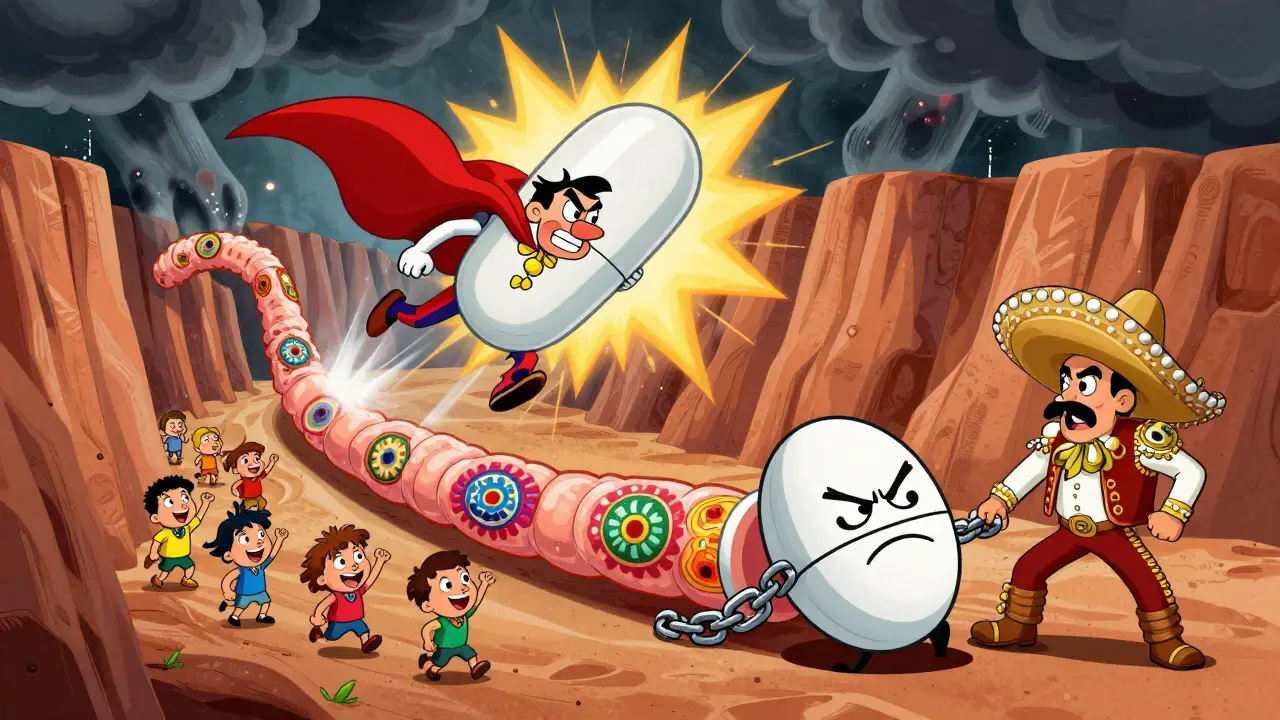
Budesonide changed everything. It’s still a steroid, but it’s designed to act locally in the gut and get broken down quickly by the liver. Only 10-15% of the drug enters your bloodstream. That’s why side effects are so much milder. In clinical trials, 84% of patients with collagenous colitis went into complete remission after eight weeks of 9mg daily budesonide. Compare that to just 38% on placebo. The same numbers hold for lymphocytic colitis.
Most people notice improvement within two weeks. One patient on PatientsLikeMe wrote: “Went from 10 bathroom trips a day to 2 in 10 days. I cried when I realized I could leave the house without a plan.” That’s not an outlier. Multiple studies confirm 70-85% of patients achieve remission within 4 to 8 weeks.
The Catch: Relapse Is Common
Here’s the hard truth: budesonide doesn’t cure microscopic colitis. It controls it. Once you stop taking it, about half of patients relapse within six months. That’s why maintenance therapy is often needed.
For those who keep having symptoms after the initial 6-8 week course, doctors typically switch to a lower daily dose-6mg instead of 9mg-and keep it going for months, sometimes years. This isn’t ideal. Long-term steroid use, even low-dose, can still affect bone density and adrenal function, especially in older adults. That’s why doctors monitor bone scans and blood sugar regularly.
Some patients get stuck on budesonide for two or three years. One Reddit user shared: “I’m on maintenance now. I can’t stop. If I do, I’m back to 10 trips a day. It’s like I’m addicted to a steroid.”
What Else Works? (And What Doesn’t)
Budesonide is the gold standard, but it’s not the only option. And not everyone tolerates it.
- Bismuth subsalicylate (Pepto-Bismol): Works for about 26% of people. Cheap, accessible, but not strong enough for severe cases.
- Mesalamine: Used for ulcerative colitis, helps about 40-50% of microscopic colitis patients. Often tried if budesonide isn’t an option.
- Cholestyramine: Binds bile acids. If your diarrhea is caused by excess bile (common in MC), this can cut symptoms by 60-70%. Often used in combination with budesonide.
- Prednisone: Works as well as budesonide-but with 3 times the side effects. Only used if budesonide fails or isn’t available.
- Anti-TNF drugs (like infliximab): Too expensive, too risky. Reserved for rare cases that don’t respond to anything else.
Combination therapy is becoming more common. One patient told me: “Budesonide fixed my inflammation, but cholestyramine stopped the leftover diarrhea. Together, they gave me my life back.”
Cost and Access
Generic budesonide capsules cost $150-$250 for an 8-week course. The brand version, Entocort EC, can run $800-$1,200. That’s a huge difference if you’re uninsured or on a fixed income. Since the FDA approved generics in 2018, access has improved-but not everywhere. In rural areas or countries without robust healthcare systems, budesonide is still hard to get.
Insurance coverage varies. Some plans require step therapy-trying cheaper options first-even though evidence shows budesonide is the most effective starting point. Patients often spend months fighting for approval.

What’s Next? The Future of Treatment
Researchers are working on better options. A new drug called vedolizumab, which targets gut-specific inflammation, showed 65% remission in early trials. It’s not approved yet, but it’s in fast-track review by the FDA. That could mean a steroid-free future for some patients.
Genetics might also play a role. Early data suggests people with certain immune genes (HLA-DQ2/DQ8) respond better to budesonide. In the next five years, we may see tests to predict who will benefit most from this drug-cutting out trial and error.
For now, budesonide remains the most reliable tool we have. The European Microscopic Colitis Group gives it the highest recommendation (GRADE 1A) based on solid evidence. In Scandinavia, where microscopic colitis is most common, nearly 92% of doctors start with it. In the U.S. and Europe, it’s 85%.
What Patients Should Know
If you’re diagnosed:
- Start budesonide 9mg daily for 6-8 weeks. Don’t skip doses.
- Expect improvement in 10-14 days. If nothing changes by week 4, talk to your doctor.
- Ask about bone density testing if you’re over 50.
- Don’t stop abruptly. Taper slowly-reduce by 3mg every 2-4 weeks-to lower relapse risk.
- Keep a symptom diary. Note frequency, urgency, and any triggers (like caffeine, dairy, or NSAIDs).
- Consider adding cholestyramine if diarrhea lingers after budesonide.
If you’re still suffering after treatment, don’t give up. Microscopic colitis is manageable. It’s not life-threatening. But it can steal years of quality life if left untreated or misdiagnosed.
Is microscopic colitis the same as IBS?
No. IBS is a functional disorder-meaning there’s no visible inflammation or damage. Microscopic colitis is an inflammatory disease, but the inflammation only shows up under a microscope. Both cause diarrhea, but IBS doesn’t require biopsies or steroids. If you’ve been told you have IBS but still have severe watery diarrhea, ask for a colonoscopy with biopsies.
Can I take budesonide if I have diabetes?
Yes, but you’ll need close monitoring. Even though budesonide has minimal systemic effects, it can still raise blood sugar. Your doctor should check your HbA1c before and during treatment. Many patients with diabetes manage budesonide safely with adjusted diet or medication.
Does budesonide cause weight gain?
Less than prednisone, but it can still happen. About 10-15% of patients report mild weight gain, usually around the face or abdomen. This is more common with higher doses or longer use. Maintaining a healthy diet and avoiding excess sugar helps minimize this.
Are there natural remedies for microscopic colitis?
No proven natural cure exists. Some people try probiotics, low-FODMAP diets, or elimination diets. These might help a little, especially if you have overlapping IBS symptoms, but they don’t address the underlying inflammation. Budesonide is the only treatment shown to reliably induce remission. Don’t delay treatment waiting for a natural solution.
Can microscopic colitis turn into Crohn’s or ulcerative colitis?
No. Microscopic colitis is a separate condition. It doesn’t progress to Crohn’s or ulcerative colitis. But some people have both. If you develop bloody diarrhea, significant weight loss, or abdominal pain that gets worse, you may need further testing to rule out another condition.
Microscopic colitis isn’t a death sentence. It’s not even a rare disease anymore. But it’s still underdiagnosed, and many patients suffer for years before getting the right treatment. Budesonide isn’t perfect-but it’s the best we have right now. For the vast majority, it means going from constant bathroom runs to living without fear. And that’s worth more than any pill price tag.
Comments (14)
Alex Brad
This post nails it. Microscopic colitis isn't talked about enough. I've seen patients suffer for years before diagnosis. Budesonide isn't perfect, but it's the only thing that actually works.
RacRac Rachel
I was diagnosed with this last year. I went from 12 trips a day to 2 in 11 days on budesonide. I cried the first time I made it through a movie without a bathroom break. 🙏 So grateful for this treatment. It didn't cure me, but it gave me my life back.
Mike Dubes
i read this whole thing and i just wanna say: budesonide is a miracle. i was on prednisone for 3 months and my face looked like a balloon. switched to budesonide and suddenly i could sit through dinner without panic. also, cholestyramine + budesonide = my new best friends.
Gretchen Rivas
As a GI nurse, I see this daily. The biggest issue isn't treatment-it's getting the biopsy done. So many patients are told 'it's IBS' and sent home. A single biopsy misses it 40% of the time. Always get multiple samples. It changes everything.
Jane Ryan Ryder
Oh great another drug company love letter. Budesonide? Yeah right. They're just selling another steroid and calling it 'targeted'. My aunt died from adrenal failure after 2 years on it. And now they want us to believe it's safe? Ha.
Zacharia Reda
I love how this post mentions the cost. I paid $190 for my 8-week supply. Insurance denied it because I 'didn't try Pepto-Bismol first'. That's like telling someone with a broken leg to try walking slower.
Renee Jackson
To those struggling with this condition: you are not alone. The path to diagnosis is long, but the relief when you find the right treatment is profound. Budesonide may not be perfect, but it is a lifeline. Please advocate for yourself-your quality of life matters.
Jeff Card
I’ve been on maintenance budesonide for 3 years. I know it’s not ideal, but I’d rather take a low-dose steroid than go back to living like a ghost. My body’s been through hell. This is the price of normalcy.
Stephen Vassilev
Wait-so you're telling me the government approved a steroid that's 'localized' but still gets absorbed? And we're supposed to trust this? What about the 2017 NIH study on adrenal suppression in elderly patients? Why isn't this on the label? This smells like corporate manipulation.
Ivan Viktor
I live in Australia. We get budesonide but it costs $400 a month. Our healthcare system says 'try mesalamine first'. Good luck with that. I’ve been on it for 6 months. Still pooping 8 times a day. Thanks, system.
John Smith
Budesonide is the only thing that didn't turn me into a zombie. Prednisone? I looked like a bloated cartoon. Budesonide? I got to hug my grandkids without panic. I'm not gonna complain about 10% of the drug leaking into my system. I'll take it.
Sharon Lammas
It’s strange how a disease that steals your dignity doesn’t come with a cure. We’re left managing, not healing. Budesonide gives us control, but not freedom. I wonder if the next generation will have something better. Or if we’re just learning to live with the quiet horror of a body that won’t hold on.
marjorie arsenault
My mom was diagnosed at 63. She thought it was stress. Took 14 months. She’s on budesonide now. We’re so thankful. I wish more doctors knew about this. It’s not rare. It’s just invisible.
Diane Croft
If you're on budesonide and feel better-don’t stop. I did. Week 3, back to 10 trips. It’s not addiction. It’s physiology. Your colon remembers the inflammation. This isn’t weakness. It’s biology.